Brent crude rose nearly 29% in a month; is $100 a barrel the end or the beginning?
2026-07-24 21:34:02
On Friday, July 24th, the core of energy market pricing has shifted from single-factor production changes to shipping safety, logistical nodes, and the duration of risks. Reports of explosions in Saudi Arabia and the potential drone strike on a US military logistics warehouse originated from Iranian media and have not yet been confirmed by Saudi Arabia, the US military, or independent channels. However, given the backdrop of attacks on Red Sea oil tankers, restrictions on key shipping lanes, and production cuts at some export facilities, such unconfirmed reports will still quickly enter the risk premium model for crude oil. Brent crude oil, which recently rose above $100 per barrel, has currently retreated to above $97 per barrel, a daily drop of over 2%, but a weekly gain of over 10%. 
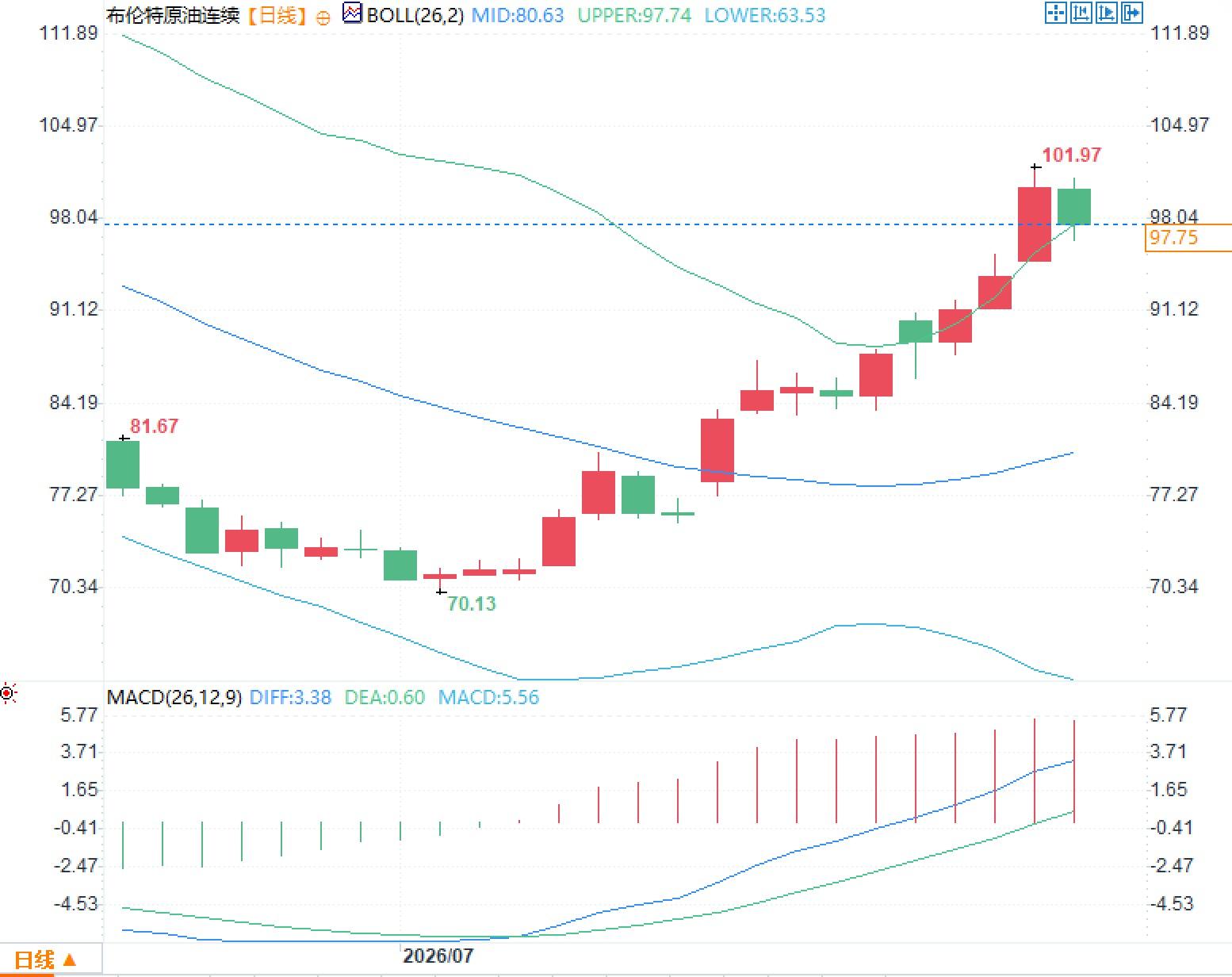 In the MACD indicator, the DIFF is 3.38, the DEA is 0.60, and the histogram reaches 5.56, indicating that the upward momentum is still in a significant expansion phase. However, the price has fluctuated at a high level after touching the upper Bollinger Band, meaning that the market has transitioned from the trend initiation phase to a high-volatility phase. At this point, the same news may cause larger intraday swings, but it may not necessarily lead to a sustained one-sided trend. The term structure is more noteworthy. If near-month contracts continue to significantly outperform far-month contracts, it indicates that the spot market is paying a premium for immediate supply and transportation scarcity; if far-month contracts rise in tandem, it means the market is beginning to factor in longer-term energy inflation and supply restructuring. Currently, Brent crude has risen nearly 29% this month and about 42% year-on-year, meaning the risk premium is no longer limited to single-day events.
While reports of an explosion are yet to be confirmed, the market is trading on the vulnerability of logistics.
The key point of this news is not just the location of the explosion, but the description of it as a US military logistics warehouse. Military logistics facilities themselves do not typically directly alter global crude oil supply, but if the incident is confirmed, it will indicate that regional conflict is spreading from sea lanes to land-based support nodes. The market will therefore need to reassess three costs: the intensity of military escort, commercial vessel insurance rates, and security expenditures for ports and storage facilities. Red Sea risks have already entered prices through tanker attacks. News of attacks on two Saudi oil tankers briefly pushed Brent crude above $100 per barrel; one tanker was damaged and caught fire on its bow, while the status of the other remains unclear. If the current situation continues to lack official information, the added premium in prices may quickly diminish; if there is damage to facilities, casualties, or subsequent responses, risk pricing will shift from short-term sentiment to quantifiable transportation losses. Trump recently stated that Iran should bear the losses related to the attacks and offered to use frozen Iranian funds to repair damaged merchant ships. Such statements will not directly increase crude oil supply, but may strengthen market expectations for a subsequent military response, asset recovery, and escalation of sanctions. For traders, what truly affects the curve structure is not the intensity of rhetoric, but whether channel traffic, shipping delays, and spot premiums/discounts deteriorate simultaneously.A pullback to around $100 per barrel does not mean the risk premium has disappeared.
Brent crude oil has retreated from above $100 per barrel to around $97, superficially a result of profit-taking at higher levels, but in reality, it reflects the market's differentiation between actual supply losses and unconfirmed potential risks. The daily chart shows that prices previously rose from $70.13, reaching a high of $101.97, and are currently trading at around $97.75, approaching the upper Bollinger Band at $97.74. The middle Bollinger Band is only at $80.63, indicating a significant deviation between the current price and the medium-term equilibrium level. In the MACD indicator, the DIFF is 3.38, the DEA is 0.60, and the histogram reaches 5.56, indicating that the upward momentum is still in a significant expansion phase. However, the price has fluctuated at a high level after touching the upper Bollinger Band, meaning that the market has transitioned from the trend initiation phase to a high-volatility phase. At this point, the same news may cause larger intraday swings, but it may not necessarily lead to a sustained one-sided trend. The term structure is more noteworthy. If near-month contracts continue to significantly outperform far-month contracts, it indicates that the spot market is paying a premium for immediate supply and transportation scarcity; if far-month contracts rise in tandem, it means the market is beginning to factor in longer-term energy inflation and supply restructuring. Currently, Brent crude has risen nearly 29% this month and about 42% year-on-year, meaning the risk premium is no longer limited to single-day events.The real constraint on oil prices comes from the dual-track system and the supply-demand buffer.
Current energy risks are concentrated in the Strait of Hormuz and the Bab el-Mandeb Strait. The former, carrying an average of approximately 20 million barrels of oil per day in 2024, is one of the world's most important oil routes; the latter connects the Red Sea and the Indian Ocean, and any detour by ships would increase travel time, fuel costs, insurance expenses, and delivery cycles. Even if oil field production does not decline, reduced transportation efficiency will tighten regional spot supply. There is still some buffer on the supply side. The latest energy outlook estimates that regional oil production shutdowns in June will average approximately 8.3 million barrels per day, lower than the May peak of 11.2 million barrels per day, indicating that some production and transportation have resumed. However, this also means that the current market is in a fragile recovery period, and new disruptions are more likely to cause marginal shocks. Some institutions calculate that if regional transportation disruptions last only one month, the average price of Brent crude oil may be around $95 per barrel; for each additional month, the price center may increase by $7 to $8 per barrel, potentially approaching $115 per barrel after three months. These estimates are not price predictions; their value lies in revealing that the duration is more important than the scale of a single disruption. As long as ships can still navigate and inventories can be redistributed across regions, oil prices may remain highly volatile rather than rise uncontrollably; if shipping volumes continue to decline, refining margins, diesel prices, and freight rates may reflect the level of tension earlier than crude oil itself.- Risk Warning and Disclaimer
- The market involves risk, and trading may not be suitable for all investors. This article is for reference only and does not constitute personal investment advice, nor does it take into account certain users’ specific investment objectives, financial situation, or other needs. Any investment decisions made based on this information are at your own risk.