A chart shows that strong Capesize freight rates supported the Baltic Dry Index, which rose during the week but fell slightly at the close.
2026-07-24 23:35:02
Latest data shows that the Baltic Dry Index (BDI) reached 2743 points on July 24, 2026, a five-day high, up 0.66% month-on-month (compared to the previous value), marking the largest increase since July 22, 2026, and the third consecutive day of increase (including zero growth). Looking at the short-term charts, the recent 11 BDI data points show: 6 positive increases, 5 negative increases, and 0 zero increases. Specifically, the Panamax Freight Index (BPI) was 2024 points, down 1.94% from the previous value; the Capesize Freight Index (BCI) was 4285 points, up 2.07%; and the Supramax Freight Index (BSI) was 1694 points, down 0.47%. For detailed 720-day and 10-year trend charts of the Baltic Dry Index and its three sub-indices, please refer to the charts specially created by FX678. 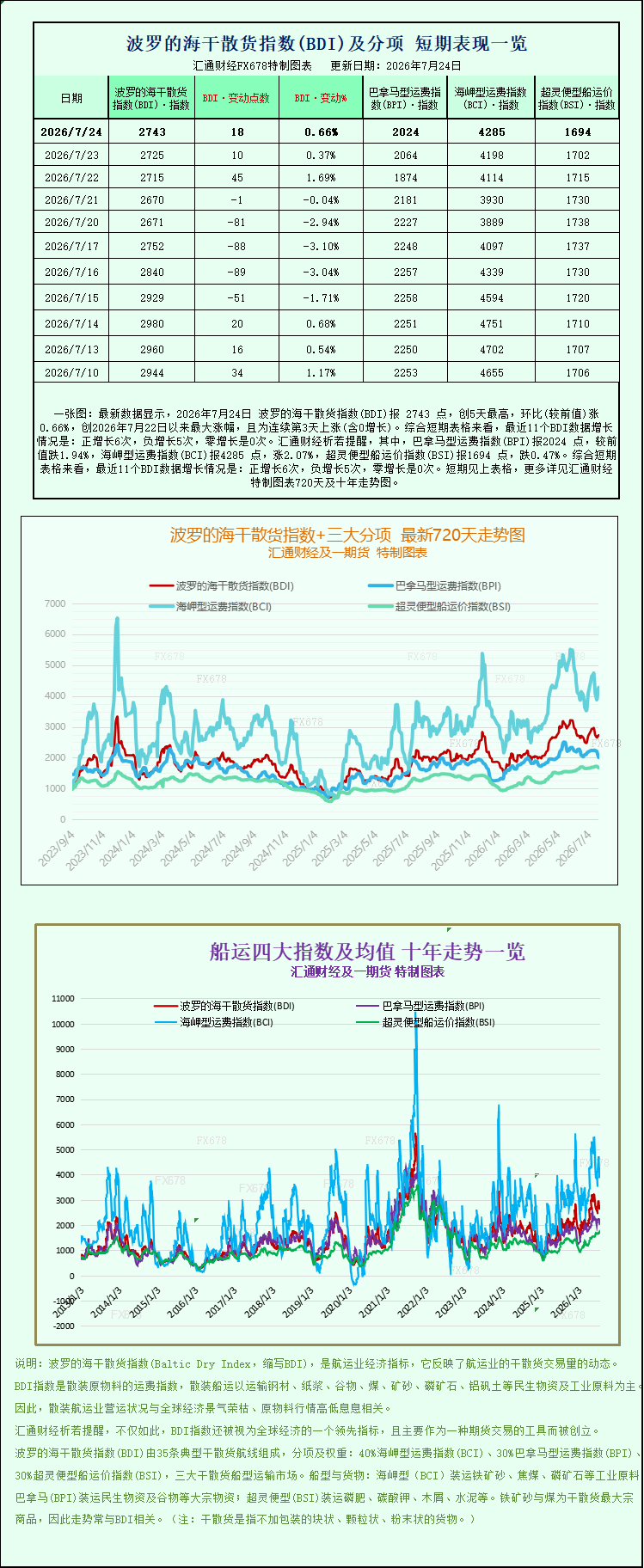 On July 24, 2026, the latest shipping market data revealed a significant structural divergence in the international dry bulk shipping market. The Baltic Dry Index (BADI) bucked the trend, rising to a one-week high since July 17, primarily driven by a sharp increase in Capesize (Good Hope) freight rates, effectively offsetting the continued weakness in Panamax and Supramax vessel rates. However, dragged down by a significant decline in freight rates for small and medium-sized vessels, the index closed slightly lower for the week at 0.3%, exhibiting a market characteristic of "intraday recovery, weekly pressure, and severe sector divergence," clearly reflecting the current imbalance in the global dry bulk shipping supply and demand structure. As a core indicator of the global dry bulk shipping market, the Baltic Dry Index (BADI) comprehensively tracks freight rate fluctuations across the three major bulk carrier types: Capesize, Panamax, and Supramax. It directly reflects changes in global maritime demand and supply-demand for industrial raw materials, food, and energy commodities, serving as a crucial leading indicator for assessing global trade and industrial health. This week's market performance was highly representative, with significant differences in price trends across different tonnages and cargo types. Large industrial raw material carriers rebounded strongly, while small and medium-sized civilian and energy carriers continued to weaken, highlighting the structural characteristics of the market. Specifically, the BADI rose 18 points, or 0.7%, to close at 2743 points, a near one-week high, but still fell slightly by 0.3% for the week, ending its previous slight upward trend. Looking at the sub-category indices, the market divergence further intensified, with Capesize vessels becoming the only strong performer this week, significantly offsetting the overall downward pressure on the index. The Capesize Index (BACI) surged 87 points, or 2.1%, to 4285 points, a near ten-day high since July 16th. The index saw a cumulative weekly gain of 4.6%, demonstrating independent upward momentum. As large dry bulk carriers with a deadweight tonnage of 150,000 tons, Capesize vessels primarily transport bulk industrial raw materials such as iron ore, coal, and bauxite, serving as a core transportation carrier in the global steel and heavy industry supply chain. Their freight rate fluctuations are directly linked to global industrial production demand. This week, the profitability of this vessel type also climbed, with average daily revenue on core routes increasing by $788, ultimately reaching $35,357, demonstrating significantly better profitability resilience than smaller vessels. Industry analysts point out that the strong performance of Capesize freight rates against the trend is mainly supported by the temporary demand for iron ore in China. Recently, inventories at major domestic iron ore ports have continued to decline, and downstream steel companies have slightly increased their restocking demand, offsetting the downward pressure on iron ore futures. This week, Dalian iron ore futures prices experienced their largest weekly drop in six weeks, mainly due to weak seasonal demand during the traditional off-season and ample global shipping capacity. However, the reduction of domestic port inventories provided rigid demand support for iron ore shipping routes, driving a steady increase in Capesize freight rates. Meanwhile, increased activity on major international iron ore shipping routes further boosted the recovery of large bulk carrier freight rates, becoming the core force supporting the index this week. In stark contrast to the strong performance of Capesize vessels, the Panamax market continued to weaken, with significant pressure on prices. This week, the Panamax Index (BPNI) fell 40 points in a single day, a 2% drop, to 2024 points, hitting its lowest level in nearly three months. The weekly decline was even higher, reaching 10%, becoming the main factor dragging down the overall market index. Panamax vessels, with a deadweight tonnage concentrated between 60,000 and 70,000 tons, mainly transport energy and consumer commodities such as coal and grains, and their freight rate trends closely reflect global energy trade and food transportation needs. The decline in freight rates directly reflects shrinking market profits. Data shows that the average daily revenue of Panamax vessels decreased by $361, falling to $18,213. The core reason for the weak market is that global coal seaborne demand has entered a period of low season, coupled with the fact that the shipping windows for grain from North and South America and Australia have not yet fully opened, resulting in a loose supply and demand situation. At the same time, there is ample idle capacity in the region, intensifying market competition and continuously suppressing freight rates for small and medium-sized industrial and civilian bulk carriers, leading to a significant correction in freight rates for this vessel type this week. The small bulk carrier market also continued its weakness. The Supramax bulk carrier index (BSIS) fell 8 points, or 0.5%, to 1694 points, a new low in nearly half a month since July 9, with a cumulative decline of 4.3% for the week. Supramax vessels, with their smaller tonnage and greater transport flexibility, primarily handle regional, small-batch bulk cargo orders, covering categories such as building materials, niche minerals, and grains. Affected by insufficient global bulk cargo trade activity and regional overcapacity, market demand remains weak, and freight rates continue to decline at low levels, further exacerbating the polarization in the dry bulk market. Looking at the overall market situation this week, the dry bulk shipping market is currently at a critical juncture of demand structure shift. Demand for large industrial raw materials remains strong due to the resilience of domestic industrial restocking, supporting a counter-trend rise in Capesize freight rates; while demand for small- and medium-sized bulk cargoes such as energy and grains weakens seasonally, coupled with ample overall shipping capacity, leading to a continued decline in freight rates for small and medium-sized vessels. Amidst these intertwined factors, the Baltic Dry Index exhibits a volatile trend of "intraday rises and slight weekly declines." Industry institutions indicate that future market trends will continue to depend on changes in commodity demand. In the short term, the pace of production resumption in the domestic steel industry and the speed of iron ore port inventory reduction will continue to determine the resilience of Capesize vessel prices. Meanwhile, the arrival of the peak global coal consumption season and the opening of the concentrated grain transportation window will be key to the recovery of Panamax and Supramax vessel freight rates. Overall, the structural differentiation in the dry bulk market is likely to continue, with the overall index likely to remain volatile, and sector rotation becoming more pronounced.
On July 24, 2026, the latest shipping market data revealed a significant structural divergence in the international dry bulk shipping market. The Baltic Dry Index (BADI) bucked the trend, rising to a one-week high since July 17, primarily driven by a sharp increase in Capesize (Good Hope) freight rates, effectively offsetting the continued weakness in Panamax and Supramax vessel rates. However, dragged down by a significant decline in freight rates for small and medium-sized vessels, the index closed slightly lower for the week at 0.3%, exhibiting a market characteristic of "intraday recovery, weekly pressure, and severe sector divergence," clearly reflecting the current imbalance in the global dry bulk shipping supply and demand structure. As a core indicator of the global dry bulk shipping market, the Baltic Dry Index (BADI) comprehensively tracks freight rate fluctuations across the three major bulk carrier types: Capesize, Panamax, and Supramax. It directly reflects changes in global maritime demand and supply-demand for industrial raw materials, food, and energy commodities, serving as a crucial leading indicator for assessing global trade and industrial health. This week's market performance was highly representative, with significant differences in price trends across different tonnages and cargo types. Large industrial raw material carriers rebounded strongly, while small and medium-sized civilian and energy carriers continued to weaken, highlighting the structural characteristics of the market. Specifically, the BADI rose 18 points, or 0.7%, to close at 2743 points, a near one-week high, but still fell slightly by 0.3% for the week, ending its previous slight upward trend. Looking at the sub-category indices, the market divergence further intensified, with Capesize vessels becoming the only strong performer this week, significantly offsetting the overall downward pressure on the index. The Capesize Index (BACI) surged 87 points, or 2.1%, to 4285 points, a near ten-day high since July 16th. The index saw a cumulative weekly gain of 4.6%, demonstrating independent upward momentum. As large dry bulk carriers with a deadweight tonnage of 150,000 tons, Capesize vessels primarily transport bulk industrial raw materials such as iron ore, coal, and bauxite, serving as a core transportation carrier in the global steel and heavy industry supply chain. Their freight rate fluctuations are directly linked to global industrial production demand. This week, the profitability of this vessel type also climbed, with average daily revenue on core routes increasing by $788, ultimately reaching $35,357, demonstrating significantly better profitability resilience than smaller vessels. Industry analysts point out that the strong performance of Capesize freight rates against the trend is mainly supported by the temporary demand for iron ore in China. Recently, inventories at major domestic iron ore ports have continued to decline, and downstream steel companies have slightly increased their restocking demand, offsetting the downward pressure on iron ore futures. This week, Dalian iron ore futures prices experienced their largest weekly drop in six weeks, mainly due to weak seasonal demand during the traditional off-season and ample global shipping capacity. However, the reduction of domestic port inventories provided rigid demand support for iron ore shipping routes, driving a steady increase in Capesize freight rates. Meanwhile, increased activity on major international iron ore shipping routes further boosted the recovery of large bulk carrier freight rates, becoming the core force supporting the index this week. In stark contrast to the strong performance of Capesize vessels, the Panamax market continued to weaken, with significant pressure on prices. This week, the Panamax Index (BPNI) fell 40 points in a single day, a 2% drop, to 2024 points, hitting its lowest level in nearly three months. The weekly decline was even higher, reaching 10%, becoming the main factor dragging down the overall market index. Panamax vessels, with a deadweight tonnage concentrated between 60,000 and 70,000 tons, mainly transport energy and consumer commodities such as coal and grains, and their freight rate trends closely reflect global energy trade and food transportation needs. The decline in freight rates directly reflects shrinking market profits. Data shows that the average daily revenue of Panamax vessels decreased by $361, falling to $18,213. The core reason for the weak market is that global coal seaborne demand has entered a period of low season, coupled with the fact that the shipping windows for grain from North and South America and Australia have not yet fully opened, resulting in a loose supply and demand situation. At the same time, there is ample idle capacity in the region, intensifying market competition and continuously suppressing freight rates for small and medium-sized industrial and civilian bulk carriers, leading to a significant correction in freight rates for this vessel type this week. The small bulk carrier market also continued its weakness. The Supramax bulk carrier index (BSIS) fell 8 points, or 0.5%, to 1694 points, a new low in nearly half a month since July 9, with a cumulative decline of 4.3% for the week. Supramax vessels, with their smaller tonnage and greater transport flexibility, primarily handle regional, small-batch bulk cargo orders, covering categories such as building materials, niche minerals, and grains. Affected by insufficient global bulk cargo trade activity and regional overcapacity, market demand remains weak, and freight rates continue to decline at low levels, further exacerbating the polarization in the dry bulk market. Looking at the overall market situation this week, the dry bulk shipping market is currently at a critical juncture of demand structure shift. Demand for large industrial raw materials remains strong due to the resilience of domestic industrial restocking, supporting a counter-trend rise in Capesize freight rates; while demand for small- and medium-sized bulk cargoes such as energy and grains weakens seasonally, coupled with ample overall shipping capacity, leading to a continued decline in freight rates for small and medium-sized vessels. Amidst these intertwined factors, the Baltic Dry Index exhibits a volatile trend of "intraday rises and slight weekly declines." Industry institutions indicate that future market trends will continue to depend on changes in commodity demand. In the short term, the pace of production resumption in the domestic steel industry and the speed of iron ore port inventory reduction will continue to determine the resilience of Capesize vessel prices. Meanwhile, the arrival of the peak global coal consumption season and the opening of the concentrated grain transportation window will be key to the recovery of Panamax and Supramax vessel freight rates. Overall, the structural differentiation in the dry bulk market is likely to continue, with the overall index likely to remain volatile, and sector rotation becoming more pronounced.
- Risk Warning and Disclaimer
- The market involves risk, and trading may not be suitable for all investors. This article is for reference only and does not constitute personal investment advice, nor does it take into account certain users’ specific investment objectives, financial situation, or other needs. Any investment decisions made based on this information are at your own risk.