Behind the brief respite in oil prices lies the Houthi's limited capabilities and the under-the-surface communication between the US and Iran.
2026-07-24 21:51:02
On Friday (July 24), during the European and American trading sessions, international oil prices retreated from their highs, falling by more than 4% at one point, as market panic subsided and eased. Does this short-term pullback in oil prices signify a genuine de-escalation of the situation in the Middle East? Or is it simply a "rational correction" by the market regarding the boundaries of conflict and the mechanisms of power struggles after the initial surge?  On the one hand, the Houthi rebels' statement that they were "only blockading Saudi Arabia" reveals that their so-called "maritime blockade" is essentially based on "firepower deterrence" rather than "physical severance" due to their limited asymmetric military capabilities. The Houthis lack both the hard power to physically block the Bab el-Mandeb Strait and the tactical restraint to avoid becoming a global enemy. The global oil supply chain is not facing the extreme apocalyptic scenario of a "complete shutdown," which has temporarily eased the market's previously heightened anxieties about supply disruptions. On the other hand, the Iraqi government's categorical denial of the "US-Iran ceasefire mediation" statement seems to have put an end to the peace process. However, in international diplomacy, "never making decisions publicly before finalizing them" and "strategic denial" are standard practices to protect diplomatic escape routes. The frequent high-level Iraqi personnel exchanges and behind-the-scenes communications indicate that the covert communication mechanisms between the US and Iran are actually "always alive." This "outwardly confrontational, but with an underground escape route" stance has temporarily dispelled the market's extreme anxiety about a sudden, all-out, no-holds-barred decisive battle between the US and Iran. This discrepancy between the expected worst-case scenario and the reality led to a temporary easing of concerns and a reduction in premiums in international oil prices. However, this brief calm cannot mask the harsh reality—the escalating direct military confrontation between the US and Iran, the simultaneous pressure on two core energy shipping routes, and the continued high-risk geopolitical tensions in the Middle East have created a tense and dangerous environment. The pricing logic of the global crude oil market has officially shifted from an "explosive surge driven by sentiment" to a "long-term tug-of-war between transportation costs and supply-demand restructuring under geopolitical pressure."
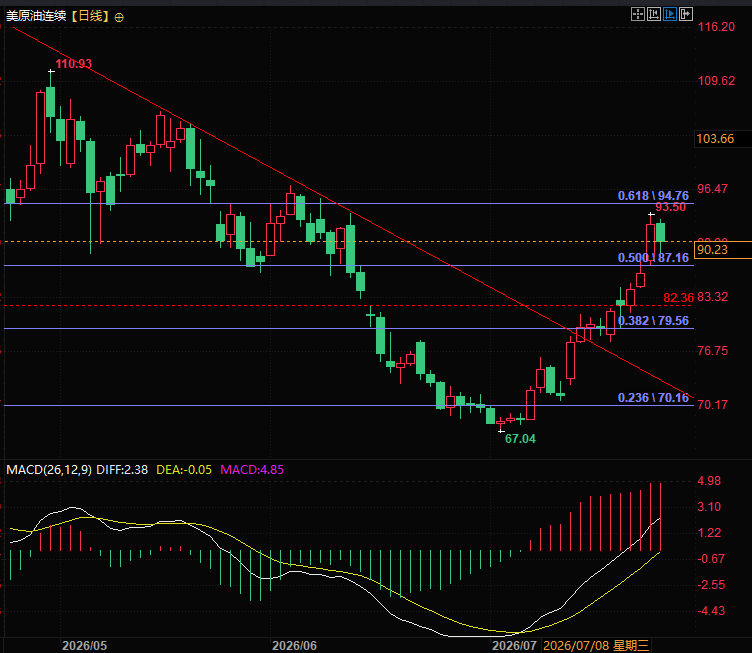 (WTI crude oil futures continuous, source: EasyTrade) At 21:47 Beijing time, WTI crude oil futures continuous is currently trading at $89.97 per barrel.
On the one hand, the Houthi rebels' statement that they were "only blockading Saudi Arabia" reveals that their so-called "maritime blockade" is essentially based on "firepower deterrence" rather than "physical severance" due to their limited asymmetric military capabilities. The Houthis lack both the hard power to physically block the Bab el-Mandeb Strait and the tactical restraint to avoid becoming a global enemy. The global oil supply chain is not facing the extreme apocalyptic scenario of a "complete shutdown," which has temporarily eased the market's previously heightened anxieties about supply disruptions. On the other hand, the Iraqi government's categorical denial of the "US-Iran ceasefire mediation" statement seems to have put an end to the peace process. However, in international diplomacy, "never making decisions publicly before finalizing them" and "strategic denial" are standard practices to protect diplomatic escape routes. The frequent high-level Iraqi personnel exchanges and behind-the-scenes communications indicate that the covert communication mechanisms between the US and Iran are actually "always alive." This "outwardly confrontational, but with an underground escape route" stance has temporarily dispelled the market's extreme anxiety about a sudden, all-out, no-holds-barred decisive battle between the US and Iran. This discrepancy between the expected worst-case scenario and the reality led to a temporary easing of concerns and a reduction in premiums in international oil prices. However, this brief calm cannot mask the harsh reality—the escalating direct military confrontation between the US and Iran, the simultaneous pressure on two core energy shipping routes, and the continued high-risk geopolitical tensions in the Middle East have created a tense and dangerous environment. The pricing logic of the global crude oil market has officially shifted from an "explosive surge driven by sentiment" to a "long-term tug-of-war between transportation costs and supply-demand restructuring under geopolitical pressure."The conflict between the US and Iran has escalated to a full extent, and geopolitical risks in the Middle East continue to spread.
The recent escalation of military confrontation between the US and Iran has led to renewed and severe geopolitical turmoil in the Middle East, simultaneously putting pressure on two major global energy shipping routes and thoroughly disrupting the global crude oil supply chain and commodity markets. This round of conflict has escalated from direct military strikes between the US and Iran to a proxies' coordinated maneuvering in the region. Coupled with blocked shipping lanes, soaring shipping risks, and stalled negotiations, this has become the core geopolitical driver of current international oil price volatility and continues to amplify uncertainty in the global energy market.Multiple rounds of military offensives continue, and the scope of the US-Iran rivalry continues to expand.
The current conflict was sparked by the joint US-Israeli military strike against Iran on February 28. The conflict has escalated to this day, with the US military conducting multiple rounds of nighttime airstrikes, targeting key military and shipping facilities across Iran. The US has focused its airstrikes on key areas including the Iranian Revolutionary Guard naval base in northern Iran, drone and boat bases around the Strait of Hormuz in the south, key air force and nuclear facilities in Isfahan, and Khuzestan. The core strategic objective is to weaken Iran's maritime harassment capabilities and seize control of shipping in the Strait of Hormuz. In response, Iran has launched a comprehensive counter-offensive. On one hand, it has targeted US overseas bases, such as Erbil in Iraq, with multiple explosive drones attacking the Erbil Kurdistan region on Friday, causing numerous explosions and smoke at the base. The US military intercepted several of the incoming drones. On the other hand, Iran has expanded the conflict by collaborating with regional proxies, pushing the conflict to multiple points of attack. US overseas military bases in Bahrain and other locations have also been targeted by Iranian airstrikes.Both major energy routes are under pressure, and the global crude oil transportation system is constrained.
The most critical risk in the current market is the simultaneous pressure on the Strait of Hormuz and the Bab el-Mandeb Strait in the Red Sea, two vital energy routes, completely disrupting the existing crude oil transportation pattern. The Strait of Hormuz handles one-fifth of global oil and gas maritime trade and is the lifeline for Middle Eastern crude oil exports. Before the conflict, it was normally unobstructed and free to navigate. With the escalation of the US-Iran confrontation, Iran has targeted ships in the US-controlled waterways and asserted its own control and toll collection rights over navigation in the strait, leading to complete disruption of navigation order. Numerous merchant ships and oil tankers have stopped or detoured to avoid the danger, significantly reducing the efficiency of the waterway. According to data from the International Maritime Organization, approximately 400 ships and over 6,000 crew members are currently stranded around the Strait of Hormuz, facing shortages of supplies and loss of operational support, further exacerbating the maritime shipping crisis. To mitigate the risks of navigation through the Strait of Hormuz, Saudi Arabia has long diverted its crude oil exports to the port of Yanbu in the Red Sea, relying on the Bab el-Mandeb Strait as an alternative transportation route. However, this backup route has also been disrupted by the current geopolitical conflict. The Houthi rebels in Yemen, an ally of Iran, have launched a new front in their operations, targeting Saudi oil tankers with precise naval strikes and explicitly blocking shipping lanes connected to Saudi Arabia. The sanctions are targeted at Saudi maritime transport, without completely blocking the Bab el-Mandeb Strait, in response to Saudi Arabia's 12-year blockade and sanctions against Yemen. The Bab el-Mandeb Strait handles 12% of global trade and a quarter of container shipping, serving as a crucial backup route for Middle Eastern crude oil exports. The restriction on these routes further tightens the global supply of crude oil, directly exacerbating market supply anxieties.Geopolitical risk premiums surge, leading to a systemic rise in oil prices and shipping costs.
The intense impact of geopolitical conflicts directly translated into the crude oil market, causing international oil prices to surge rapidly. Brent crude briefly broke through $100 per barrel, setting a new high for the period, before falling sharply. However, the geopolitical risk premium remained firmly rooted in the market. Simultaneously, war insurance costs on Middle East shipping routes skyrocketed, forcing ships to detour around the Cape of Good Hope in Africa, adding 10 to 15 days to one-way voyages. This contraction in global effective crude oil shipping capacity and increased transportation costs further solidified the floor support for oil prices, leading to a systemic increase in global crude oil trade and supply chain costs.US-Iran negotiations have completely stalled, and a protracted conflict has taken shape.
Judging from the US-Iran rivalry and negotiation process, there is no clear path to de-escalation or withdrawal in this round of conflict, and the standoff is characterized by its protracted nature. In the early stages of the conflict, the US and Israel's stated objectives included the ultimate goals of overthrowing the Iranian regime and destroying Iranian nuclear facilities. However, the current conflict has gradually evolved into a tug-of-war over control of the Strait of Hormuz and energy pricing power. Iran is using disruptions to global oil shipping and exporting economic shocks to force concessions from the US in exchange for bargaining leverage; the US, in turn, is weakening Iran's bargaining power through continuous military strikes and maximum pressure, making it difficult to reconcile the core demands of both sides. The Trump administration has further escalated its sanctions, announcing that it will use US-controlled frozen Iranian assets to compensate for losses to ships and cargo damaged in this round of shipping. This move has been strongly condemned by the Iranian Foreign Ministry, which believes that it will completely break international asset credit rules, exacerbate global disorder, and further close off any possibility of short-term reconciliation. Currently, there is no substantial progress in US-Iran negotiations, and the situation is unlikely to ease quickly.Market Summary: "Resurgence of extreme panic" pressures short-term oil prices, while "pressure from both price levels" supports a medium- to long-term bottom.
Overall, the current situation in the Middle East presents a complex and intertwined picture of "undercurrents in the shadows, tense skies on the surface, and continued restrictions on both shipping lanes." In the short term (easing concerns triggering a price correction in oil): The previous surge was built on extreme expectations of a complete physical blockade of global energy shipping lanes and an out-of-control decisive battle between the US and Iran. However, the Houthi rebels' limited firepower means they cannot truly cut off the Red Sea, while the ongoing communication channels and strategic denials between the US and Iran have preserved a bottom line to prevent a full-scale war. This discrepancy between reality and expectations directly led to a decline in market fear indices, driving a short-term correction in international oil prices due to profit-taking and easing concerns. In the medium to long term (tense tensions laying the foundation for a reshaping of high oil prices): It must be emphasized that the short-term price correction is by no means a trend reversal. Although the worst-case "doomsday scenario" has been ruled out, the normalization of military clashes between the US and Iran, the standoff between the US, UK, and Iran in the Strait of Hormuz, and the Houthi rebellion's targeted harassment of Saudi shipping have already significantly disrupted the efficiency of global oil transportation. Soaring shipping insurance costs and increased freight rates due to tankers circumventing the Cape of Good Hope are translating into an irreversible "restructuring of shipping costs." As long as the undercurrents of the US-Iran conflict remain unresolved, the tense confrontational tone in the Middle East will not fundamentally change. Short-term emotional pullbacks have actually squeezed out the bubble in oil prices, while the transportation premiums and supply tightening resulting from the "long-term pressure on dual-energy shipping routes" will continue to solidify the bottom of oil prices, completely reshaping global oil pricing and medium- to long-term trends. Technically, WTI crude oil is trending upwards in stages, consolidating before the important resistance level at the 0.618 Fibonacci retracement level, with current support around 87.16. (WTI crude oil futures continuous, source: EasyTrade) At 21:47 Beijing time, WTI crude oil futures continuous is currently trading at $89.97 per barrel.
- Risk Warning and Disclaimer
- The market involves risk, and trading may not be suitable for all investors. This article is for reference only and does not constitute personal investment advice, nor does it take into account certain users’ specific investment objectives, financial situation, or other needs. Any investment decisions made based on this information are at your own risk.