Institutional portfolio managers: Multiple headwinds are suppressing the market, but a moderate long-term allocation to gold is advisable.
2026-07-27 11:06:02
Gold prices rose about 1.5% in early Asian trading on Monday (July 27) to above $4,100 per ounce, reaching a high of $4,115.89 per ounce. However, short-term downside risks have become apparent, and prices have since retreated slightly to around $4,095, with gains narrowing to 1%. Russ Koesterich, Global Allocation Strategy Portfolio Manager at BlackRock, analyzed that gold prices have fallen significantly since their record high in January. This correction is driven by multiple factors, including a stronger dollar, rising real interest rates, and capital inflows into the AI sector. After the surge at the beginning of the year, gold's safe-haven appeal has weakened, and it no longer serves as a hedge against portfolio risk. He emphasized that the underlying logic of high global debt deficits, the long-term risk of currency devaluation, and persistent geopolitical tensions remains unchanged, and he recommends maintaining a moderate gold position in portfolios.
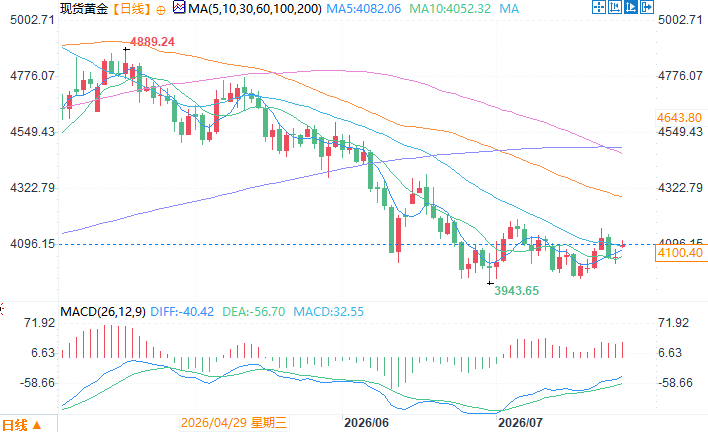 Spot gold daily chart source: FX678. At 11:03 AM Beijing time on July 27, spot gold was trading at $4093.90 per ounce.
After a bull market surge followed by a deep correction, gold's fundamentals have shifted.
Gold experienced a strong surge at the beginning of the year, reaching a record high, but subsequently weakened. Since its January peak, gold prices have fallen by approximately 25%, with a cumulative year-to-date decline of 7%. Kosterridge makes a key observation: the sharp rise at the beginning of the year altered gold's function within portfolios. Fueled by a strong trend, gold is no longer a traditional safe-haven asset. Previously used to hedge against market declines, gold's own volatility has amplified in this bull market, failing to hedge against portfolio pullbacks and instead increasing overall portfolio risk. The waning trend momentum is one of the contributing factors to this months-long correction, but it is only a secondary factor.The three key headwinds suppressing gold prices
1. The strengthening US dollar is the primary driver of the current gold price decline. Although currency devaluation is frequently discussed in the market, the US dollar index has rebounded by more than 6% from its January low. Concerns about a global energy shock, better-than-expected performance in US stocks, and a shift in Federal Reserve policy expectations have all contributed to the strengthening of the US dollar. 2. Rising real interest rates, accompanying the rising US dollar, have led to a simultaneous increase in long-term interest rates, putting significant pressure on gold. The real yield on 10-year TIPS rose from 1.65% in early March to 2.20%. As gold is a non-interest-bearing asset, the rise in real interest rates significantly increases the opportunity cost of holding gold. 3. High concentration of funds in the AI sector has led to a neglect of gold. Currently, market funds are clearly concentrated in a few leading AI companies with impressive profit growth. Gold cannot generate cash flow or profits, leading investors to equate it with low-growth, stable assets, resulting in its temporary neglect by market funds. In an environment where risk appetite is concentrated in growth technology stocks, gold is struggling to attract new buying interest.Key takeaway: Short-term headwinds do not change the long-term investment value.
Despite a concentration of negative factors, BlackRock managers remain optimistic about gold's long-term investment value. The structural logic supporting gold remains intact: global government debt and fiscal deficits are at historical highs, and the risk of long-term currency devaluation persists; geopolitical conflicts have not eased, but the current round has not yet fully triggered safe-haven buying of gold. They believe that one should not liquidate gold holdings based solely on a period of adjustment. Within a diversified investment framework, a moderate gold position should be maintained to hedge against various long-term tail risks.Summarize
In summary, the short-term pressure on gold is due to a confluence of factors, including a stronger US dollar, rising real interest rates, and capital chasing AI growth stocks. After a significant surge at the beginning of the year, gold's safe-haven function has weakened temporarily, and the correction is still ongoing. However, in the medium to long term, the underlying logic supporting gold, such as high debt, currency depreciation, and geopolitical risks, has not disappeared. Institutional views suggest that a complete exit from the market is unnecessary; a moderate gold position should be maintained. In the short term, the focus should be on monitoring the US dollar's performance and changes in US Treasury real interest rates, as these two variables will dominate gold price fluctuations. Spot gold daily chart source: FX678. At 11:03 AM Beijing time on July 27, spot gold was trading at $4093.90 per ounce.
- Risk Warning and Disclaimer
- The market involves risk, and trading may not be suitable for all investors. This article is for reference only and does not constitute personal investment advice, nor does it take into account certain users’ specific investment objectives, financial situation, or other needs. Any investment decisions made based on this information are at your own risk.