Institutional research report: Major Asian powers are supporting the $4,000 mark, and gold pricing power is gradually shifting eastward.
2026-07-28 13:16:05
Gold prices have recently experienced a period of consolidation and correction, with weak Western investment demand suppressing upward movement, but consistently holding above the key support level of $4,000 per ounce. A recent research report from BMO points out that this resilience stems primarily from demand from major Asian countries. These countries possess significantly larger-than-expected gold reserves and market influence, contributing one-third of global gold demand. Their central banks' continued accumulation of gold on dips and robust private physical demand will be key drivers of gold price increases in the second half of the year. In the medium to long term, their internationalization strategies are propelling the continued expansion of their gold reserves, while their domestic gold market infrastructure is improving, indicating a gradual shift in global gold pricing power from the West to these major Asian countries.
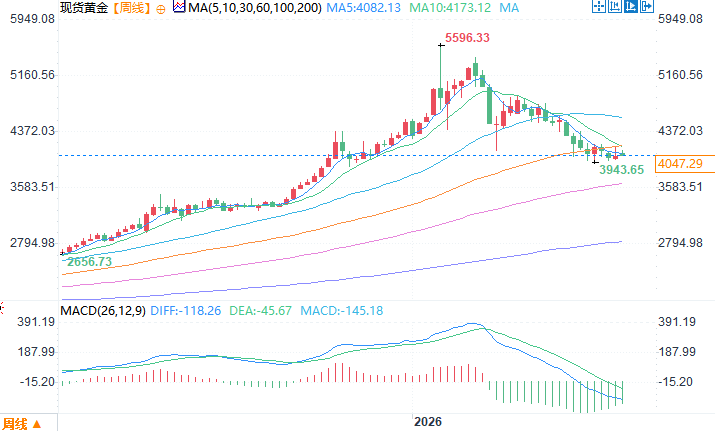 Spot gold weekly chart source: FX678. As of 13:14 Beijing time on July 28, spot gold was trading at $4042.29 per ounce.
Key support for the market: Weak demand from the West, with major Asian powers providing a floor for gold prices.
International gold prices have been under pressure in recent months, entering a long-term correction phase. Weak investment demand in European and American markets has continued to limit the upside potential for gold prices. However, gold prices have consistently held above the important psychological level of $4,000, avoiding a deep collapse. BMO analysts believe that the core logic behind this resilience is not overseas institutional allocation, but rather the continued support from physical demand in Asia, particularly from major Asian countries. This has offset the negative pressure from capital outflows from the West, establishing a solid bottom for gold prices.Key data: Gold reserves in a major Asian country are severely underestimated.
The market has long relied on official reserve data to judge a country's gold holdings, but BMO's new calculations overturn this traditional understanding. The actual stock size significantly exceeds expectations and is substantially higher than publicly disclosed data. Current demand now accounts for one-third of global gold demand, making it the largest core source of incremental growth in the global gold market. Breaking down the stock structure, apart from the gold reserves held by the country's central bank, the vast majority of the remaining stock is concentrated in private jewelry consumption and physical investment gold bars. Currently, major Asian countries hold 13% of the world's above-ground gold reserves, very close to the US's 15% share, and the two countries' gold reserve sizes are gradually becoming equal.Reasons for increasing holdings and medium- to long-term goals
BMO points out that while major Asian countries haven't publicly disclosed their ultimate gold reserves targets, their core strategies of economic expansion and currency internationalization provide a strong and compelling rationale for increasing their gold holdings. Catching up with US official reserves is merely the minimum target, achievable within 2-5 years at the current pace. However, based on building global currency credibility, their actual reserve targets will be far higher. Simultaneously, these major Asian countries are continuously investing in overseas assets, with a cumulative investment of approximately $18 billion to safeguard their gold strategies. In terms of the pace of catching up: at the current rate of gold purchases, it will take these major Asian central banks about 5 years to catch up with the US in official reserves; if we consider the overall national gold reserves, the time to surpass the US will be significantly shortened.Short-term practical application: The central bank continues to buy on dips during the adjustment window.
In response to the months-long gold price correction, central banks in major Asian countries have adopted precise and tactical measures to increase their gold holdings, seizing the opportunity of low prices to replenish their reserves. Latest data shows that central banks added 15 tons of gold last month, marking the largest monthly increase since October 2023; this year, they have accumulated over 40 tons of gold purchases, continuously sending a strong bullish signal and providing sustained support for gold prices.Ultimate Landscape: Global Gold Pricing Power Shifts Eastward at an Accelerated Pace
In addition to expanding its reserves, major Asian powers are comprehensively building a global gold pricing system. By upgrading Hong Kong's international gold hub, improving clearing and settlement infrastructure, linking with gold exchanges, and expanding liquidity in futures and over-the-counter trading, they are continuously attracting global funds to participate in the domestic gold market. BMO predicts that as the demand, market liquidity, and reserve scale of major Asian powers continue to grow, the centuries-old Western-dominated gold pricing structure will be broken, and global gold pricing power is systematically shifting to major Asian powers.Summarize
Overall, the core support for the current range-bound gold price movement comes from strong physical demand from major Asian countries, while weak investment demand from the West is only a short-term disturbance. The gold reserves and demand contribution of major Asian countries far exceed market expectations, and driven by their currency internationalization strategies, the long-term logic for increasing gold holdings remains solid. The central banks of these countries are continuously buying gold on dips to support prices, coupled with a well-developed domestic gold market system and increased pricing power. Demand from major Asian countries will be the core driver of gold price increases in the second half of the year and even in the medium to long term. Spot gold weekly chart source: FX678. As of 13:14 Beijing time on July 28, spot gold was trading at $4042.29 per ounce.- Risk Warning and Disclaimer
- The market involves risk, and trading may not be suitable for all investors. This article is for reference only and does not constitute personal investment advice, nor does it take into account certain users’ specific investment objectives, financial situation, or other needs. Any investment decisions made based on this information are at your own risk.