Is the US-Iran ceasefire just a delaying tactic? How long can the Canadian dollar bulls hold on?
2026-07-27 14:09:02
On Monday (July 27) during Asian trading hours, the US dollar fell against the Canadian dollar after a slight gain in the previous session, trading around 1.4080. The suspension of military hostilities between the US and Iran over the weekend—after 13 consecutive days of escalating conflict, the US halted its strikes, and Iran suspended retaliation—escalated geopolitical tensions, reducing demand for the US dollar as a safe haven and pushing the market into a risk-averse mode. However, the Canadian dollar's upward momentum was significantly constrained by the plunge in oil prices. Although shipping restrictions in the Strait of Hormuz and the Red Sea have not been lifted, the ceasefire itself was enough for the market to repric the previously priced-in extreme geopolitical risk premium. 
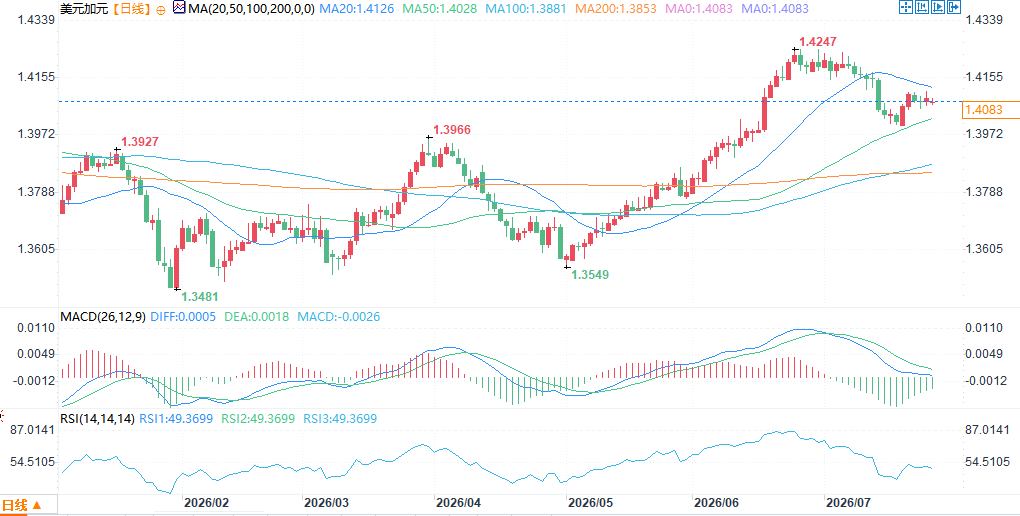 (USD/CAD daily chart, source: EasyForex) Key variables: US-Iran diplomatic progress - if negotiations break down, the US dollar will regain safe-haven buying; FOMC statement wording - the degree of hawkishness will determine the short-term direction of the US dollar; oil price trend - if it continues to decline, it will suppress the Canadian dollar through commodity currency channels.
The US-Iran ceasefire is reshaping market risk appetite.
Last weekend, the United States suspended its bombing campaign after 13 consecutive nights of airstrikes against Iranian targets, prompting Tehran to halt retaliatory attacks against Washington's allies in the Middle East. This "diplomatic window" fueled market expectations that the five-month-long conflict might be turning a corner. The market reaction was a typical "risk appetite return" pattern: safe-haven assets (the US dollar) were sold off, while risk assets (commodity currencies such as the Canadian dollar) saw buying interest. Safe-haven funds that had previously flowed into the US dollar due to the escalation of the Middle East conflict began to flow back. However, concerns about supply disruptions have not completely dissipated. The Houthi rebels claimed responsibility for attacks on Saudi facilities along the Red Sea coast, indicating that the conflict has not completely subsided, but has merely shifted from direct confrontation between the US and Iran to ongoing friction at the proxy level. The underlying reasons for the US suspension of strikes are also noteworthy. Reports indicate that dwindling interceptor stockpiles and a shortage of strikeable targets within Iran are the main constraints. Chairman of the Joint Chiefs of Staff Kaine reportedly warned Trump that continuing the current pace of strikes would severely deplete critical ammunition reserves. This suggests that the ceasefire may be a passive choice constrained by military resources, rather than entirely based on diplomatic goodwill.The plunge in oil prices has a double-edged sword effect on the Canadian dollar.
The anticipated ceasefire between the US and Iran drove a sharp decline in oil prices, a double-edged sword for the USD/CAD exchange rate: Through the dollar channel, it benefits the Canadian dollar: lower oil prices eased global inflation concerns, weakened expectations of a Fed rate hike, and thus pressured the dollar. This is the core logic behind the USD/CAD weakness on Monday. Through the commodity currency channel, it harms the Canadian dollar: as a major oil exporter, falling oil prices mean deteriorating terms of trade for Canada, weakening the Canadian dollar's fundamental support. This is a key factor limiting the Canadian dollar's gains. The combined result of these two forces is that the decline in USD/CAD is relatively limited. As long as oil prices remain above $80/barrel, the Canadian dollar's commodity currency nature will continue to provide some support; however, if oil prices fall further below $80, the Canadian dollar may face greater downward pressure.Markets remain cautious ahead of FOMC meeting
Beyond the dual narratives of the US-Iran ceasefire and the plunge in oil prices, market attention is now turning to Wednesday's FOMC meeting. The market widely expects the Fed to keep interest rates unchanged, but TD Securities points out that the Middle East conflict, which has driven up oil prices, has "increased inflation risks and strengthened the case for a rate hike." TD expects two members to vote against the rate hike—a signal of divergence that could undermine the credibility of the "hold-at-home" policy. If the statement leans hawkish, the dollar could quickly recover lost ground, pushing the USD/CAD pair back above 1.4150. For USD/CAD, the current policy environment is at a delicate balance: if the Fed holds rates steady but releases hawkish signals, the dollar will be supported; if the statement leans dovish, the dollar could weaken further.Technical Analysis
The USD/CAD pair is currently trading around 1.4080, in the lower half of its recent trading range. Support levels: The first support zone is 1.4030-1.4050 (near last week's low); a break below this zone would target the psychological level of 1.4000. Resistance levels: The first resistance zone is 1.4120-1.4150 (near the 20-day moving average); a break above this zone would target 1.4200-1.4220. (USD/CAD daily chart, source: EasyForex) Key variables: US-Iran diplomatic progress - if negotiations break down, the US dollar will regain safe-haven buying; FOMC statement wording - the degree of hawkishness will determine the short-term direction of the US dollar; oil price trend - if it continues to decline, it will suppress the Canadian dollar through commodity currency channels.Institutional Views
Scotiabank maintained its medium-term bullish stance on the Canadian dollar in its latest FX outlook on July 23, but lowered its USD/CAD target to 1.37 in Q4 2026 and 1.33 in Q4 2027, with the overall path still pointing downwards. The core logic lies in the significant narrowing of the US-Canada policy rate differential: the Federal Reserve is expected to cut rates by about 50 basis points in the first half of 2027, while the Bank of Canada may raise rates by a cumulative 75 basis points to 3% during the forecast period. After falling by about 2% against the US dollar in Q2, the Canadian dollar attempted a modest rebound in Q3. Scotiabank currently assesses that the fair value of the Canadian dollar is close to its spot level, suggesting that future movements will be driven more by fundamental factors than valuation repair. Market sentiment and positioning remain bearish on the Canadian dollar, a structure that itself provides potential support—once sentiment reverses, the Canadian dollar could see a more significant rebound.The Canadian dollar seeks a balance between oil prices and safe-haven demand.
The USD/CAD pair is currently caught in a tug-of-war between bulls and bears. The improved risk appetite resulting from the US-Iran ceasefire has provided support for the Canadian dollar, but the plunge in oil prices has limited its upside potential. The safe-haven demand for the US dollar has temporarily subsided due to diplomatic developments, but with the FOMC meeting approaching, any hawkish signals could trigger a rapid rebound in the dollar. In the short term, USD/CAD is likely to consolidate within the 1.4000-1.4200 range. For traders, Wednesday's FOMC meeting is the real highlight of the week—before that, directional bets should be approached with caution. Whether the Canadian dollar can continue to strengthen despite the headwinds from oil prices depends on whether the situation in the Middle East can remain calm and whether the Fed's policy signals are sufficiently dovish. At 14:07 Beijing time on July 27, USD/CAD was trading at 1.4088/89.- Risk Warning and Disclaimer
- The market involves risk, and trading may not be suitable for all investors. This article is for reference only and does not constitute personal investment advice, nor does it take into account certain users’ specific investment objectives, financial situation, or other needs. Any investment decisions made based on this information are at your own risk.