The US dollar index fluctuated at high levels, awaiting the release of the Federal Reserve's interest rate decision.
2026-07-27 14:31:04
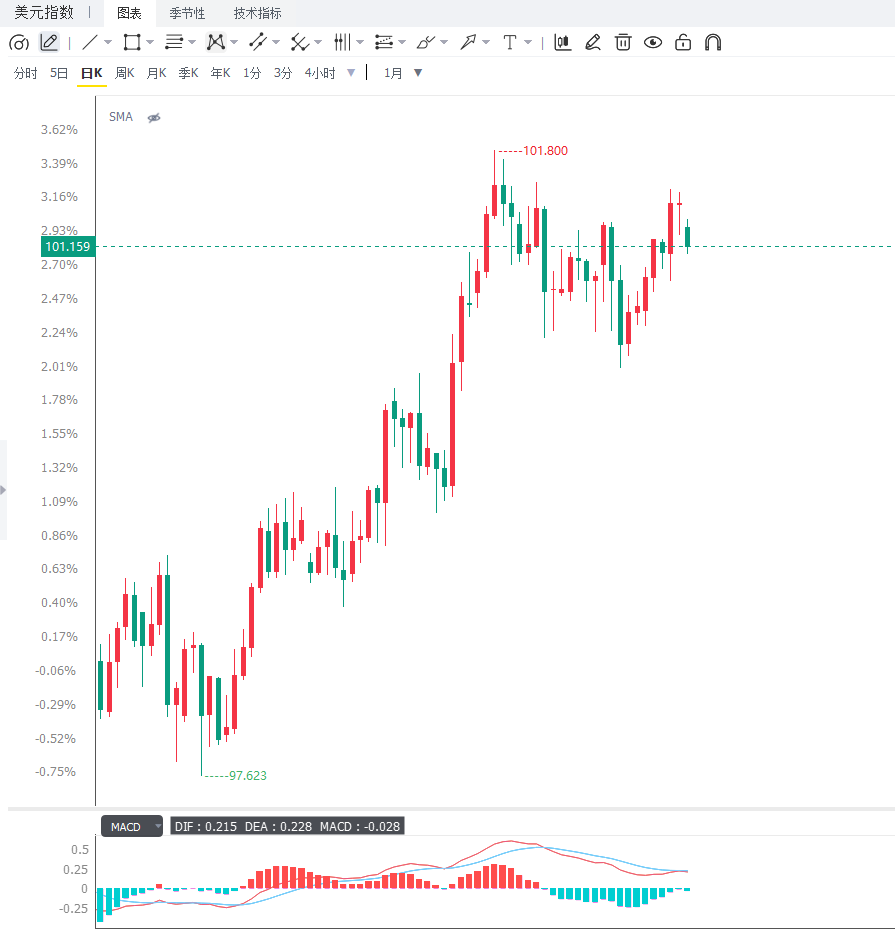
The US dollar index (DXY) continued its decline in Asian trading on Monday, weakening further after an earlier slight drop and currently hovering around 101.20. The main reason for the dollar's pressure is that global market risk sentiment has improved following the temporary halt in military operations between the US and Iran, leading investors to reduce demand for the dollar as a safe-haven asset.  The 13-day tensions that followed provided safe-haven support for the US dollar, but with the US suspending its actions and Iran halting further responses, the market began to reassess risk premiums. Market surveys indicate that the US hopes to create space for potential negotiations, leading to some safe-haven funds flowing out of dollar assets and pushing the dollar index down from recent highs. However, market concerns about energy supply risks have not been completely dispelled. Recent uncertainties remain in the Red Sea region, with the Houthi rebels in Yemen claiming to have attacked Saudi energy facilities along the Red Sea coast, raising investor concerns about the security of key shipping routes. Further disruptions to energy transport could cause oil prices to rise again, impacting global monetary policy expectations through inflation. One reason for the US suspension of its actions is the potential for continued action to increase military resource consumption. Reports indicate that senior US military official Dan Kane warned that continuing the actions could put significant pressure on key resource reserves. This factor further drives market attention to future developments. The recent weakening of the dollar is also influenced by falling oil prices. Previously, the market worried that rising energy prices could reignite US inflation and strengthen the Federal Reserve's case for maintaining a tight monetary policy. However, with a significant pullback in crude oil prices, market concerns about renewed inflationary pressures have lessened. The decline in energy prices has weakened market expectations for further tightening by the Federal Reserve, putting short-term pressure on the dollar . Regarding monetary policy, the market widely expects the Fed to maintain interest rates at its meeting this week and may readjust its policy direction in September. However, some market participants are still betting on a possible hawkish signal from the Fed, thus limiting the dollar's downside potential. Going forward, investors will focus on US economic data, including preliminary Q2 GDP figures, PCE inflation data, and earnings reports from large corporations. This data will help the market assess the resilience of the US economy and influence the Fed's future policy path. If US economic data continues to be strong, the market may lower its expectations for monetary easing, and the dollar is likely to regain support; conversely, if economic growth slows while inflationary pressures decline, expectations of a Fed policy shift may rise, and the dollar index may face further pressure. Currently, the dollar market is in a phase of intertwined factors. On the one hand, easing Middle East risks have reduced safe-haven demand; on the other hand, uncertainty surrounding Fed policy and global energy supply risks may still drive dollar volatility. From a daily chart perspective, the US dollar index has recently undergone a correction in the high range, currently trading around 101.20, with short-term upward momentum weakening. The daily chart structure indicates that the dollar remains in a slightly bullish consolidation pattern, but a break below the support around 101.00 could lead to further correction towards the 100.50 area. Resistance levels to watch are 102.00 and 102.50; a break above these levels could resume the rebound. Currently, the market is in a high-level consolidation phase, and its direction still depends on changes in expectations regarding Federal Reserve policy. From a 4-hour chart perspective, the US dollar index has entered a short-term correction phase, trading under pressure after breaking below the recent consolidation range. The MACD indicator shows gradually weakening upward momentum, and the RSI indicator has fallen back to the neutral zone, reflecting a decline in short-term buying power. However, there is still some support around 101.00. If the dollar index can stabilize, it may retest the 101.80 to 102.00 area; a break below 101.00 could extend the correction, with further support around 100.50 to watch. The current 4-hour trend is weak, but the market is waiting for the Federal Reserve meeting and economic data to provide new directional guidance.
  Editor's Summary: The recent decline in the US dollar index was mainly due to the easing of tensions in the Middle East, reduced safe-haven demand, and a pullback in oil prices. However, the dollar remains supported by expectations of Federal Reserve policy and the fundamentals of the US economy, which may limit its downside potential in the short term. This week's Federal Reserve meeting, GDP data, and PCE inflation indicators will be crucial factors in determining the dollar's trajectory. If inflation continues to ease and strengthens expectations of a policy shift, the dollar may adjust further; if economic data remains strong and the Federal Reserve maintains a tight policy stance, the dollar may still gain upward momentum. Investors should pay close attention to policy signals and changes in global risks to determine the dollar's next direction.
The 13-day tensions that followed provided safe-haven support for the US dollar, but with the US suspending its actions and Iran halting further responses, the market began to reassess risk premiums. Market surveys indicate that the US hopes to create space for potential negotiations, leading to some safe-haven funds flowing out of dollar assets and pushing the dollar index down from recent highs. However, market concerns about energy supply risks have not been completely dispelled. Recent uncertainties remain in the Red Sea region, with the Houthi rebels in Yemen claiming to have attacked Saudi energy facilities along the Red Sea coast, raising investor concerns about the security of key shipping routes. Further disruptions to energy transport could cause oil prices to rise again, impacting global monetary policy expectations through inflation. One reason for the US suspension of its actions is the potential for continued action to increase military resource consumption. Reports indicate that senior US military official Dan Kane warned that continuing the actions could put significant pressure on key resource reserves. This factor further drives market attention to future developments. The recent weakening of the dollar is also influenced by falling oil prices. Previously, the market worried that rising energy prices could reignite US inflation and strengthen the Federal Reserve's case for maintaining a tight monetary policy. However, with a significant pullback in crude oil prices, market concerns about renewed inflationary pressures have lessened. The decline in energy prices has weakened market expectations for further tightening by the Federal Reserve, putting short-term pressure on the dollar . Regarding monetary policy, the market widely expects the Fed to maintain interest rates at its meeting this week and may readjust its policy direction in September. However, some market participants are still betting on a possible hawkish signal from the Fed, thus limiting the dollar's downside potential. Going forward, investors will focus on US economic data, including preliminary Q2 GDP figures, PCE inflation data, and earnings reports from large corporations. This data will help the market assess the resilience of the US economy and influence the Fed's future policy path. If US economic data continues to be strong, the market may lower its expectations for monetary easing, and the dollar is likely to regain support; conversely, if economic growth slows while inflationary pressures decline, expectations of a Fed policy shift may rise, and the dollar index may face further pressure. Currently, the dollar market is in a phase of intertwined factors. On the one hand, easing Middle East risks have reduced safe-haven demand; on the other hand, uncertainty surrounding Fed policy and global energy supply risks may still drive dollar volatility. From a daily chart perspective, the US dollar index has recently undergone a correction in the high range, currently trading around 101.20, with short-term upward momentum weakening. The daily chart structure indicates that the dollar remains in a slightly bullish consolidation pattern, but a break below the support around 101.00 could lead to further correction towards the 100.50 area. Resistance levels to watch are 102.00 and 102.50; a break above these levels could resume the rebound. Currently, the market is in a high-level consolidation phase, and its direction still depends on changes in expectations regarding Federal Reserve policy. From a 4-hour chart perspective, the US dollar index has entered a short-term correction phase, trading under pressure after breaking below the recent consolidation range. The MACD indicator shows gradually weakening upward momentum, and the RSI indicator has fallen back to the neutral zone, reflecting a decline in short-term buying power. However, there is still some support around 101.00. If the dollar index can stabilize, it may retest the 101.80 to 102.00 area; a break below 101.00 could extend the correction, with further support around 100.50 to watch. The current 4-hour trend is weak, but the market is waiting for the Federal Reserve meeting and economic data to provide new directional guidance. Editor's Summary: The recent decline in the US dollar index was mainly due to the easing of tensions in the Middle East, reduced safe-haven demand, and a pullback in oil prices. However, the dollar remains supported by expectations of Federal Reserve policy and the fundamentals of the US economy, which may limit its downside potential in the short term. This week's Federal Reserve meeting, GDP data, and PCE inflation indicators will be crucial factors in determining the dollar's trajectory. If inflation continues to ease and strengthens expectations of a policy shift, the dollar may adjust further; if economic data remains strong and the Federal Reserve maintains a tight policy stance, the dollar may still gain upward momentum. Investors should pay close attention to policy signals and changes in global risks to determine the dollar's next direction.
- Risk Warning and Disclaimer
- The market involves risk, and trading may not be suitable for all investors. This article is for reference only and does not constitute personal investment advice, nor does it take into account certain users’ specific investment objectives, financial situation, or other needs. Any investment decisions made based on this information are at your own risk.