Bank of England: Energy price rebound unlikely to trigger interest rate hike; rates likely to remain unchanged this year.
2026-07-28 00:00:02
Despite the recent significant rise in international energy prices, market analysts point out that the Bank of England's July 30 policy meeting is almost certain to keep the benchmark interest rate unchanged. For the central bank to initiate an interest rate hike, oil and gas prices will need to rise even more significantly.  Market analysts predict that the Bank of England's latest economic outlook report will show that UK inflation is likely to peak this year, reaching a peak of around 3%. Analysts believe that the current energy price surge alone is insufficient to prompt the Bank of England to raise interest rates in September. The energy price hike presents a challenge for the central bank, but the threshold for a rate hike has not yet been reached . The continued rise in energy prices presents new challenges to the Bank of England's monetary policy. Industry experts generally expect that the vote at this Thursday's policy meeting will likely continue the 7-2 pattern, maintaining the current interest rate level. The central bank's latest forecast shows that UK inflation may approach 3% in the second half of this year to early next year. An important benchmark is 4%: the Bank of England has previously argued that once inflation climbs above 4%, it is highly likely to trigger a second wave of inflation, creating long-term inflationary pressure where wages and prices push each other up. Investors should note that this inflation forecast does not fully reflect the impact of the latest round of energy price increases. The Bank of England's calculation model generally uses the average oil and gas price over three consecutive weeks as a benchmark, and the current statistical window began around the beginning of July. Compared to the central bank's baseline scenario in April, the model at that time predicted that natural gas prices would only rise slightly in 2026 and then gradually decline, while the long-term oil price expectation was low. In other words, if the current higher energy spot prices are used for recalculation, inflation expectations will be significantly revised upward, and the inflation peak may fall in the range of 3.5% to 4%.
 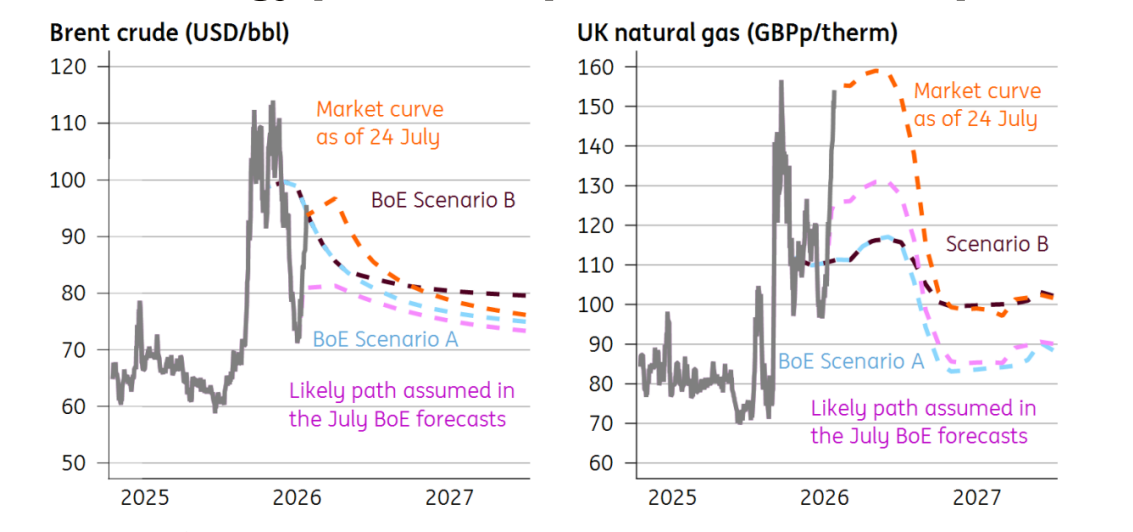 (Chart: Comparison of Energy Market Forward Prices and the Bank of England's April Scenario Assumptions) The left chart shows Brent crude oil prices (USD/barrel), and the right chart shows UK natural gas prices (pence/calorie); the gray solid line represents historical prices. The orange dashed line represents the market forward price curve as of July 24; the dark brown and light blue dashed lines correspond to the Bank of England's April baseline scenario B and optimistic scenario A, respectively; the purple dashed line represents the energy price benchmark used in the Bank of England's July forecast. The chart clearly shows that the current market-priced natural gas is significantly higher than the central bank's modeling assumptions, meaning that the current inflation forecast has not fully absorbed the upward pressure from recent energy price increases. Weakening economic indicators support the central bank's temporary pause in tightening policy. Many investors are concerned: Will rising energy prices prompt the central bank to release a strong hawkish signal? From the perspective of the Monetary Policy Committee members, Kathleen Mann, a hawkish member who has long adhered to tightening policies, may join Hugh Peele and Megan Green in voting for a rate hike. If Claire Lombardy, who previously strongly opposed rate cuts during the tense situation with Iran, also turns to support a rate hike, it would exceed market expectations. Even with an increase in the number of members in the interest rate hike camp, the hawkish-dove divide within the committee remains clear. Five members, including Bank of England Governor Andrew Bailey, tend to believe that the UK economy is unlikely to experience a repeat of the massive inflation wave of four years ago, a view supported by recent economic data. The UK labor market is generally weak, characterized by companies reducing hiring while avoiding layoffs. Private sector wage growth has fallen below 3%; the Bank of England noted that the composition effect in its statistical methodology has somewhat suppressed wage data, but wage growth expectations have generally cooled since the geopolitical conflict with Iran. Overall inflationary pressures are moderate, and a stronger catalyst of rising energy prices is needed for interest rate hikes. Currently, overall inflation in the UK is relatively stable, with food inflation remaining low, a phenomenon common in other European countries. Only if energy price increases form a complete transmission chain will they gradually pass on to consumer goods prices, a process with a significant time lag. Meanwhile, inflation in core service sectors continues to ease, and various business surveys indicate that companies do not plan to significantly raise product prices or proactively increase employee salaries. Considering all factors, a significant increase in energy prices is needed to persuade more committee members to support an interest rate hike. According to some institutions' calculations, international crude oil prices would rise from the current $90/barrel to $120/barrel, and the benchmark Dutch TTF natural gas price would rise from €58/MWh to €80/MWh. Inflation could then exceed 4%, potentially forcing the central bank to slightly tighten monetary policy. Geopolitical risks are a key variable: if the Strait of Hormuz continues to be blocked in August, a sharp rise in oil and gas prices is possible. However, mainstream market expectations indicate that the Bank of England will maintain its interest rate unchanged throughout 2026. Current institutional predictions suggest that the earliest window for interest rate cuts may appear in the spring of 2027, with plans for two rounds of rate cuts; however, this prediction rests on the crucial premise that the UK's autumn budget will not introduce large-scale stimulus measures.
Market analysts predict that the Bank of England's latest economic outlook report will show that UK inflation is likely to peak this year, reaching a peak of around 3%. Analysts believe that the current energy price surge alone is insufficient to prompt the Bank of England to raise interest rates in September. The energy price hike presents a challenge for the central bank, but the threshold for a rate hike has not yet been reached . The continued rise in energy prices presents new challenges to the Bank of England's monetary policy. Industry experts generally expect that the vote at this Thursday's policy meeting will likely continue the 7-2 pattern, maintaining the current interest rate level. The central bank's latest forecast shows that UK inflation may approach 3% in the second half of this year to early next year. An important benchmark is 4%: the Bank of England has previously argued that once inflation climbs above 4%, it is highly likely to trigger a second wave of inflation, creating long-term inflationary pressure where wages and prices push each other up. Investors should note that this inflation forecast does not fully reflect the impact of the latest round of energy price increases. The Bank of England's calculation model generally uses the average oil and gas price over three consecutive weeks as a benchmark, and the current statistical window began around the beginning of July. Compared to the central bank's baseline scenario in April, the model at that time predicted that natural gas prices would only rise slightly in 2026 and then gradually decline, while the long-term oil price expectation was low. In other words, if the current higher energy spot prices are used for recalculation, inflation expectations will be significantly revised upward, and the inflation peak may fall in the range of 3.5% to 4%. (Chart: Comparison of Energy Market Forward Prices and the Bank of England's April Scenario Assumptions) The left chart shows Brent crude oil prices (USD/barrel), and the right chart shows UK natural gas prices (pence/calorie); the gray solid line represents historical prices. The orange dashed line represents the market forward price curve as of July 24; the dark brown and light blue dashed lines correspond to the Bank of England's April baseline scenario B and optimistic scenario A, respectively; the purple dashed line represents the energy price benchmark used in the Bank of England's July forecast. The chart clearly shows that the current market-priced natural gas is significantly higher than the central bank's modeling assumptions, meaning that the current inflation forecast has not fully absorbed the upward pressure from recent energy price increases. Weakening economic indicators support the central bank's temporary pause in tightening policy. Many investors are concerned: Will rising energy prices prompt the central bank to release a strong hawkish signal? From the perspective of the Monetary Policy Committee members, Kathleen Mann, a hawkish member who has long adhered to tightening policies, may join Hugh Peele and Megan Green in voting for a rate hike. If Claire Lombardy, who previously strongly opposed rate cuts during the tense situation with Iran, also turns to support a rate hike, it would exceed market expectations. Even with an increase in the number of members in the interest rate hike camp, the hawkish-dove divide within the committee remains clear. Five members, including Bank of England Governor Andrew Bailey, tend to believe that the UK economy is unlikely to experience a repeat of the massive inflation wave of four years ago, a view supported by recent economic data. The UK labor market is generally weak, characterized by companies reducing hiring while avoiding layoffs. Private sector wage growth has fallen below 3%; the Bank of England noted that the composition effect in its statistical methodology has somewhat suppressed wage data, but wage growth expectations have generally cooled since the geopolitical conflict with Iran. Overall inflationary pressures are moderate, and a stronger catalyst of rising energy prices is needed for interest rate hikes. Currently, overall inflation in the UK is relatively stable, with food inflation remaining low, a phenomenon common in other European countries. Only if energy price increases form a complete transmission chain will they gradually pass on to consumer goods prices, a process with a significant time lag. Meanwhile, inflation in core service sectors continues to ease, and various business surveys indicate that companies do not plan to significantly raise product prices or proactively increase employee salaries. Considering all factors, a significant increase in energy prices is needed to persuade more committee members to support an interest rate hike. According to some institutions' calculations, international crude oil prices would rise from the current $90/barrel to $120/barrel, and the benchmark Dutch TTF natural gas price would rise from €58/MWh to €80/MWh. Inflation could then exceed 4%, potentially forcing the central bank to slightly tighten monetary policy. Geopolitical risks are a key variable: if the Strait of Hormuz continues to be blocked in August, a sharp rise in oil and gas prices is possible. However, mainstream market expectations indicate that the Bank of England will maintain its interest rate unchanged throughout 2026. Current institutional predictions suggest that the earliest window for interest rate cuts may appear in the spring of 2027, with plans for two rounds of rate cuts; however, this prediction rests on the crucial premise that the UK's autumn budget will not introduce large-scale stimulus measures.
- Risk Warning and Disclaimer
- The market involves risk, and trading may not be suitable for all investors. This article is for reference only and does not constitute personal investment advice, nor does it take into account certain users’ specific investment objectives, financial situation, or other needs. Any investment decisions made based on this information are at your own risk.