Yen strengthens: Easing geopolitical tensions weigh on dollar as markets await Fed and Bank of Japan decisions.
2026-07-28 01:00:02
On Monday (July 27), the USD/JPY pair edged lower during the US session, trading around 163.644, a daily decline of 0.13%. The dollar came under pressure as market risk appetite improved due to recent geopolitical developments. The US and Iran confirmed a suspension of mutual strikes, reigniting market expectations for renewed diplomatic negotiations and significantly improving risk appetite. The dollar's weakness was also reflected in the dollar index remaining in negative territory; US stocks rose in tandem, creating a favorable environment for risk assets overall.  Market attention is now focused on the interest rate decisions of two major central banks this week: the Federal Reserve will announce its results on Wednesday, and the Bank of Japan will speak on Friday. The market widely expects both central banks to maintain their current interest rates. Investors are paying close attention to the policy tone released by officials. Previously, Federal Reserve Chairman Kevin Warsh stated that forward guidance is not suitable for the current policy environment. The Japanese market generally believes that the Bank of Japan will maintain its tendency to gradually tighten monetary policy. Surveys show that the vast majority of economists expect the Bank of Japan to raise interest rates again this year, reinforcing market expectations for the continued normalization of Japanese monetary policy. US economic data released on Monday also failed to provide strong support for the dollar: durable goods orders in June rose by only 0.3%, far below the market expectation of 1.6%. Excluding transportation goods, orders rose by 0.6%, with computers and electronic products being the main driver of growth. In summary, easing geopolitical tensions, weak US economic data, and market caution ahead of the Federal Reserve and Bank of Japan interest rate meetings have combined to put slight downward pressure on the USD/JPY exchange rate at the beginning of this week. The yen remains near multi-decade lows, putting pressure on the Bank of Japan to send a more hawkish signal. Analysts at MUFG noted, "The decline in energy prices at the beginning of the week provided Japanese policymakers with a much-needed respite, while also slowing the upward momentum of the USD/JPY pair. Since the end of last week, the exchange rate has been fluctuating below the 164 level." The analysts added, "The market's core focus this week is on how the Bank of Japan will address domestic inflationary pressures, and investors are closely watching whether the central bank will adjust its policy guidance at this policy meeting."
 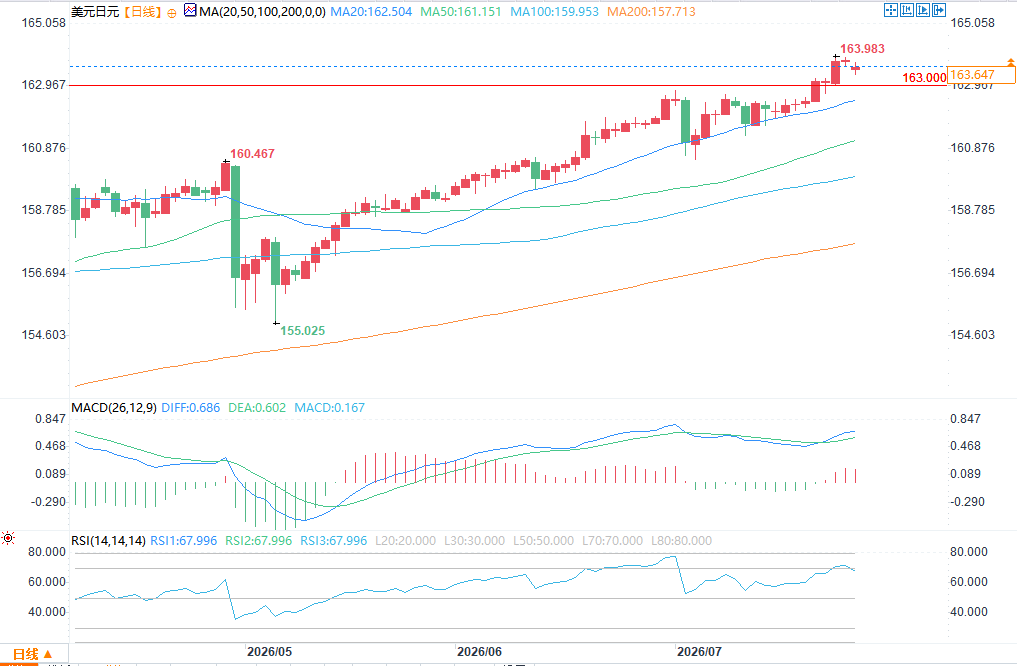 (USD/JPY Daily Chart Source: EasyForex) Mitsubishi UFJ stated that the Bank of Japan (BOJ) just completed a rate hike in June and is expected to maintain the current rate. However, the market will be closely watching whether the BOJ releases any hawkish clues regarding future rate hikes. A recent Bloomberg report mentioned that the BOJ is not limited to raising rates every six months and there is a possibility of accelerating the pace of rate hikes; at the same time, the continued weakening of the yen is pushing up inflation risks. The bank believes: "If this meeting fails to release hawkish policy guidance, the yen faces further depreciation risks; if the Fed unexpectedly releases a hawkish stance this week, the downward pressure on the yen will be further amplified." Strategists at BNY Mellon also pointed out that the market generally expects the BOJ to maintain its current policy, and policy guidance and updated economic forecasts are the core clues for judging the timing of rate hikes. Analysts said that Tokyo CPI, retail sales, and industrial production data will be the last batch of key indicators to assess the current economic situation before the policy meeting, influencing the direction of policy discussions. BNY Mellon predicts that the BOJ will most likely keep the benchmark interest rate unchanged at 1.00%. However, with the yen exchange rate falling to a more than 40-year low, the central bank urgently needs to release a statement promising to continue tightening monetary policy. The report warns that, combined with the latest fiscal budget, market concerns about Japan's fiscal situation continue to rise. The Bank of Japan needs to signal a tightening of monetary policy to offset the various risks associated with fiscal stimulus. Until the central bank's policy statements fail to anticipate market expectations, the yen's performance is unlikely to improve, and renewed balance-of-payments risks are further weighing on its performance.
Market attention is now focused on the interest rate decisions of two major central banks this week: the Federal Reserve will announce its results on Wednesday, and the Bank of Japan will speak on Friday. The market widely expects both central banks to maintain their current interest rates. Investors are paying close attention to the policy tone released by officials. Previously, Federal Reserve Chairman Kevin Warsh stated that forward guidance is not suitable for the current policy environment. The Japanese market generally believes that the Bank of Japan will maintain its tendency to gradually tighten monetary policy. Surveys show that the vast majority of economists expect the Bank of Japan to raise interest rates again this year, reinforcing market expectations for the continued normalization of Japanese monetary policy. US economic data released on Monday also failed to provide strong support for the dollar: durable goods orders in June rose by only 0.3%, far below the market expectation of 1.6%. Excluding transportation goods, orders rose by 0.6%, with computers and electronic products being the main driver of growth. In summary, easing geopolitical tensions, weak US economic data, and market caution ahead of the Federal Reserve and Bank of Japan interest rate meetings have combined to put slight downward pressure on the USD/JPY exchange rate at the beginning of this week. The yen remains near multi-decade lows, putting pressure on the Bank of Japan to send a more hawkish signal. Analysts at MUFG noted, "The decline in energy prices at the beginning of the week provided Japanese policymakers with a much-needed respite, while also slowing the upward momentum of the USD/JPY pair. Since the end of last week, the exchange rate has been fluctuating below the 164 level." The analysts added, "The market's core focus this week is on how the Bank of Japan will address domestic inflationary pressures, and investors are closely watching whether the central bank will adjust its policy guidance at this policy meeting." (USD/JPY Daily Chart Source: EasyForex) Mitsubishi UFJ stated that the Bank of Japan (BOJ) just completed a rate hike in June and is expected to maintain the current rate. However, the market will be closely watching whether the BOJ releases any hawkish clues regarding future rate hikes. A recent Bloomberg report mentioned that the BOJ is not limited to raising rates every six months and there is a possibility of accelerating the pace of rate hikes; at the same time, the continued weakening of the yen is pushing up inflation risks. The bank believes: "If this meeting fails to release hawkish policy guidance, the yen faces further depreciation risks; if the Fed unexpectedly releases a hawkish stance this week, the downward pressure on the yen will be further amplified." Strategists at BNY Mellon also pointed out that the market generally expects the BOJ to maintain its current policy, and policy guidance and updated economic forecasts are the core clues for judging the timing of rate hikes. Analysts said that Tokyo CPI, retail sales, and industrial production data will be the last batch of key indicators to assess the current economic situation before the policy meeting, influencing the direction of policy discussions. BNY Mellon predicts that the BOJ will most likely keep the benchmark interest rate unchanged at 1.00%. However, with the yen exchange rate falling to a more than 40-year low, the central bank urgently needs to release a statement promising to continue tightening monetary policy. The report warns that, combined with the latest fiscal budget, market concerns about Japan's fiscal situation continue to rise. The Bank of Japan needs to signal a tightening of monetary policy to offset the various risks associated with fiscal stimulus. Until the central bank's policy statements fail to anticipate market expectations, the yen's performance is unlikely to improve, and renewed balance-of-payments risks are further weighing on its performance.
- Risk Warning and Disclaimer
- The market involves risk, and trading may not be suitable for all investors. This article is for reference only and does not constitute personal investment advice, nor does it take into account certain users’ specific investment objectives, financial situation, or other needs. Any investment decisions made based on this information are at your own risk.