













Gold Trading Alert: Bulls and Bears Engage in Fierce Competition! Oil Price Plunge Provides Relief for Gold Prices; Fed Interest Rate Meeting Looms!
2026-07-28 07:47:02
On Monday (July 27), the international gold market experienced a dramatic Monday as US President Trump told reporters aboard Air Force One that the US had "enough patience to reach a new agreement with Iran." Spot gold gapped up nearly $40 to around $4096, briefly surging to $4115 during the session, but subsequently gave back most of its gains, ultimately closing at $4076.46, a slight increase of only about 0.5%. Meanwhile, Brent crude oil futures plummeted by more than 8%, falling below the $90 mark. This rise and fall reflects a profound paradox currently facing the gold market: the easing of geopolitical tensions should have weakened safe-haven demand, but the cooling of inflation expectations brought about by the oil price plunge has instead opened a window for gold. Gold is at a crossroads pulled by multiple forces—the pause in the US-Iran conflict, the sharp drop in oil prices, the strengthening of the US dollar, and the upcoming interest rate decision by the Federal Reserve are all weaving a complex web. On Tuesday (July 28) in early Asian trading, spot gold traded in a narrow range, currently at $4,072.99 per ounce. 
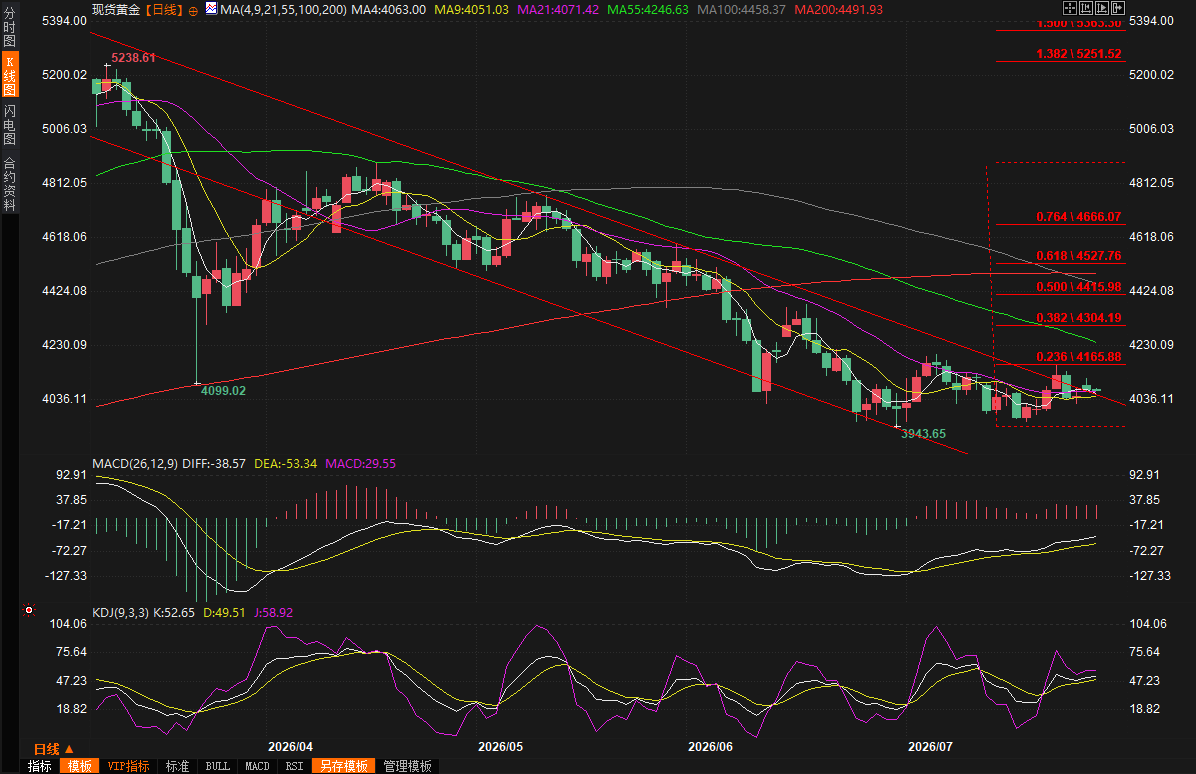 (Spot gold daily chart, source: EasyTrade) At 07:44 Beijing time, spot gold is currently trading at $4072.24 per ounce.
I. From Gunfire to the Negotiating Table: An Unexpected Blessing of Geopolitical Easing
Tensions in the Gulf region have reached a fever pitch over the past two weeks. The United States launched airstrikes against Iran for 13 consecutive nights, while Iran retaliated with strikes against US bases in the Middle East. The conflict between the US and Iran began on February 28, less than a month after the two sides signed a memorandum of understanding on June 17. Pakistan's mediation efforts, supported by Qatar, failed to achieve any breakthrough. Iranian Foreign Ministry spokesman Esmail Bagheei made it clear that Iran was only concerned with its own national interests, not the expectations of the United States, and accused the United States of violating the memorandum of understanding first. However, the situation took a dramatic turn last Friday (July 24). Just hours after Trump threatened to consider an unprecedented large-scale attack on Iran, Axios, citing sources, reported that Admiral Brad Cooper, the top military commander in the Middle East, recommended halting the bombing campaign because its effectiveness had reached saturation. More importantly, Chairman of the Joint Chiefs of Staff General Dan Kane privately warned that the US air defense interceptors were running out of ammunition, which could weaken the US's ability to protect itself and its allies in the Middle East. Trump subsequently ordered a halt to the planned large-scale attack. Iran responded immediately—it would maintain the ceasefire as long as the US continued its suspension of operations. US Ambassador to the UN, Mike Walz, later stated on NBC that Trump wanted to leave some room for negotiations. Trump himself also stated on Monday that US-Iran negotiations were "going well," adding, "I think it's very likely something will happen." Iranian Foreign Ministry spokesman Bagheei denied formal negotiations with the US but acknowledged that information exchanges did exist. This series of events forms the core narrative of the short-term gold market trend. The sudden emergence of hope for a diplomatic solution to the five-month-long US-Iran war directly triggered a massive sell-off in the oil market.II. The Chain Reaction of the Oil Price Crash: Gold's Unexpected Reinforcement
The movement of oil prices is key to understanding the current volatility in gold prices. On Monday, Brent crude futures fell more than 8%, hitting a one-week low of $87.47 per ounce. The previous week, oil prices had briefly surpassed $100 per barrel due to the escalating conflict between the US and Iran. Bart Melek, global head of commodities strategy at TD Securities, aptly summarized this: "What we're mainly seeing is oil prices falling from over $100 last week to below $90, which is driving down market expectations for interest rate prospects." This assessment reveals a subtle transmission chain between gold and crude oil. Gold has long been considered a hedge against inflation, but the market's reaction to inflation is not linear. When rising oil prices push up inflation expectations, the market tends to bet on the Federal Reserve raising interest rates to curb inflation. Rising interest rates increase the opportunity cost of holding gold, a non-interest-bearing asset, thus suppressing gold prices. This is the root cause of the previous anomaly of "rising oil prices, falling gold prices." However, when oil prices plummet, inflation concerns cool, and market expectations for further tightening of monetary policy by the Federal Reserve decrease, providing support for gold. Analysts also pointed out that after the mediators in the US-Iran conflict proposed a ceasefire, market expectations for a de-escalation increased, putting downward pressure on oil prices, which in turn reduced energy inflationary pressures and lessened market concerns about further tightening of monetary policy by the Federal Reserve, thus supporting gold prices. It can be said that oil prices have shifted from an "inflation catalyst" to a "rate hike relief valve," providing gold with an unexpected opportunity for a rebound. The sharp decline in crude oil prices helped alleviate inflation concerns and curb bets on a Fed rate hike, which was then seen by the market as a supporting factor for gold.III. The Dollar's Comeback: The Ceiling for Gold's Rebound
However, gold's rally failed to hold. Spot gold retreated to around $4,075 after hitting a high of $4,115. The main pressure behind this came from a strong US dollar. The US dollar index touched a four-week high of 101.54 on Monday, closing at 101.53, a gain of about 0.1%. Notably, the dollar index initially fell 0.33% to 101.11 in early Asian trading, but subsequently recovered all its losses and rose. This indicates that although geopolitical easing put short-term pressure on the dollar, market expectations regarding the Fed's policy path continue to support it. The seesaw relationship between the dollar and gold is particularly evident in the current market. Geopolitical easing has put some pressure on the dollar as some geopolitical risk premiums have been removed. However, traders seem unwilling to make aggressive bearish bets on the dollar, choosing instead to wait for more clues about the Fed's policy path. Meanwhile, US economic data also provided support for the dollar. Data released by the U.S. Commerce Department on Monday showed that core durable goods orders rose 0.9% month-over-month in June, higher than economists' expectations of 0.8%, with May's figure revised upward to 1.9%. Core capital goods shipments surged even more, rising 1.9%, the largest increase since December 2021. Economists expect business equipment spending to see double-digit growth for the second consecutive quarter. These figures suggest that the AI investment boom is helping to mitigate the drag on the economy from the U.S.-Iran conflict and tariffs. Strong economic data reinforces market confidence in the resilience of the U.S. economy and provides justification for the Federal Reserve to maintain high interest rates. BMO Capital Markets senior economist Tiaga Murti pointed out that AI-driven equipment spending is a double-edged sword for the Fed—on the one hand, it supports economic activity and productivity; on the other hand, the continued boom in AI-related investments may maintain inflationary pressures.IV. The Federal Reserve Interest Rate Meeting is Coming
The most critical uncertainty in the current gold market is undoubtedly the upcoming Federal Reserve interest rate meeting on July 28-29. This meeting has been described by the market as "the most unpredictable in years." According to the CME Group's FedWatch tool, investors believe there is a 37.9% probability that the Fed will raise interest rates by 25 basis points at this meeting, while the probability of keeping rates unchanged is 62.1%. Market expectations for a September rate hike are even stronger, with bets on the probability rising to about 80%. This divergence itself illustrates the complexity of the issue. Just a few weeks ago, when the June CPI recorded its largest monthly drop since April 2020, market bets on a July rate hike dropped to about 10%. However, within just a few weeks, the triple impact of the US-Iran conflict, Trump's tariffs, and the AI investment boom completely reversed this narrative. The divisions within the Fed are also widening rapidly. Dallas Fed President Logan and Cleveland Fed President Hammark have both called for a rate hike, and both have voting rights at this meeting. Citigroup economists predict that more than two dissenting votes will be interpreted by the market as a stronger hawkish signal. However, a dovish camp also exists, with figures like New York Fed President Williams favoring a decision in September. This policy uncertainty is triggering rare two-way betting in the financial system. The CEO of Derivative Path revealed that about one-third of their clients are preparing for further rate hikes, while the rest are hedging against rate cuts. For gold, the Fed's decision is crucial. If the Fed maintains interest rates, the precious metals market may experience a short-lived rebound. But if the Fed unexpectedly raises rates or releases a stronger hawkish signal, gold prices may face new downward pressure.V. The $4,000 defense line: the tug-of-war between bulls and bears in gold.
From a technical perspective, gold has fallen by more than 27% since its historical high of $5,596 in February 2026. Gold prices repeatedly broke below the $4,000 mark in July, but were quickly recovered each time. The $4,000 level has become a significant psychological and technical support level. UBS's global team remains optimistic about the medium-term outlook for gold, predicting international gold prices to reach $4,675/oz in 2026 and $4,800/oz in 2027. Goldman Sachs predicts a short-term gold price of $4,900/oz. The World Gold Council's latest report indicates that gold will continue to serve as a barometer of the global macroeconomy, with prices likely to fluctuate slightly around $4,100/oz this year. However, some institutions hold a more cautious view. JPMorgan Chase stated in a research report in early July that the average gold price in the second half of the year will be $4,400/oz, and if the Federal Reserve raises interest rates, it could potentially fall to $3,500/oz. Fu Yifu, a special researcher at Suzhou Commercial Bank, pointed out that the recent fluctuations in international gold prices around $4,100 per ounce are primarily driven by the repeated failures to meet expectations for a Federal Reserve rate cut and the rising expectations for a rate hike. The fund flows of gold ETFs also reflect market hesitation. After a period of continuous net outflows, the outflow trend of the SPDR Gold ETF slowed significantly in July, even showing net inflows in some weeks. This indicates that bargain hunters have begun to gradually position themselves around $4,000. However, total holdings in gold ETFs remain at a relatively low level. While market pessimism has eased marginally, a fundamental reversal has not yet occurred. This means that the rebound in gold prices is more due to short covering and bargain hunting than the accumulation of a sustained bullish trend.VI. The Fork in the Road Ahead: A Golden Prospect Amidst a Complex Interplay of Variables
Looking ahead, the gold market faces a complex interplay of variables. Geopolitically, the US-Iran situation is far from settled. Trump stated clearly on Monday that the US would resume military strikes against Iran if a new ceasefire agreement wasn't reached. He said, "Time is running out. It's either a quick victory or nothing at all." Meanwhile, tensions continue to escalate in the Red Sea, with Saudi Arabia announcing the destruction of a drone originating from Iraq, and the Houthi rebels in Yemen claiming to have attacked Saudi oil infrastructure. The Middle East conflict is spreading in multiple directions. Iran also intercepted six ships attempting to cross the Strait of Hormuz early Monday morning. These signs suggest that the current ceasefire may only be a temporary respite, not a lasting peace. Zhengxin Futures predicts that the US-Iran situation will initially ease before escalating again this week, with precious metals maintaining a bottom-level consolidation. On the economic data front, investors are awaiting the release of US personal consumption expenditure data for June on Thursday—the Fed's preferred inflation indicator. If the inflation data is strong, expectations for a September rate hike may further intensify, and $4,000 will once again become a clear downside target. If price pressures show signs of easing, gold may get a breather. In the medium to long term, structural support for gold remains. Continued gold purchases by global central banks provide long-term support. The People's Bank of China has increased its gold holdings for the 20th consecutive month. In the first quarter of 2026, central banks worldwide made net purchases of 244 tons of gold, the strongest quarterly performance in over a year. Geopolitical uncertainty and global debt pressures also enhance the strategic allocation value of gold. As James Stanley, senior market strategist at Forex, stated, even if the Federal Reserve begins raising interest rates this week, in the long run, "we won't see tightening or a balanced budget anytime soon, so even in this temporary contrarian context, the bullish case for gold remains."Conclusion
The current gold market is at a delicate juncture, caught in a tug-of-war between multiple forces. A respite in geopolitical tensions provides short-term support for gold, but a strong dollar and uncertainty surrounding the Federal Reserve pose upward resistance. The plunge in oil prices is a double-edged sword—while easing inflation concerns and lowering expectations of interest rate hikes, it also diminishes gold's appeal as an inflation hedge. The $4,000 level has become a fiercely contested battleground between gold bulls and bears. On the upside, $4,200 is a significant resistance level; on the downside, $3,950 is a crucial defense line for the previous lows. Until the Fed's policy path becomes clearer, gold prices will likely maintain a range-bound pattern with a ceiling and a floor. (Spot gold daily chart, source: EasyTrade) At 07:44 Beijing time, spot gold is currently trading at $4072.24 per ounce.
- Risk Warning and Disclaimer
- The market involves risk, and trading may not be suitable for all investors. This article is for reference only and does not constitute personal investment advice, nor does it take into account certain users’ specific investment objectives, financial situation, or other needs. Any investment decisions made based on this information are at your own risk.

