













Oil prices continue to be under pressure after the plunge; how long can the "diplomatic window" between the US and Iran last?
2026-07-28 08:16:02
Brent crude futures opened about 2.8% lower in early Asian trading on Tuesday (July 28), currently trading around $85.30 per barrel. Oil prices continued to be pressured after Monday's 10% plunge, as the market digested optimistic signals from Trump regarding negotiations, but ongoing tensions in the Middle East cast serious doubt on the sustainability of the ceasefire. On Monday, US President Trump stated that the US and Iran were having "good talks" and that an agreement on the five-month-long conflict was possible, but warned that airstrikes would resume if negotiations failed. These signs of easing geopolitical tensions were quickly put to the test – Saudi Arabia intercepted a drone launched from Iraq on Monday, the Houthis claimed responsibility for attacking Saudi oil pipelines in the Red Sea, and Iran drove away six ships attempting to cross the Strait of Hormuz. Trump's optimistic remarks contrasted sharply with the ongoing tensions on the battlefield, exposing the fragility of the ceasefire. 
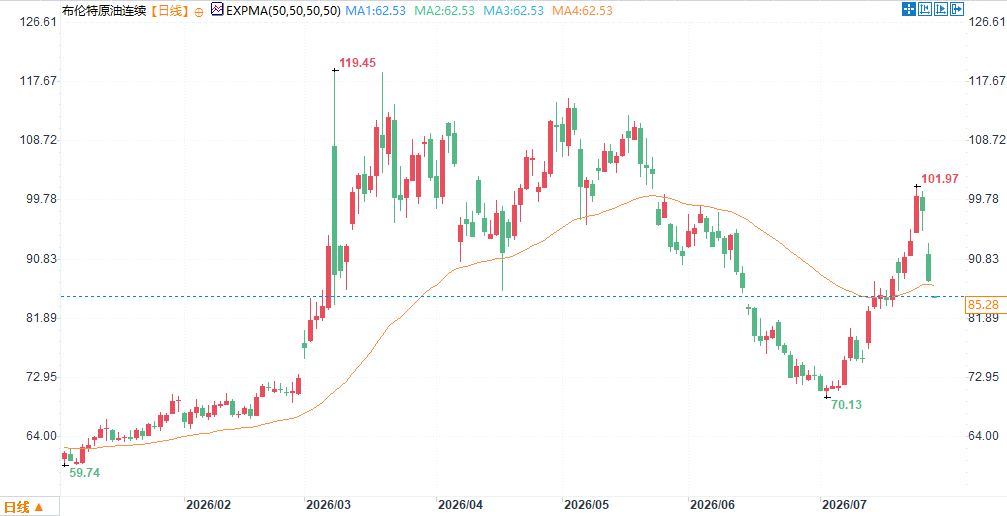 (Brent crude oil futures daily chart, source: EasyTrade) At 8:12 AM Beijing time on July 28, Brent crude oil futures were trading at $85.37 per barrel.
Trump's "Negotiation Window"
On Monday aboard Air Force One, Trump told reporters that the United States and Iran were having "good talks" and that "there's a good chance of reaching some kind of outcome." However, he also warned, "If we don't, we'll revert to the actions we took two days ago." This statement came against the backdrop of Washington's abrupt suspension of its two-week-long airstrikes last Saturday. According to US officials and media reports, Trump's decision to suspend the airstrikes reflected the military's assessment that the bombing had reached its limits—with fewer and fewer targets to strike, and Chairman of the Joint Chiefs of Staff General Kane expressing concern about the depletion of aerial munitions reserves. Trump himself dismissed claims of ammunition shortages, saying that the US military was rapidly replenishing its stockpiles and expressed a desire to acquire more "more advanced equipment." In stark contrast to Trump's optimistic remarks was Tehran's cautious stance. Iranian Foreign Ministry spokesman Bagaei stated that both sides were still communicating through mediators, and that Iran had not abandoned diplomatic channels, but reports of Iran demanding negotiations were "pure fabrication," adding, "That's not in our nature." A senior Iranian official stated on Sunday that Iran would also cease its own attacks should Trump unilaterally announce a suspension of military operations.Saudi Arabia intercepts drone; Houthi threat over Red Sea oil pipeline
On the same day Trump signaled optimism, Saudi Arabia reported multiple attacks. Saudi Arabia stated it had shot down "several" drones launched from Iraq by Iranian-backed militants and reserved the right to retaliate. Saudi Arabia demanded that Iraq "take all necessary measures to ensure its territory is not used as a launch site for attacks." A more strategic threat lies in the Red Sea region. The Houthi rebels claimed responsibility for attacks on the East-West oil pipeline carrying oil to the Saudi Red Sea port of Yanbu. Yanbu is a key hub for Saudi oil exports via the Red Sea, bypassing the Strait of Hormuz. Meanwhile, the Houthi rebels, Iran's allies in Yemen, also claimed responsibility for attacks on Saudi oil facilities, escalating the threat to the Red Sea shipping route. Last week, the Houthis announced a naval blockade of Saudi Arabia and launched several attacks on Saudi ships in recent days. A Saudi assessment concluded that as many as half of the nearly 1,000 drone attacks against Saudi territory originated from Iraq. These attacks targeted a Saudi refinery at the Yanbu oil hub on the Red Sea coast and oil fields in Saudi Arabia's Eastern Province. According to Gulf state officials, Monday's attack caused minor damage to Saudi Arabia's Abqaiq oil processing and stabilization facility, the world's largest of its kind, which processes approximately 7 million barrels per day.Iran drives away six ships, control dispute remains unresolved.
Aside from the drone attacks, the battle for control of the Strait of Hormuz continues. Several Iranian state media outlets, citing a "source familiar with the matter," reported that Iran drove away six "illegal vessels" attempting to cross the Strait of Hormuz without permission on Monday morning. This comes after Tehran fired on ships using a US-recommended route—the US suggested ships sail close to the Omani coast, while Iran insists ships can only use the channel closer to its coast, which it controls and plans to levy transit fees on. Iran maintains control of the Strait of Hormuz, while Trump demands free passage for ships. This fundamental disagreement remains unresolved and is one of the core obstacles to US-Iran negotiations.Geopolitical risk premiums are being rapidly eroded, but fundamental concerns remain.
A sudden ceasefire following 13 consecutive nights of US airstrikes, coupled with Trump's statements regarding negotiations, pushed oil prices sharply lower. Brent crude plunged on Monday, hitting a low of $87.47 during the session. However, the price drop reflected more of a retracement of geopolitical risk premiums than a fundamental improvement in fundamentals. The drone attack on Saudi Arabia, the Houthi threat to the Red Sea oil pipeline, and the ongoing standoff in the Strait of Hormuz—these facts indicate that geopolitical risks on the supply side have not completely dissipated; they have merely been temporarily downgraded from "direct US-Iran confrontation" to "proxy friction." If US-Iran negotiations break down and the US resumes airstrikes, oil prices could rebound rapidly.How long can the diplomatic window last?
The current ceasefire between the US and Iran exhibits a highly asymmetrical characteristic: Favorable signals for negotiations include Trump's optimistic statements, Iran's assertion that it hasn't abandoned diplomatic channels, and the exchange of messages through mediators. The US suspension of airstrikes has created space for diplomatic efforts. However, variables threatening negotiations include the ongoing drone attack on Saudi Arabia, the Houthi threat to the Red Sea oil pipeline, and Iran's expulsion of ships from the Strait of Hormuz—tense friction on the battlefield continues. Iraqi militias operate independently of the central government, and the Houthis coordinate closely with the Iranian Revolutionary Guard; continued attacks by these proxies could ignite a new round of conflict at any time. Trump has clearly drawn a red line: "If negotiations fail, we will resume airstrikes." Iran's stance of "responding to attacks with attacks" means that any miscalculation by either side could lead to the rapid collapse of the ceasefire.The oil price plunge is not a trend reversal; geopolitical risk premiums could reignite at any time.
Trump's signal of "good dialogue" with Iran triggered a plunge in Brent crude oil prices, but this decline reflects more of a short-term retracement of geopolitical risk premiums than a fundamental improvement in fundamentals. Saudi Arabia's interception of a drone, Houthi threats to Red Sea oil pipelines, and the ongoing standoff in the Strait of Hormuz—the structural risks on the supply side have not disappeared. For the market, the core question now is: how long can the diplomatic window between the US and Iran last? There is a significant discrepancy between Trump's "good dialogue" statement and Iran's claim that "reports of negotiations are pure fabrication," while the attack on Saudi Arabia further exposes the fragility of the ceasefire. The short-term direction of oil prices depends on three variables: whether the US-Iran negotiations can achieve substantial progress, whether the conflict between Saudi Arabia and the Houthi/Iraqi militias will escalate, and how the struggle for control of the Strait of Hormuz will evolve. Before the situation becomes clearer, the high volatility of oil prices is unlikely to subside—the current plunge may only be the prelude to the next round of sharp fluctuations. (Brent crude oil futures daily chart, source: EasyTrade) At 8:12 AM Beijing time on July 28, Brent crude oil futures were trading at $85.37 per barrel.
- Risk Warning and Disclaimer
- The market involves risk, and trading may not be suitable for all investors. This article is for reference only and does not constitute personal investment advice, nor does it take into account certain users’ specific investment objectives, financial situation, or other needs. Any investment decisions made based on this information are at your own risk.

