The yen intervention is "not short of money but short of quotas," and Friday may be a key turning point.
2026-07-28 08:32:02
On Tuesday (July 28) in early Asian trading, the USD/JPY pair fluctuated at high levels, currently trading slightly below 164.00, maintaining its strongest level since 1986. The market has been awaiting action from Tokyo for two weeks, and the focus is shifting from "whether Japan will intervene" to "whether Japan is incapable of intervention." However, the answer is not simply "not enough money"—Japan's ammunition reserves remain ample; the real constraint is another, more difficult-to-replenish resource. 
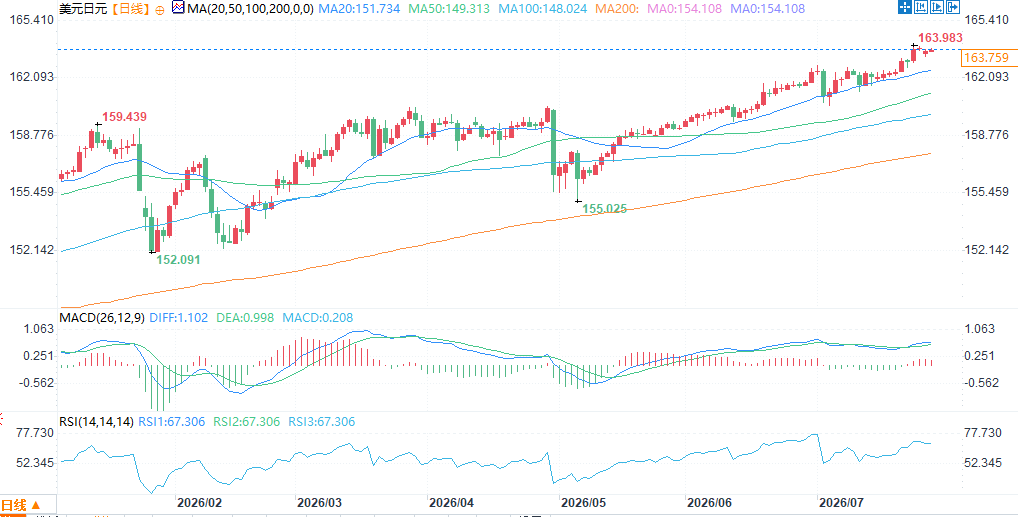 (USD/JPY daily chart, source: FX678) At 8:27 AM Beijing time on July 28, the USD/JPY exchange rate was 163.76/77.
Ammunition is plentiful, but what's truly scarce is "intervention quotas."
Japan holds approximately $1.3 trillion in foreign exchange reserves, the second largest in the world. Of this, about $1.1 trillion is in foreign securities (primarily US Treasury bonds). Rapidly liquidating these assets would disrupt the bond market and result in book losses. The real "operational funds" are foreign currency deposits held in accounts with the central bank and other central banks, amounting to approximately $150 billion to $180 billion, plus a standing swap line with the Federal Reserve, which could provide an additional $120 billion. Based on the typical size of a single operation, a strategist's calculations at the beginning of the year indicated that Japan still had room for about 32 interventions—no one seriously believed that Japan would run out of dollar reserves. The real constraint comes from the classification rules of the International Monetary Fund (IMF). The IMF classifies exchange rate regimes as "free-floating" on the premise that official intervention is limited to a few short-term events within a rolling window. Japan had already used up most of this quota in the spring. Analysts estimated in early May that Japan could conduct a maximum of two more interventions before November without losing its "free-floating" label. This is a monetary defense resource allocated by "classification" rather than "funds," a completely different constraint that is far from being replenished.The 164 mark is under emergency again.
In April and May, after the exchange rate broke through 160.00, Japan's Ministry of Finance deployed 11.73 trillion yen (approximately US$73 billion) in intervention—twice the largest intervention in Japanese history—and was carried out in the absence of any market catalysts. However, just six weeks later, the dollar recovered that level against the yen and is currently about 4 yen higher than at the time of the intervention. This fact demonstrates that a single intervention cannot reverse a structural depreciation trend driven by interest rate differentials.The marginal effectiveness of intervention is diminishing.
On Monday, the ceasefire between the US and Iran triggered a sharp drop in oil prices, representing the most significant single-day improvement in terms of trade for Japan, which relies almost entirely on energy imports. However, the yen's reaction was minimal—appreciating by less than 0.1 yen against the dollar. This signal reveals a structural problem: although the US-Japan interest rate differential has narrowed by about 40 basis points from its cyclical low, the yen has still depreciated by about 15%, with rising domestic inflation expectations filling the gap left by the narrowing interest rate differential. Verbal warnings have failed to stop the depreciation; the market has completely priced it in.Friday may be a key turning point
Tokyo's recent silence is likely strategic rather than fiscal. Market consensus holds that a single intervention has a short-lived effect, therefore the best time to act is when there is already buying pressure on the yen – and this week's calendar provides just such a window: Thursday (Fed decision): The market widely expects the Fed to keep interest rates unchanged at 3.75% for the fourth consecutive time, but a minority still prices in a rate hike – the 48 hours following the decision are the window with the highest intervention risk; Friday (Japanese data): Tokyo's core inflation for July is expected to rise to 1.7% from 1.6%, the unemployment rate to 2.5%, and retail sales to slow sharply to 3.1%; Friday (Bank of Japan decision + intervention data): The Bank of Japan is expected to keep interest rates unchanged at 1.00% and release its quarterly outlook report. Most observers expect the next rate hike in December, but reports indicate the committee is open to faster action due to increased price risks associated with the yen. On the same day, the Ministry of Finance will release July intervention data – the market will then know whether Tokyo has "preemptively acted."Japan still has the capacity to intervene, but the window of opportunity is narrowing.
Japan does not lack dollar reserves; its real shortage lies in the "intervention quota" under the IMF's classification rules. The record intervention in April and May only provided six weeks of respite, and Monday's nearly 9% plunge in oil prices while the yen remained virtually unaffected—these signals indicate that the marginal effectiveness of single interventions is diminishing, and the structural depreciation trend is difficult to reverse with a single action. This Friday may be a crucial juncture. The Bank of Japan's decision, quarterly outlook report, market volatility following the Fed's decision, and the concentrated release of intervention data from the Ministry of Finance may provide Tokyo with a natural "intervention window." If the yen weakens further after the Fed's decision and breaks through 164.00, Japanese authorities may have to use their remaining "intervention quota" to defend the exchange rate. However, even with another intervention, whether it can reverse the trend remains uncertain—the next market game will revolve around how long Tokyo's "classified quota" can sustain its position. (USD/JPY daily chart, source: FX678) At 8:27 AM Beijing time on July 28, the USD/JPY exchange rate was 163.76/77.
- Risk Warning and Disclaimer
- The market involves risk, and trading may not be suitable for all investors. This article is for reference only and does not constitute personal investment advice, nor does it take into account certain users’ specific investment objectives, financial situation, or other needs. Any investment decisions made based on this information are at your own risk.