Crude oil trading alert:
2026-07-28 09:31:05
International crude oil markets continued their downward trend on Tuesday, with WTI crude oil prices falling to around $81, down about 9% from Friday's closing price of nearly $89. Meanwhile, Brent crude oil fell below the $85 mark. This sharp market correction was mainly due to investors quickly digesting expectations of easing tensions in the Middle East and prematurely withdrawing from the risk premium previously incurred due to supply disruption risks.  The recent drop in oil prices primarily reflects a shift in market sentiment rather than a genuine recovery in supply. The US suspended its military operations after 13 consecutive nights, and there have been no further escalations for several days. The US President stated that negotiations still have a chance, but if progress is not made, stronger measures may be taken. The market therefore believes that short-term tensions may ease, pushing crude oil futures prices down rapidly. However, significant uncertainty remains regarding the development of the situation. Iran has stated that there are currently no direct negotiations with the US, and communication is only maintained through Oman regarding navigation in the Strait of Hormuz. While some intermediaries are pushing to restore the previously interrupted framework, the market is currently seeing more of a ceasefire intention than an informal agreement. The previous rise in oil prices was based on expectations of supply risks, and the current decline is similarly based on expectations of improved diplomacy; no actual supply changes have yet occurred. From the supply side, there are no clear signs of improvement in the crude oil market. The number of energy transport ships passing through the Strait of Hormuz daily over the weekend remained significantly lower than normal, and this passage typically handles about one-fifth of global maritime energy transport. If transport restrictions continue, the global crude oil supply chain may still face pressure. Furthermore, shipping risks near the Bab el-Mandeb Strait remain, forcing some oil-producing countries to take longer routes for exports, increasing transportation costs. Therefore, current crude oil price movements reflect more the financial market's pre-pricing of future supply changes than a genuine improvement in the supply-demand balance in the real market. WTI crude oil fell nearly 9% in a single day, but global crude oil transportation bottlenecks have not been completely resolved; the market is trading on "expectations of easing supply risks" rather than actual new supply. The refined product market also reflects that supply-side pressures have not fully eased. The average price of gasoline in the United States recently rose to about $4.11 per gallon, up about 11 cents from a week ago and about 38% higher than at the beginning of the conflict. This indicates that consumers are still bearing high energy costs, and the rapid decline in the crude oil futures market is more due to the repricing of risks at the financial trading level. In the coming week, macroeconomic factors will be another major focus for the crude oil market. The market awaits the results of the Federal Reserve's interest rate meeting, and it is currently widely expected that the federal funds rate will remain unchanged at around 3.75% for the fourth consecutive time. The decline in energy prices is considered a key factor in the recent easing of inflationary pressures. Therefore, subsequent statements from the Federal Reserve Chairman regarding changes in energy costs and economic growth risks could influence the dollar's trajectory and sentiment in the commodity market. Meanwhile, US economic data will provide new directional guidance. The market is focused on second-quarter economic growth data, the core personal consumption expenditure price index, and employment market indicators. If the US economy shows further signs of slowing, it could reinforce expectations of declining demand, putting pressure on oil prices. Conversely, if economic resilience is maintained, coupled with renewed supply risks, crude oil prices could still rebound rapidly. Currently, investors' focus has shifted from simple geopolitical risks to a "dual factor": whether the Middle East supply chain has truly recovered, and whether global economic demand can be sustained. Similar risk trades have occurred multiple times before, with oil price increases often forming quickly, but the pullback is even faster as market sentiment recovers. From a technical perspective, WTI crude oil remains highly volatile in the short term. The market is currently testing support near the $80 mark. If this area holds, oil prices may see a technical rebound; if it breaks below this key support, it could further test the important trend level established since spring. From a daily chart perspective, WTI crude oil previously surged due to geopolitical risks, briefly breaking through the $90 area. However, the recent sharp pullback has brought prices back to the key area of the upward trend. Currently, oil prices are still trading near the medium-term moving average, with the first resistance level around $84.50, corresponding to the rebound resistance level after this decline. Further resistance is seen at the $90 psychological level. If prices regain a foothold above $90, the market may re-induce supply risk premiums. On the downside, the first support level to watch is the $80 area, with a more significant support level around $78, which is close to the 200-day exponential moving average and a crucial defensive zone after recent corrections. Regarding market momentum, the daily stochastic oscillator remains in high territory, but this signal reflects more of a technical lag after the previous rise and does not necessarily indicate a trend reversal. Looking at the 4-hour chart, the short-term trend for WTI crude oil has clearly weakened, with prices quickly breaking below the previously formed upward channel. The market is currently digesting the risk premium accumulated over more than a week. If oil prices can hold above $80 in the short term and rebound with supported trading volume, they may test the $84.50 resistance area. If the rebound fails to break through this level, oil prices may continue their weak and volatile trend. Technically, short-term momentum indicators have clearly cooled, and the market needs new fundamental catalysts to confirm its direction. If geopolitical tensions worsen again, oil prices may quickly recover some of their losses; if expectations of supply recovery strengthen further, the $78 area may become the next important testing zone.
 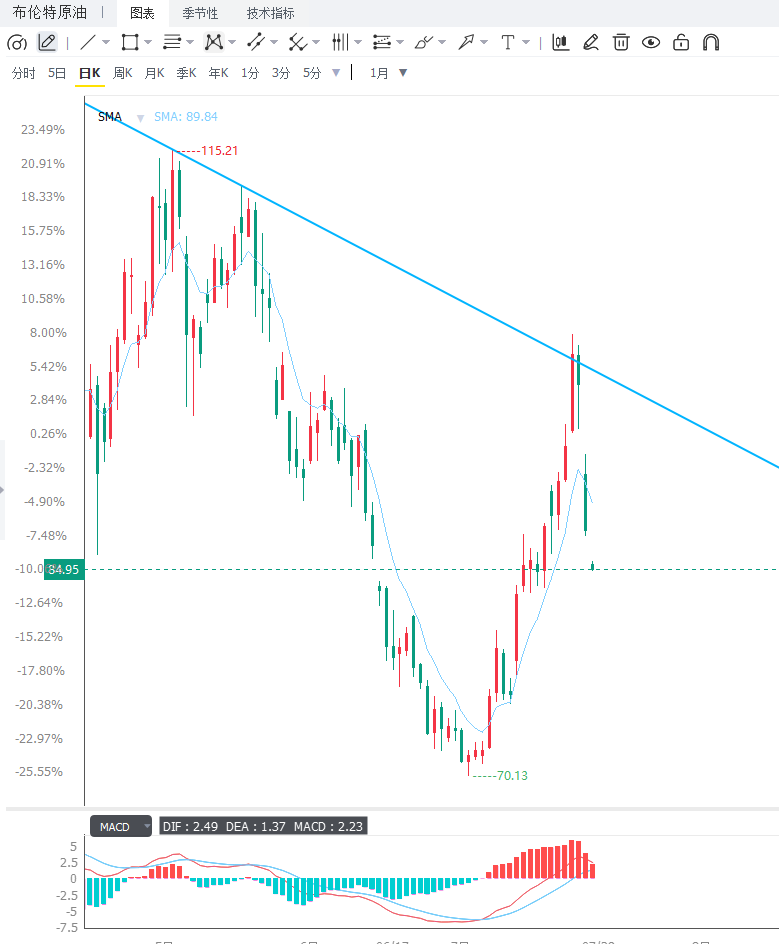 Editor's Summary: The recent sharp drop in WTI crude oil prices is essentially a result of the market rapidly withdrawing its risk premium. Improved ceasefire expectations have driven funds out of the market, but the incomplete recovery of the physical supply chain means that oil prices remain in a tug-of-war between fundamentals and market sentiment. In the short term, the $80 level will become a crucial battleground between bulls and bears. The market needs to pay attention to Middle East transportation conditions, Federal Reserve policy signals, and US economic data. If supply constraints persist, oil prices still have a basis for a rebound; however, if global economic demand slows while expectations of supply recovery strengthen, oil prices may face further downward pressure. The core variable in the future crude oil market will gradually shift from "conflict risk" to a rebalancing of "the speed of supply recovery and the intensity of demand growth."
The recent drop in oil prices primarily reflects a shift in market sentiment rather than a genuine recovery in supply. The US suspended its military operations after 13 consecutive nights, and there have been no further escalations for several days. The US President stated that negotiations still have a chance, but if progress is not made, stronger measures may be taken. The market therefore believes that short-term tensions may ease, pushing crude oil futures prices down rapidly. However, significant uncertainty remains regarding the development of the situation. Iran has stated that there are currently no direct negotiations with the US, and communication is only maintained through Oman regarding navigation in the Strait of Hormuz. While some intermediaries are pushing to restore the previously interrupted framework, the market is currently seeing more of a ceasefire intention than an informal agreement. The previous rise in oil prices was based on expectations of supply risks, and the current decline is similarly based on expectations of improved diplomacy; no actual supply changes have yet occurred. From the supply side, there are no clear signs of improvement in the crude oil market. The number of energy transport ships passing through the Strait of Hormuz daily over the weekend remained significantly lower than normal, and this passage typically handles about one-fifth of global maritime energy transport. If transport restrictions continue, the global crude oil supply chain may still face pressure. Furthermore, shipping risks near the Bab el-Mandeb Strait remain, forcing some oil-producing countries to take longer routes for exports, increasing transportation costs. Therefore, current crude oil price movements reflect more the financial market's pre-pricing of future supply changes than a genuine improvement in the supply-demand balance in the real market. WTI crude oil fell nearly 9% in a single day, but global crude oil transportation bottlenecks have not been completely resolved; the market is trading on "expectations of easing supply risks" rather than actual new supply. The refined product market also reflects that supply-side pressures have not fully eased. The average price of gasoline in the United States recently rose to about $4.11 per gallon, up about 11 cents from a week ago and about 38% higher than at the beginning of the conflict. This indicates that consumers are still bearing high energy costs, and the rapid decline in the crude oil futures market is more due to the repricing of risks at the financial trading level. In the coming week, macroeconomic factors will be another major focus for the crude oil market. The market awaits the results of the Federal Reserve's interest rate meeting, and it is currently widely expected that the federal funds rate will remain unchanged at around 3.75% for the fourth consecutive time. The decline in energy prices is considered a key factor in the recent easing of inflationary pressures. Therefore, subsequent statements from the Federal Reserve Chairman regarding changes in energy costs and economic growth risks could influence the dollar's trajectory and sentiment in the commodity market. Meanwhile, US economic data will provide new directional guidance. The market is focused on second-quarter economic growth data, the core personal consumption expenditure price index, and employment market indicators. If the US economy shows further signs of slowing, it could reinforce expectations of declining demand, putting pressure on oil prices. Conversely, if economic resilience is maintained, coupled with renewed supply risks, crude oil prices could still rebound rapidly. Currently, investors' focus has shifted from simple geopolitical risks to a "dual factor": whether the Middle East supply chain has truly recovered, and whether global economic demand can be sustained. Similar risk trades have occurred multiple times before, with oil price increases often forming quickly, but the pullback is even faster as market sentiment recovers. From a technical perspective, WTI crude oil remains highly volatile in the short term. The market is currently testing support near the $80 mark. If this area holds, oil prices may see a technical rebound; if it breaks below this key support, it could further test the important trend level established since spring. From a daily chart perspective, WTI crude oil previously surged due to geopolitical risks, briefly breaking through the $90 area. However, the recent sharp pullback has brought prices back to the key area of the upward trend. Currently, oil prices are still trading near the medium-term moving average, with the first resistance level around $84.50, corresponding to the rebound resistance level after this decline. Further resistance is seen at the $90 psychological level. If prices regain a foothold above $90, the market may re-induce supply risk premiums. On the downside, the first support level to watch is the $80 area, with a more significant support level around $78, which is close to the 200-day exponential moving average and a crucial defensive zone after recent corrections. Regarding market momentum, the daily stochastic oscillator remains in high territory, but this signal reflects more of a technical lag after the previous rise and does not necessarily indicate a trend reversal. Looking at the 4-hour chart, the short-term trend for WTI crude oil has clearly weakened, with prices quickly breaking below the previously formed upward channel. The market is currently digesting the risk premium accumulated over more than a week. If oil prices can hold above $80 in the short term and rebound with supported trading volume, they may test the $84.50 resistance area. If the rebound fails to break through this level, oil prices may continue their weak and volatile trend. Technically, short-term momentum indicators have clearly cooled, and the market needs new fundamental catalysts to confirm its direction. If geopolitical tensions worsen again, oil prices may quickly recover some of their losses; if expectations of supply recovery strengthen further, the $78 area may become the next important testing zone. Editor's Summary: The recent sharp drop in WTI crude oil prices is essentially a result of the market rapidly withdrawing its risk premium. Improved ceasefire expectations have driven funds out of the market, but the incomplete recovery of the physical supply chain means that oil prices remain in a tug-of-war between fundamentals and market sentiment. In the short term, the $80 level will become a crucial battleground between bulls and bears. The market needs to pay attention to Middle East transportation conditions, Federal Reserve policy signals, and US economic data. If supply constraints persist, oil prices still have a basis for a rebound; however, if global economic demand slows while expectations of supply recovery strengthen, oil prices may face further downward pressure. The core variable in the future crude oil market will gradually shift from "conflict risk" to a rebalancing of "the speed of supply recovery and the intensity of demand growth."
- Risk Warning and Disclaimer
- The market involves risk, and trading may not be suitable for all investors. This article is for reference only and does not constitute personal investment advice, nor does it take into account certain users’ specific investment objectives, financial situation, or other needs. Any investment decisions made based on this information are at your own risk.