The US-Iran ceasefire gave the euro a boost, but the near 80% probability of a Fed rate hike in September remains a major obstacle.
2026-07-28 12:08:04
On Tuesday (July 28) during Asian trading hours, the euro consolidated near its monthly lows against the dollar, currently trading around 1.1375. Markets remained cautious ahead of Thursday's FOMC decision, with traders reluctant to establish aggressive positions before policy clarity emerges. The overnight plunge in oil prices driven by the US-Iran ceasefire eased inflation concerns and weakened expectations of a Fed rate hike, limiting the dollar's upside and providing a breather for the euro. However, concerns about global oil supply disruptions have not completely dissipated, inflation risks remain, and the fundamental backdrop still favors a stronger dollar. 
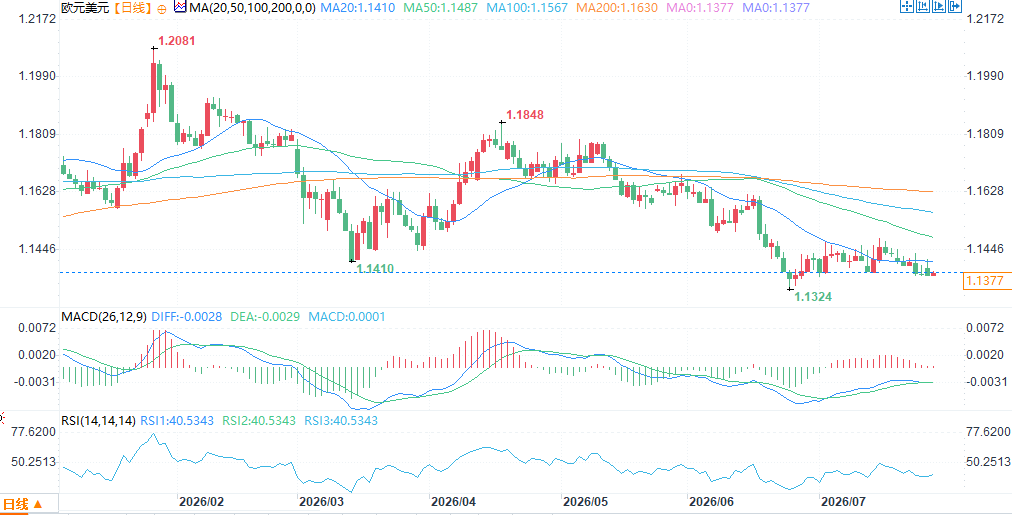 (Euro/USD daily chart, source: FX678) At 12:06 Beijing time on July 28, the euro was trading at 1.13761/72 against the US dollar.
The US-Iran ceasefire triggered a sharp drop in oil prices, easing inflation concerns but not dissipating.
A suspension of military hostilities between the US and Iran over the weekend, and Washington's three-day hiatus from airstrikes, pushed crude oil prices to a one-week low overnight. The drop in oil prices eased short-term inflation concerns and reduced the urgency for further interest rate hikes by the Federal Reserve, causing the dollar to retreat slightly from near monthly highs and providing support for the euro. However, market concerns about disruptions to global oil supply have not completely dissipated. Shipping restrictions in the Strait of Hormuz and the Red Sea remain in place, Houthi rebels continue to threaten Saudi oil facilities, and the sustainability of US-Iran diplomatic negotiations is questionable. This means that inflation risks persist, providing potential support for dollar bulls and limiting the euro's upside potential. This fundamental backdrop implies that any attempt to ralli in the euro is likely to be seen as a selling opportunity rather than a signal of a trend reversal.Markets remain cautious ahead of the FOMC decision; policy signals are a key variable.
The market's focus is firmly on Thursday's FOMC decision. While the market widely expects the Fed to keep interest rates unchanged, the policy statement and Chairman Warsh's press conference are the real highlights – the market will meticulously analyze the wording to determine the policy path in September and beyond. Currently, the market prices a July rate hike at approximately 34%-38%, and a September rate hike at a high 81%. This pricing structure of "fuzzy near-term and clear long-term" means that if the Fed releases hawkish signals in its statement (such as hinting at a September rate hike), the dollar may strengthen further, and the euro may fall below the 1.1300 level; if the statement is dovish, the dollar may pull back, and the euro may get a breather to rebound above 1.1400. Until the Fed's policy signals become clearer, traders are remaining cautious with directional bets on the euro, which is more likely to fluctuate within its current range.Three keys to the future of the euro
The recent movement of the euro against the US dollar will heavily depend on three key variables. If the Federal Reserve's FOMC decision is more hawkish than expected, the dollar's interest rate advantage will be further strengthened, and the euro may come under pressure, breaking below the key support level of 1.1350 and accelerating its decline. Simultaneously, if the US-Iran diplomatic negotiations break down, geopolitical risks will escalate rapidly, and safe-haven funds will flow back into the dollar, further consolidating its strength and putting additional pressure on the euro. However, if international oil prices continue to fall, it will effectively alleviate global inflation concerns and reduce market expectations for further tightening by the Fed, thereby weakening dollar support and providing potential room for a euro rebound. In summary, the euro remains in an environment of intertwined policy and geopolitical uncertainties in the short term, with the aforementioned three factors interacting. Investors need to closely monitor the FOMC's wording, the progress of US-Iran negotiations, and oil price fluctuations, and flexibly respond to potential breakouts.Institutional Views
A recent report released by Bank of America's foreign exchange team on July 27th predicts that the euro will weaken further against the dollar to around 1.12 in the third quarter of 2026, before rebounding to 1.15 by the end of the year and gradually strengthening to around 1.20 in 2027. The bank believes that the yield advantage of US Treasury bonds and continued energy price pressures will continue to support the dollar, while the euro faces dual pressure from interest rate and geopolitical risks. Although the dollar's long-term cycle advantage is expected to weaken, the market's underestimation of policy and geopolitical uncertainties in the short term makes the dollar more attractive. Goldman Sachs believes the euro remains "trapped in the shadow of the dollar." Unfavorable interest rate dynamics and renewed energy market pressures make it difficult for the euro to rebound effectively. Investors continue to favor high-yielding currencies, while geopolitical tensions are pushing up energy prices, worsening the eurozone's terms of trade and limiting the euro's upside potential. Even though the European Central Bank has largely completed its tightening cycle, the euro is unlikely to gain sufficient support. The bank believes that the dollar's yield advantage and energy factors will continue to dominate the market in the short term, and the euro needs a clearer policy shift to emerge from its weakness.The euro is awaiting FOMC guidance above 1.1350.
The euro held steady near its monthly lows against the dollar, with the US-Iran ceasefire and falling oil prices providing some breathing room, while the dollar's rally paused ahead of the FOMC decision. However, the euro's upside is limited by several factors: the market has priced in an 81% rate hike in September, meaning the dollar's interest rate support has not disappeared; concerns about global oil supply disruptions persist, and inflation risks continue to support the dollar; the Eurozone's own economic growth prospects remain constrained by high interest rates and geopolitical risks. In the short term, the euro's movement around the 1.1350 level will depend on the wording of the FOMC statement and marginal changes in the Middle East situation. Before these two variables become clear, the euro is more likely to consolidate within the 1.1320-1.1450 range. For traders, Thursday's FOMC decision is the real highlight of the week—before that, any directional bets could face two-way risks. If the Fed's stance is more hawkish than expected, the euro could fall below 1.1320 and accelerate its decline; if it is less hawkish than expected, the euro could rebound above 1.1400. Regardless of the scenario, the medium-term direction of the euro still depends on the relative strength of the policy paths of the Federal Reserve and the European Central Bank. (Euro/USD daily chart, source: FX678) At 12:06 Beijing time on July 28, the euro was trading at 1.13761/72 against the US dollar.
- Risk Warning and Disclaimer
- The market involves risk, and trading may not be suitable for all investors. This article is for reference only and does not constitute personal investment advice, nor does it take into account certain users’ specific investment objectives, financial situation, or other needs. Any investment decisions made based on this information are at your own risk.