Gold Trading Alert: Gold Prices Plunge to One-Week Low Ahead of Fed Decision! Is a Strong Dollar and Middle East Tensions Breaching the Bulls' Defenses?
2026-07-29 07:44:03
At a crucial moment before the Federal Reserve's interest rate decision, international gold prices fell to a one-week low on Tuesday (July 29). Spot gold briefly dipped to $4,011.54 per ounce before closing at $4,028.42, a daily drop of 1.2%. Meanwhile, the US dollar index remained near a one-month high, oil prices fluctuated wildly due to conflicting signals of US-Iran dialogue and renewed tensions, and while bond yields declined slightly, they failed to change the overall high-level trend. The gold market is at a crossroads of intense competition among multiple forces: on one hand, the heavy pressure from a strong dollar and expectations of interest rate hikes; on the other hand, the support from geopolitical uncertainty and lingering demand for long-term inflation hedging. This tug-of-war over gold prices is far from over. In early Asian trading on Wednesday (July 29), spot gold traded in a narrow range at low levels, currently trading at $4,017.38 per ounce. 
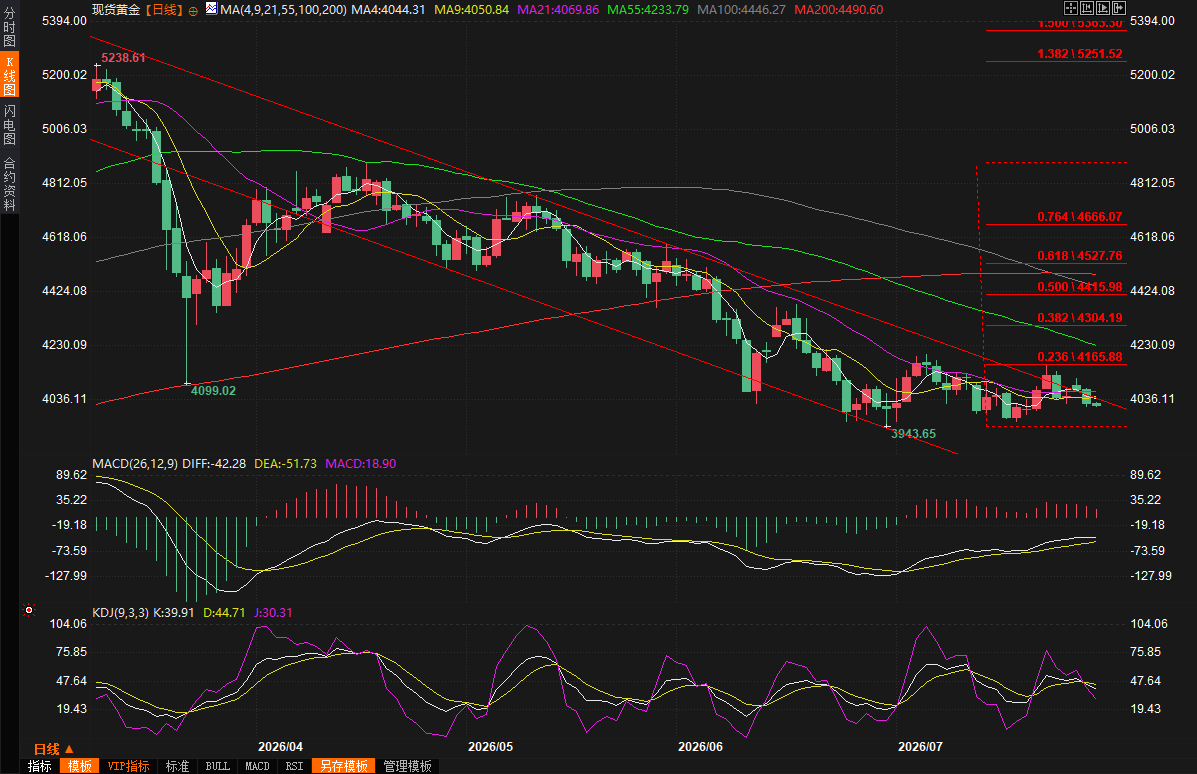 (Spot gold daily chart, source: EasyTrade) At 07:39 Beijing time, spot gold is currently trading at $4018.85 per ounce.
A strong dollar and hawkish expectations combined to exert downward pressure on gold in the short term.
The decline in the gold market on Tuesday was primarily driven by the continued strength of the US dollar. The dollar index fell slightly by 0.12% to 101.41, but remains close to its late June high of 101.80, making dollar-denominated gold increasingly expensive for non-US buyers. Market participants generally attribute this phenomenon to a significant reassessment of the Federal Reserve's policy path in recent months. Since the escalation of US-Israeli military action against Iran, sharp fluctuations in energy prices have fueled inflation concerns, and the hawkish statements made by new Fed Chairman Warsh have further reinforced expectations that interest rates will remain high for an extended period. David Meger, director of precious metals trading at High Ridge Futures, stated bluntly that persistently high energy prices remain a concern for Fed members regarding inflation, and the market's anticipated hawkish stance has directly increased expectations of interest rate hikes and the dollar exchange rate, thus putting significant pressure on gold. The logic behind the suppressive effect of the interest rate environment on gold is clearly evident. As a non-interest-bearing asset, gold often loses its appeal during periods of rising real interest rates. Traders are currently pricing in a roughly 71% probability that the Federal Reserve will keep interest rates unchanged on Wednesday, but the probability of a rate hike in September has climbed to around 75%, with some market observers even suggesting a near 30% chance of a 25 basis point rate hike this week. Commerzbank has significantly lowered its year-end gold price target by $300 to $4,500 per ounce, warning that if interest rate expectations fail to reverse, gold ETF investors will struggle to return sustainably, and gold prices will find it difficult to see a substantial rebound. Since the outbreak of the conflict at the end of February, gold prices have fallen by approximately 24%, fully reflecting the market's pricing in a scenario of "higher interest rates for a longer period." Bond market dynamics also corroborate this assessment. Although falling oil prices pushed the 10-year and 30-year Treasury yields down slightly for the third consecutive trading day, with the 10-year yield touching a one-week low of around 4.588%, it remains in multi-month highs. While the two-year yield has declined, it is poised to rise for the fifth consecutive month. Regarding inflation expectations, the breakeven inflation rates for 5-year and 10-year TIPS were approximately 2.17% and 2.20%, respectively, indicating that the market's anchoring of medium- to long-term inflation remains relatively mild. However, the shadow of short-term energy disturbances has not completely dissipated. All of these factors together constitute the macroeconomic backdrop for short-term downward pressure on gold prices.The fluctuating situation in the Middle East and the rollercoaster ride of oil prices have left gold's geopolitical premium in a dilemma.
If the US dollar and interest rates are the visible forces suppressing gold, then the fluctuating geopolitics in the Middle East is a potential variable that the gold market cannot ignore. US President Trump stated that Washington and Iran are having "good talks" and are expected to reach a solution, but warned that if negotiations fail, the US will resume military strikes, targeting hardened underground facilities near Tehran. Iran, on the other hand, denied seeking to resume negotiations and warned that any country or company accepting "compensation" from the US using frozen Iranian assets would have its ships banned from passing through the Strait of Hormuz. Oman's proposal for joint management of the Strait of Hormuz and collection of voluntary passage fees, while supported by some Gulf states, failed to quickly resolve the deadlock. The sharp fluctuations in oil prices directly reflect this game. After Trump called a halt to airstrikes and signaled a willingness to engage in dialogue, Brent crude and US crude futures fell sharply, with a cumulative drop of nearly 20% in the past three trading days. Brent crude futures for September delivery fell more than 3% on Tuesday to near a two-week low. The decline in oil prices eased some inflation concerns and also provided room for a slight decline in bond yields. However, the fragility of the situation quickly became apparent: Iran's launch of a ballistic missile at a US military base in Jordan marked the breakdown of the brief informal ceasefire, causing a surge in the oil market on Wednesday. US crude oil prices rose by more than $3, a gain of nearly 5%, recovering all of Tuesday's losses. This pattern of alternating dialogue and conflict leaves gold's geopolitical premium in a constant dilemma—escalation of conflict could instantly ignite safe-haven buying, while any substantial signs of de-escalation would quickly weaken this support. More often than not, escalation exacerbates inflationary pressures and boosts expectations of a Fed rate hike, attracting safe-haven buying to the dollar and thus suppressing gold prices. When the situation eases, gold prices actually have a short-term rebound opportunity. In the longer term, the shipping crisis in the Strait of Hormuz remains a Damocles' sword hanging over the global energy and commodity markets. Before the war, the strait carried about one-fifth of the world's oil and liquefied natural gas transport; the situation after Iran took control, allowing only its own ships to pass, has already had a profound impact on the supply chain. The Oman proposal attempts to find a solution through voluntary contributions and joint management, similar to the existing mechanism in the Strait of Malacca. However, significant differences remain between the US and Iran regarding the legality of the fees and control. Gold, as a traditional safe-haven asset, should have been supported in this highly uncertain geopolitical environment, but its performance was weak due to pressure from interest rates and the US dollar, reflecting the current market's strong acceptance of the "real interest rate-driven" logic.The Fed's decision serves as a short-term indicator, but the medium- to long-term narrative for gold remains uncertain.
Investors are currently focused on the Federal Reserve's two-day policy meeting, which concludes on Wednesday, and Chairman Warsh's subsequent speech. Regardless of the outcome, the dollar appears to be in a relatively favorable position: a direct rate hike would provide a clear boost, while a hawkish stance would merely postpone rate hike expectations to September. However, some analysts caution that speculative positions bullish on the dollar are already high, and any dovish signals could trigger large-scale liquidation. The US June Personal Consumption Expenditures (PCE) data, scheduled for release on Thursday, will further provide clues about the path of monetary policy. For gold, short-term movements are highly dependent on signals from the Federal Reserve. If the decision and speech reinforce expectations of "higher and longer" interest rates, gold prices may further test support; conversely, any dovish statements or downplaying of the energy shock could present a technical rebound opportunity for gold. In the medium to long term, the narrative surrounding gold has not been completely negated. Despite recent significant declines, its attributes as a long-term inflation hedge and a geopolitical safe-haven asset remain. If the situation in the Middle East eases substantially, oil prices continue to fall, and inflation expectations decline, upward pressure on real interest rates is expected to ease, and a genuine inflow of funds into gold ETFs may begin. Conversely, if conflict reignites and energy prices surge again, gold's safe-haven appeal will be repriced by the market. In summary, the current drop in gold prices to a one-week low is a temporary result of the interplay between a strong dollar, interest rate hike expectations, and geopolitical premiums, rather than the end of a trend. The Fed's decision will be a key turning point for short-term sentiment, while the progress of Middle East negotiations and the ultimate direction of oil prices will determine whether the medium-term narrative for gold can shift back to positive. In the current climate of high uncertainty, market participants need to closely monitor both interest rate paths and geopolitical trends; unexpected changes on either side could quickly rewrite the trajectory of gold. (Spot gold daily chart, source: EasyTrade) At 07:39 Beijing time, spot gold is currently trading at $4018.85 per ounce.
- Risk Warning and Disclaimer
- The market involves risk, and trading may not be suitable for all investors. This article is for reference only and does not constitute personal investment advice, nor does it take into account certain users’ specific investment objectives, financial situation, or other needs. Any investment decisions made based on this information are at your own risk.