US crude oil prices rose by about 5% at one point, as the Iranian attack triggered geopolitical risks, and OPEC+ may suspend production increases starting in October.
2026-07-29 08:30:04
On Wednesday (July 29) in early Asian trading, US crude oil futures rose by about 5% to $83.30 per barrel before falling back, currently trading around $81.70 per barrel. The US Central Command stated on the 28th that at 5:45 PM Eastern Time, the Iranian Islamic Revolutionary Guard Corps launched multiple ballistic missiles from within Iran, "attempting a surprise attack on US forces stationed in the Middle East." Amidst this sudden escalation of geopolitical risks, another variable on the supply side is also brewing—OPEC+ is considering suspending production increases starting in October, providing additional support for oil prices. Sources revealed that after OPEC+ completes its planned release of voluntarily reduced crude oil back into the market, it is likely to suspend production increases for three months starting in October. The oil-producing alliance is also facing difficult negotiations regarding new production quotas, thus requiring more time to discuss future supply arrangements. Suspending production increases means that the approximately 2 million barrels per day production cuts within OPEC+ will remain in place after September, until the organization decides how to allocate the additional supply among its member countries. 
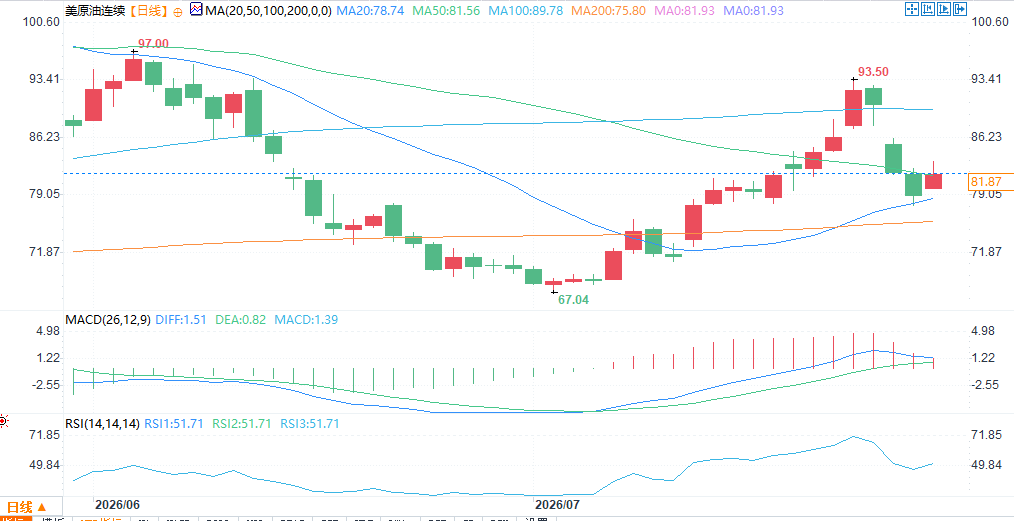 (US crude oil futures daily chart, source: FX678) At 8:22 AM Beijing time on July 29, US crude oil futures were trading at $81.80 per barrel.
A Look Ahead to the Core Meeting on August 2
Seven core OPEC members—Saudi Arabia, Russia, Iraq, Kuwait, Algeria, Kazakhstan, and Oman—will meet on August 2 and are likely to raise their September production target by approximately 188,000 barrels per day, consistent with increases in June, July, and August. This increase would complete the phased withdrawal of the 1.65 million barrels per day production cut initially agreed upon in 2023 (when the UAE was still in the organization; it withdrew in May of this year). A source familiar with the matter stated, “There will be no further adjustments for the remainder of the year; current production levels will be maintained until the new quotas take effect in January 2027.” All sources requested anonymity and indicated that no final decision has been made. OPEC and Russian authorities did not immediately respond to requests for comment.The production cut of 2 million barrels per day will be extended to the end of 2026.
Following the September production increase, OPEC+ will suspend further adjustments. This decision firstly means that the organization needs more time to assess the actual production capacity of member countries and future quota allocations—some member countries are pushing for increased quotas to reflect higher production capacity, while supply disruptions caused by the Iran war have significantly reduced the actual available spare capacity, making the quota dispute increasingly complex. Secondly, the approximately 2 million barrels per day production cut implemented since 2022, applicable to most member countries, will continue until the end of 2026. OPEC+'s production policy is shifting from a "monthly fine-tuning" to a "quarterly observation" model, reflecting the high degree of uncertainty in the current market environment—the trajectory of geopolitical conflicts, changes in demand expectations, and the recovery of shipping in the Strait of Hormuz will all be key variables in the organization's decision on its next steps.Quota Dispute
Production policy in 2027 will depend on several factors. Sources say OPEC+ is assessing member countries' oil production capacity to determine baseline production levels for 2027—quotas are set based on this. The organization needs to wait for the assessment results before deciding on its next steps. Some member countries (including Iraq) are pushing to increase their respective quotas to reflect their higher production capacity. Meanwhile, the outlook for the oil market in 2027 is equally crucial—the International Energy Agency predicts a significant oversupply, but this depends on whether oil traffic through the Strait of Hormuz can recover. UBS analysts noted, "Regarding future production levels, many things depend on how the Middle East conflict evolves. Furthermore, the organization is determining maximum sustainable production levels for all member countries, which will likely form the basis for further adjustments to production in the future."OPEC+ enters a "wait-and-see" period; geopolitical and production capacity variables will determine the direction in 2027.
OPEC+ is at a critical juncture in its policy adjustment. Following its final production increase in September, the organization is highly likely to pause production increases for three months starting in October, extending the 2 million barrels per day production cut to the end of 2026. This decision buys time for quota negotiations and capacity assessments, but it also exposes internal divisions – some member countries are demanding higher quotas to reflect higher production capacity. Production policy in 2027 will depend on three major variables: the final outcome of the capacity assessment, the trajectory of the Middle East conflict, and the recovery of shipping through the Strait of Hormuz. For the crude oil market, OPEC+'s "pause" signal means that there will be no large-scale increase in supply in the short term, but the quota dispute in 2027 may become the next key variable affecting oil prices. (US crude oil futures daily chart, source: FX678) At 8:22 AM Beijing time on July 29, US crude oil futures were trading at $81.80 per barrel.
- Risk Warning and Disclaimer
- The market involves risk, and trading may not be suitable for all investors. This article is for reference only and does not constitute personal investment advice, nor does it take into account certain users’ specific investment objectives, financial situation, or other needs. Any investment decisions made based on this information are at your own risk.