Silver continues to fluctuate at low levels; is a short-term rebound possible?
2026-07-29 13:52:49
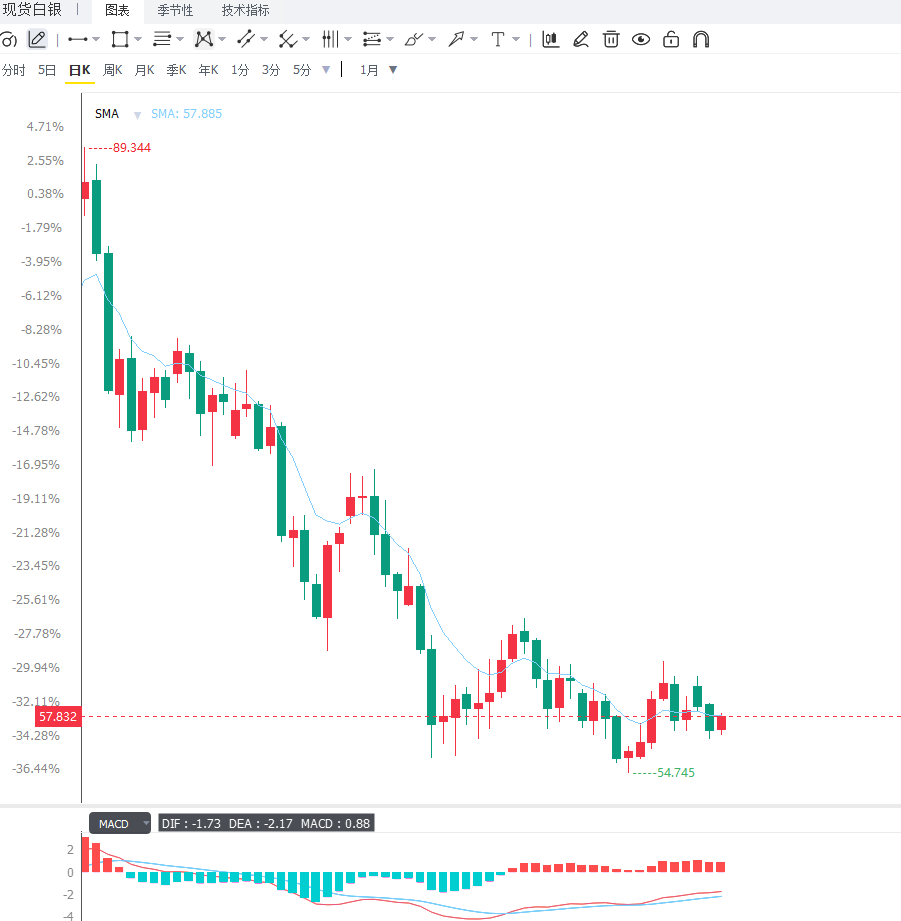
Spot silver (XAG/USD) performed strongly in Asian trading on Wednesday, rising approximately 1.14% to around $57.80. The rise in silver was mainly driven by increased global risk aversion. Recent tensions in the Middle East have led investors to refocus on energy supply risks and financial market volatility, providing some support for the precious metals market.  Meanwhile, the sharp rebound in the crude oil market also became a significant factor influencing silver's price movement. WTI crude oil prices rose approximately 3.65% that day, reaching around $81.20, ending a three-day losing streak. Rising energy prices increased market concerns about rising inflationary pressures and heightened investor focus on changes in global economic policy. The recent escalation of tensions in the Middle East has become a market focus. The US Central Command stated that all ballistic missiles launched by the Iranian Islamic Revolutionary Guard Corps were successfully intercepted. Subsequently, the US military launched precision strikes against related armed targets in Iraq, raising market concerns that regional tensions could escalate further. From a market perspective, geopolitical risks typically enhance silver's safe-haven appeal. However, unlike gold, silver has stronger industrial attributes, and its price is also influenced by economic growth expectations. While the current rise in oil prices increases safe-haven demand, it may also reinforce inflationary expectations, prompting major central banks globally to maintain higher interest rates. A high-interest-rate environment is generally unfavorable for non-interest-bearing assets, and precious metals, including silver, may face funding cost pressures . One of the key reasons for silver's relatively weaker performance compared to gold in recent months is that inflationary concerns stemming from rising energy prices have limited market expectations for monetary policy easing. Investors are currently awaiting the outcome of the Federal Reserve's monetary policy meeting. The market widely expects the Fed to maintain the current interest rate range and continue to monitor changes in inflation and economic data. Market surveys indicate that traders expect a 69.5% probability that the Fed will keep interest rates in the 3.50%-3.75% range. The market is also focused on Fed Chairman Warsh's statements regarding the future policy path. Previously, the Fed stated that traditional forward guidance has limited effectiveness in the current policy environment, therefore investors expect this meeting may not provide a clear commitment to future policy. The future trend of silver will still depend on three factors: the Fed's policy direction, the dollar's performance, and changes in global geopolitical risks. If Middle East risks continue to escalate while the dollar weakens, silver may gain further upward momentum; however, if high interest rate expectations strengthen, silver may still be suppressed. Looking at the daily chart for spot silver, XAG/USD is currently maintaining a rebound, with the price near $57.80, but the overall short-term structure remains cautious. The current price is still below the 20-day exponential moving average, which is around $58.90, indicating that the market rebound still faces short-term pressure. Resistance levels to watch are $58.90, $60.00, and $61.50. A break above $60 could improve the short-term consolidation structure. Support levels are $56.00, $54.77, and $53.50, with $54.77 being a key support level in the near term. Daily momentum indicates that bulls are attempting a recovery, but a trend reversal still needs further confirmation. The 4-hour chart for silver shows a stronger short-term rebound, but it remains in a consolidation phase. The RSI is currently around 43, below the neutral level of 50, indicating that bearish pressure has not completely subsided, but it has not entered a clearly oversold zone. The MACD indicator shows that short-term downward momentum has eased. If the price breaks through the resistance near $58.90, it may further test the $60 level; if the rebound fails and falls below $56, it may fall back to around $54.77 to find support. Short-term price movements will depend heavily on the Fed's decision, changes in the US dollar index, and fluctuations in the oil market.
  Editor's Summary: Silver's recent price movements have been influenced by both safe-haven demand and interest rate pressures. Escalating tensions in the Middle East have driven capital inflows into the precious metals market, providing short-term upward momentum for silver. However, inflationary pressures from rising oil prices may limit the scope for monetary policy adjustments, leaving silver still facing the challenge of a high-interest-rate environment. The future direction of silver prices will depend on the Federal Reserve's policy signals, the dollar's performance, and the development of global risk events. If the Fed releases dovish signals while the dollar weakens, silver is expected to continue its rebound and challenge key resistance levels. However, if inflationary pressures drive the market to maintain high interest rate expectations, silver's upside potential may be limited. Overall, silver is exhibiting a short-term oscillating rebound pattern. The area around $57.80 is currently a battleground between bulls and bears, and a break above $58.90 will be a crucial signal for determining the subsequent trend.
Meanwhile, the sharp rebound in the crude oil market also became a significant factor influencing silver's price movement. WTI crude oil prices rose approximately 3.65% that day, reaching around $81.20, ending a three-day losing streak. Rising energy prices increased market concerns about rising inflationary pressures and heightened investor focus on changes in global economic policy. The recent escalation of tensions in the Middle East has become a market focus. The US Central Command stated that all ballistic missiles launched by the Iranian Islamic Revolutionary Guard Corps were successfully intercepted. Subsequently, the US military launched precision strikes against related armed targets in Iraq, raising market concerns that regional tensions could escalate further. From a market perspective, geopolitical risks typically enhance silver's safe-haven appeal. However, unlike gold, silver has stronger industrial attributes, and its price is also influenced by economic growth expectations. While the current rise in oil prices increases safe-haven demand, it may also reinforce inflationary expectations, prompting major central banks globally to maintain higher interest rates. A high-interest-rate environment is generally unfavorable for non-interest-bearing assets, and precious metals, including silver, may face funding cost pressures . One of the key reasons for silver's relatively weaker performance compared to gold in recent months is that inflationary concerns stemming from rising energy prices have limited market expectations for monetary policy easing. Investors are currently awaiting the outcome of the Federal Reserve's monetary policy meeting. The market widely expects the Fed to maintain the current interest rate range and continue to monitor changes in inflation and economic data. Market surveys indicate that traders expect a 69.5% probability that the Fed will keep interest rates in the 3.50%-3.75% range. The market is also focused on Fed Chairman Warsh's statements regarding the future policy path. Previously, the Fed stated that traditional forward guidance has limited effectiveness in the current policy environment, therefore investors expect this meeting may not provide a clear commitment to future policy. The future trend of silver will still depend on three factors: the Fed's policy direction, the dollar's performance, and changes in global geopolitical risks. If Middle East risks continue to escalate while the dollar weakens, silver may gain further upward momentum; however, if high interest rate expectations strengthen, silver may still be suppressed. Looking at the daily chart for spot silver, XAG/USD is currently maintaining a rebound, with the price near $57.80, but the overall short-term structure remains cautious. The current price is still below the 20-day exponential moving average, which is around $58.90, indicating that the market rebound still faces short-term pressure. Resistance levels to watch are $58.90, $60.00, and $61.50. A break above $60 could improve the short-term consolidation structure. Support levels are $56.00, $54.77, and $53.50, with $54.77 being a key support level in the near term. Daily momentum indicates that bulls are attempting a recovery, but a trend reversal still needs further confirmation. The 4-hour chart for silver shows a stronger short-term rebound, but it remains in a consolidation phase. The RSI is currently around 43, below the neutral level of 50, indicating that bearish pressure has not completely subsided, but it has not entered a clearly oversold zone. The MACD indicator shows that short-term downward momentum has eased. If the price breaks through the resistance near $58.90, it may further test the $60 level; if the rebound fails and falls below $56, it may fall back to around $54.77 to find support. Short-term price movements will depend heavily on the Fed's decision, changes in the US dollar index, and fluctuations in the oil market. Editor's Summary: Silver's recent price movements have been influenced by both safe-haven demand and interest rate pressures. Escalating tensions in the Middle East have driven capital inflows into the precious metals market, providing short-term upward momentum for silver. However, inflationary pressures from rising oil prices may limit the scope for monetary policy adjustments, leaving silver still facing the challenge of a high-interest-rate environment. The future direction of silver prices will depend on the Federal Reserve's policy signals, the dollar's performance, and the development of global risk events. If the Fed releases dovish signals while the dollar weakens, silver is expected to continue its rebound and challenge key resistance levels. However, if inflationary pressures drive the market to maintain high interest rate expectations, silver's upside potential may be limited. Overall, silver is exhibiting a short-term oscillating rebound pattern. The area around $57.80 is currently a battleground between bulls and bears, and a break above $58.90 will be a crucial signal for determining the subsequent trend.
- Risk Warning and Disclaimer
- The market involves risk, and trading may not be suitable for all investors. This article is for reference only and does not constitute personal investment advice, nor does it take into account certain users’ specific investment objectives, financial situation, or other needs. Any investment decisions made based on this information are at your own risk.