Oil prices are fluctuating wildly amid geopolitical news; where will WTI crude oil go next?
2026-07-29 15:34:50
On Wednesday (July 29) during the European session, WTI crude oil rose more than 3%, currently trading around $82 per barrel. UOB strategists pointed out that crude oil prices have exhibited a pattern of initial decline followed by a rise amidst the dramatic swings in the US-Iran conflict. Previously, the suspension of US military action against Iran pushed oil prices sharply lower—WTI crude oil fell to $79.13 per barrel. However, with the outbreak of new conflict and news of the US military successfully intercepting an Iranian "surprise attack attempt," WTI crude oil subsequently rebounded sharply. Geopolitically driven volatility is rising significantly. 
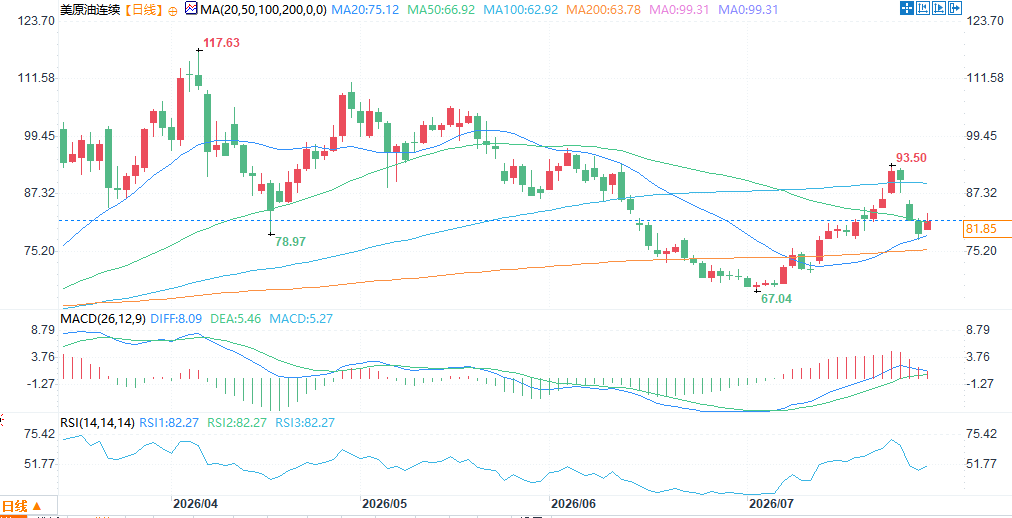 (WTI crude oil futures daily chart, source: FX678) At 15:24 Beijing time on July 29, WTI crude oil futures were trading at $82.20 per barrel.
The expectation of a ceasefire caused oil prices to fall briefly.
Previously, signs of de-escalation in the Iranian conflict led to a continued decline in oil prices—a welcome development for the market. On Tuesday, WTI crude oil fell more than 3% to $79.13 per barrel, its lowest level since July 16. Rising market expectations for a short-term solution to the conflict drove a faster retracement of geopolitical risk premiums. Against this backdrop, market attention turned to the July FOMC meeting.Renewed geopolitical risks drove oil prices sharply higher.
However, the pullback in oil prices proved short-lived. On Tuesday, a new conflict erupted – the US Central Command reported that it had successfully thwarted an attempted raid by the Iranian Islamic Revolutionary Guard Corps against US forces in the Middle East. Following this news, WTI crude oil rebounded sharply, rising as much as 5% to above $83 per barrel. This event highlights the current oil market's high sensitivity to geopolitical news – any new signal of conflict can trigger significant two-way price fluctuations.The rebound in oil prices has strengthened expectations of a Fed rate hike.
The rebound in oil prices is influencing macroeconomic policy expectations. UOB points out that the rise in crude oil prices has pushed the market's pricing in a 25 basis point rate hike at the July FOMC meeting to 35.8%. Geopolitical risk-driven oil price increases have reignited inflation concerns, reinforcing the Federal Reserve's case for maintaining a tightening stance. This transmission chain means that oil price movements not only affect the energy market itself but will also indirectly impact the US dollar and broader financial markets through inflation expectations and the Fed's policy path.The crude oil market has entered a "news-driven" high-volatility mode.
UOB's analysis reveals the core characteristic of the current crude oil market: geopolitical news is dominating the short-term direction of oil prices. The geopolitical premium previously priced in due to ceasefire expectations is now being re-incorporated into prices as geopolitical conflicts escalate again. The sharp fluctuations in WTI crude oil within the $79-83/barrel range are a typical manifestation of this "news-driven" model. In the short term, the direction of oil prices depends on three major variables: whether the US-Iran military conflict escalates further, the actual passage through the Strait of Hormuz, and the impact of the FOMC decision on the US dollar and risk appetite. Before the situation becomes clearer, the high volatility of the crude oil market is unlikely to subside—any new geopolitical news could trigger sharp two-way fluctuations in oil prices. For traders, the current operating environment requires a high degree of sensitivity to geopolitical news, while also being wary of the potential directional impact on the macroeconomic level from the FOMC decision. (WTI crude oil futures daily chart, source: FX678) At 15:24 Beijing time on July 29, WTI crude oil futures were trading at $82.20 per barrel.
- Risk Warning and Disclaimer
- The market involves risk, and trading may not be suitable for all investors. This article is for reference only and does not constitute personal investment advice, nor does it take into account certain users’ specific investment objectives, financial situation, or other needs. Any investment decisions made based on this information are at your own risk.