Oil prices rebounded sharply; the US claimed peace talks were progressing smoothly; Iran retaliated with missile strikes.
2026-07-29 16:08:50
On Wednesday (July 29), during the Asian and European sessions, international oil prices rebounded sharply, mirroring the overall trend of bottoming out and recovering the previous night. Key points: Previously, news of the resumption of Memorandum of Understanding (MOU) negotiations between the US and Iran, along with Oman's mediation efforts, rapidly cooled market risk aversion, diminished the geopolitical premium for oil, and led to a temporary bottoming out of oil prices. However, this expectation quickly collapsed: the US-Israel meeting focused on the risks of Iran's new nuclear facilities; Iran, distrustful of the US's ceasefire strategy, launched a ballistic missile attack on US bases in Jordan; the US and Saudi Arabia subsequently launched joint airstrikes against pro-Iranian militias in Iraq, leading to multiple outbreaks of conflict and a comprehensive escalation of the multi-party conflict in the Middle East. 
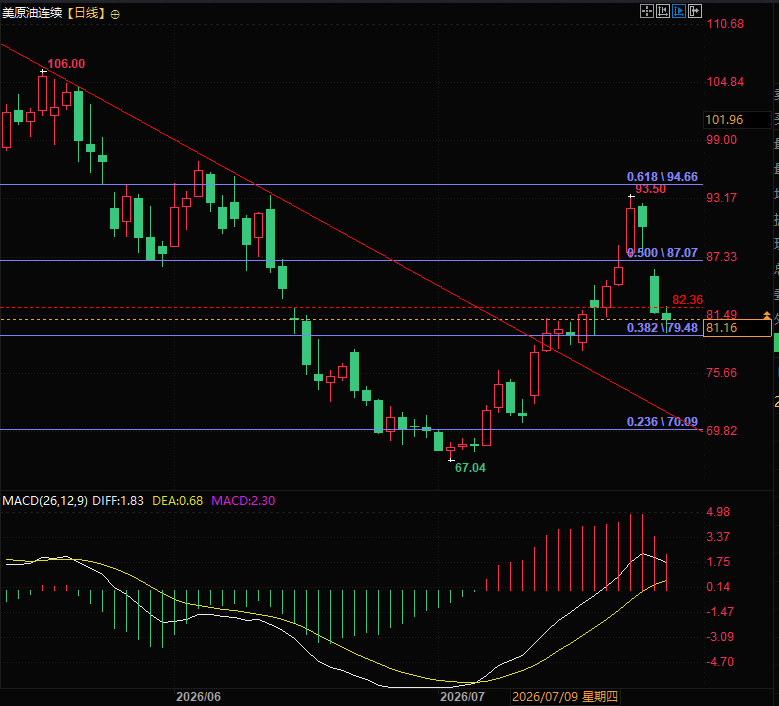 (WTI crude oil futures daily chart, source: EasyTrade) At 16:01 Beijing time, the WTI crude oil futures contract is currently trading at $82.14 per barrel.
The market weakened earlier: expectations of easing tensions between the US and Iran led to a temporary bottoming out of oil prices.
Significant news has emerged in the market regarding potential resumption of negotiations between the US and Iran on a Memorandum of Understanding (MOU). The US has also reportedly communicated this through Oman, a mediating channel, promising not to launch any military strikes against Iran in the short term. This message has been formally communicated to Iran. Coupled with President Trump's decision on July 24th to halt the two-week bombing campaign against Iran and his public statement that the US and Iran were advancing substantive negotiations, the 13-day standoff between the two countries has seen a brief respite. This has rapidly cooled geopolitical risk aversion in the Middle East, significantly reducing the geopolitical risk premium for oil and pushing oil prices to a temporary bottom.Situation reverses expectations: US-Israel negotiations conclude, Iranian nuclear risk resurfaces.
However, the market's expectation of easing did not last long. The situation in the Middle East quickly reversed, with multiple risk variables erupting simultaneously, completely shattering the temporary illusion of peace and providing strong support for the rebound in oil prices. The core trigger for this turning point was the nearing conclusion of negotiations between the United States and Israel, and the renewed escalation of risks related to the Iranian nuclear issue. Related reports indicate that Israeli Prime Minister Netanyahu has long urged the United States to take a tough stance against Iran, and during his White House meeting with Trump, he focused on the issue of the Ghoshul region in Iran. Monitoring revealed ongoing construction in that area, suggesting the construction of a new nuclear facility. The continued pressure from both the US and Israel regarding the Iranian nuclear issue has led to strong market doubts about the sustainability of the US-Iran negotiations.The conflict escalates fully: Iran launches a preemptive missile strike, and the US-Israel peace treaty collapses.
Amid escalating geopolitical tensions, Iran broke the deadlock by launching a preemptive military operation, reshaping the regional situation and shattering market optimism. The U.S. Central Command confirmed in an official statement released on Wednesday on the social media platform X that the Iranian Islamic Revolutionary Guard Corps (IRGC) had launched multiple ballistic missiles in a preemptive strike against U.S. military bases in the Middle East. The statement emphasized that this missile attack was not a reactive response but a strategic move by Iran to escalate the situation. The U.S. military reported successfully intercepting all incoming ballistic missiles and maintaining the highest level of readiness throughout. Meanwhile, the Jordanian news agency confirmed that five missile interceptions occurred in Jordanian airspace that day, targeting the Iranian Revolutionary Guard Corps' publicly disclosed objectives—precision strikes against the Mowafak Salti Air Base in Jordan and U.S. Central Command outposts in Jordan.Iran's strategic logic: distrust of the US ceasefire and a proactive effort to regain regional dominance.
Iran simultaneously released a strong strategic stance. The Islamic Republic of Iran Broadcasting (IRNA) published a statement from its Revolutionary Guard, clearly stating that as long as Iran continues to face external threats and the US continues its illegal and hostile actions that harm Iranian interests, Iran's resistance and counterattacks will not cease. Jason Campbell, a senior researcher at the Middle East Institute, analyzed that the core objective of Iran's latest military action is to regain control of the regional situation. Iran has consistently distrusted the US's brief ceasefire, judging it to be merely a strategy of building up strength for future conflict, not a genuine easing of tensions. This is the core logic behind its proactive military counterattack.Multiple conflicts escalate: US-Saudi joint airstrikes against pro-Iranian militias in Iraq
The current escalation of the Middle East conflict is characterized by multiple outbreaks and multi-party involvement, leading to a comprehensive increase in regional instability. Hours before Iran's attack on US bases, the US, in conjunction with Saudi forces, conducted precision airstrikes against Iranian-backed militia strongholds in Iraq. US Central Command stated that this operation was a strong response to more than 30 drone attacks led by the Iranian Revolutionary Guard in the past 72 hours. The US also issued a clear warning that if US personnel or Saudi energy infrastructure are attacked again, it will immediately launch additional military strikes. The Saudi Ministry of Defense also publicly confirmed the joint airstrikes, stating that Saudi Arabia has no intention of escalating the situation but will certainly retaliate against any external aggression.Regional risks are spreading: the situations in Iraq and Yemen are intertwined, disrupting the Middle East landscape.
The joint US-Saudi airstrikes targeted multiple militia logistics facilities and weapons depots in eastern Iraq. The Popular Mobilization Forces (PMF), an Iraqi government-affiliated group supported by Iran, confirmed casualties and damage to buildings and supplies following the attacks. While specific casualty figures were not disclosed, the intensity of the regional armed conflict has significantly escalated. Public information shows that this group was designated an independent operational unit of the regular army by the Iraqi government in 2016, but it has maintained a high degree of autonomy and has a long history of attacking US facilities. As the conflict continues to spread, Saudi Arabia shot down another drone launched by pro-Iranian Iraqi militias on Tuesday. The Houthi rebels in Yemen also launched simultaneous attacks, claiming to have imposed a maritime blockade and forced Saudi oil tankers to change course, leading to a comprehensive spread of geopolitical risks across the Middle East. The Iraqi Prime Minister convened an emergency meeting of the National Security Council to discuss the situation. The Iraqi military stated that it would strictly prohibit its territory from becoming a springboard for attacks on friendly nations, but pro-Iranian militias within Iraq denied all allegations of drone attacks, pointing the finger at the Houthi rebels in Yemen, further complicating and destabilizing the regional situation.Key supply-side risk: The shipping crisis in the Strait of Hormuz continues to escalate.
As a core global oil transportation route, the shipping crisis in the Strait of Hormuz continues to escalate, further amplifying risks on the oil supply side and becoming a key driver of the oil price rebound. The Strait of Hormuz handles 20% of global seaborne oil trade, making it a vital chokepoint in the global energy supply chain and a key issue of concern for the Trump administration. The US has repeatedly accused Iran of illegally intercepting passing merchant ships. Iran, however, has consistently maintained its legitimate sovereignty over the strait's navigation and has rejected external interference.The Taiwan Strait standoff escalates: Iran vetoes joint control plan and intercepts transit oil tankers.
The proposed joint management of the Strait of Hormuz and a 50/50 split of shipping lanes, previously put forward by Oman, has been formally rejected by Iran. Iran's Deputy Foreign Minister publicly stated that Iran will only accept a zonal management model where it controls the Iranian side of the Strait of Hormuz, while Oman is responsible for the opposite side, rejecting a complete joint management plan. Amidst the escalating tensions, the Iranian Revolutionary Guard announced on Wednesday that it had intercepted three oil tankers in the Strait of Hormuz, stating that the vessels ignored repeated warnings and insisted on entering dangerous and illegal shipping lanes designated by Iran. Although no independent third-party source has yet confirmed details of the tanker attacks, market panic regarding potential disruptions to shipping in the Strait and disruptions to crude oil supplies is rapidly escalating.Dual shipping lanes under pressure: Red Sea risks compounded, exacerbating uncertainty in crude oil supply.
Shipping risks in the Red Sea have also increased, coupled with geopolitical risk aversion, further supporting the stabilization and rebound of oil prices. The Houthi rebels in Yemen previously announced a blockade of Saudi shipping, leading to a sharp increase in shipping risks in the Bab el-Mandeb Strait, and claimed to have attacked Saudi oil tankers, forcing them to turn back. The UK's Maritime Trade Operations Centre also confirmed a sudden incident in the southern Red Sea involving an oil tanker, with explosions heard. Although there were no casualties on the ship or crew, the two major Middle Eastern oil shipping routes are under pressure simultaneously, significantly increasing uncertainty in global oil supply.Institutional Viewpoint:
Wall Street investment banks generally believe that the core driver of the current crude oil market has shifted from pure supply and demand fundamentals to the dynamic interplay of geopolitical risk premiums. Goldman Sachs points out that although core OPEC+ members such as Saudi Arabia and the UAE have millions of barrels per day of spare capacity as a buffer, the market is extremely sensitive to whether the Strait of Hormuz, a key choke point (carrying about 20% of global seaborne crude oil), will be subject to a substantial and prolonged blockade. Any physical disruption or threat will quickly amplify the geopolitical safe-haven premium, pushing oil prices up in a pulse. Citi and Morgan Stanley emphasize that the "high uncertainty" of the geopolitical situation leads to oil prices exhibiting typical characteristics of "high volatility and strong sensitivity." Once expectations of diplomatic reconciliation rise or the shipping crisis eases, the geopolitical premium will quickly subside, and the market will return to the weakening logic of medium- to long-term supply recovery and demand slowdown. However, with the ongoing hardline confrontation between the US and Iran and the continued escalation of military conflicts on multiple fronts, the crude oil futures market will maintain a strong oscillating pattern under high-risk premiums in the short term.Viewpoints and Technical Analysis:
In the short term, geopolitical tensions have escalated again, but the US has not yet retaliated against Iran's attack. We need to observe the US military's actions tonight to understand the outcome of Iran's probing attack. Iran is also worried about the sincerity of US negotiations, even suspecting that the talks are merely a cover for US military resupply. As long as this distrust persists, negotiations are unlikely to yield results. In the long term (focus on macroeconomic inflation and demand suppression): We need to be wary of the negative feedback from high oil prices. If the Middle East situation leads to persistently high oil prices, it will further increase global inflationary pressures, delay major central banks' interest rate cuts, and thus suppress global macroeconomic recovery and actual oil demand, ultimately creating a top-down pressure on oil prices. Technically: The support level for oil prices is at the 0.382 Fibonacci retracement level of 79.48, while the resistance level is at the previous upward gap at 82.36. Currently, we are watching for a breakout above these two levels. The market is currently in a range-bound phase, with bulls and bears locked in a stalemate. (WTI crude oil futures daily chart, source: EasyTrade) At 16:01 Beijing time, the WTI crude oil futures contract is currently trading at $82.14 per barrel.
- Risk Warning and Disclaimer
- The market involves risk, and trading may not be suitable for all investors. This article is for reference only and does not constitute personal investment advice, nor does it take into account certain users’ specific investment objectives, financial situation, or other needs. Any investment decisions made based on this information are at your own risk.