Whether it's 7-2 or 6-3, the next round of volatility in the pound could be triggered by a single ballot.
2026-07-29 15:46:49
On Wednesday, July 29th, the pound traded around 1.3300 against the dollar, showing signs of stabilization. After retreating from its recent high of 1.3557, the exchange rate has broken below several short-term moving averages, and market focus has shifted to the Bank of England's interest rate decision, committee voting distribution, inflation forecasts, and annual quantitative tightening assessment, all to be announced on July 30th. The Bank of England's current interest rate is 3.75%. At the June meeting, a 7-2 vote was passed to keep rates unchanged, with two committee members advocating for a 25 basis point hike. The key to this meeting is not the interest rate itself, as maintaining it unchanged has gained considerable consensus, but rather whether the hawkish camp will expand, and whether the Bank of England will define the energy price shock as short-term imported inflation or a persistent risk that could spread to wages and service prices. 
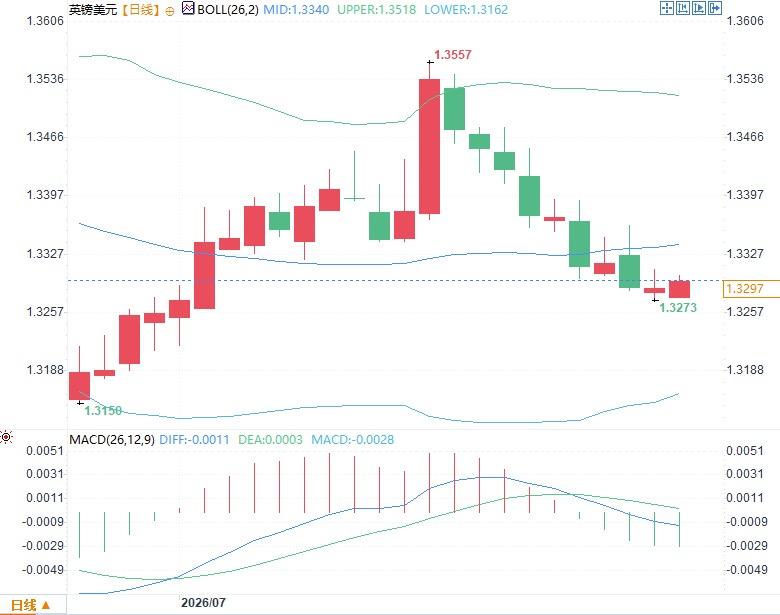 However, the current price action has not yet confirmed a one-sided trend. The exchange rate is near the recent low of 1.3273 while remaining far from the high of 1.3557, indicating that the market is awaiting new policy information to determine the direction of fluctuations. If the decision lowers expectations for UK terminal interest rates, whether the price can hold around 1.3273 will reflect the bulls' risk-taking capacity; if the vote is unexpectedly hawkish, the 1.3340 area will become a crucial zone to test whether the policy impact can translate into a sustained interest rate advantage.
A policy tug-of-war arises between declining inflation and energy risks.
The UK's Consumer Price Index (CPI) rose 2.6% year-on-year in June, down from 2.8% in May; the core CPI remained at 2.6%, while services price inflation fell from 3.7% to 3.6%. These figures indicate that underlying inflationary pressures are slowly easing, but services prices remain significantly above the 2% policy target, meaning the Bank of England is not yet in a position to declare the risk of inflation eliminated. The policy challenge lies in the transmission path of the energy shock. Brent crude oil prices rose above $100 per barrel at one point, before falling back to around $85 as relevant parties released easing signals. Lower energy prices can reduce the direct contribution to inflation in the coming months, but monetary policy is more concerned with the second-round effect: whether businesses raise prices for goods and services, whether workers demand higher wages, and whether inflation expectations re-anchor. If the July decision downplays the second-round effect, the market's previously priced-in probability of a rate hike may quickly recede; if the peak inflation forecast is close to 4%, short-term interest rates may still maintain a high risk premium. Compared to the energy shock of 2022, the current wage environment is significantly weaker. Regular wages rose 3.4% year-on-year from March to May, with private sector wages increasing by only 2.9%. During the same period, the unemployment rate was 4.9%, job vacancies fell to 712,000, and the number of salaried employees decreased by approximately 90,000 year-on-year. The increased slack in the labor market means that companies' ability to pass on energy costs through continuous wage increases is constrained, and it also reduces the probability of a reinforcing relationship between wages and prices.The distribution of votes will determine the initial reaction of the pound and UK bonds.
If the vote remains 7-2, and the policy statement emphasizes that energy prices have fallen from their highs and the cooling labor market is sufficient to constrain wages, the yield curve may reduce pricing for a rate hike this year. The pressure on the pound will primarily come from narrowing interest rate expectations, rather than a sudden economic deterioration. Conversely, if the vote turns to 6-3, it indicates that more members believe current financial conditions are insufficient to prevent the spread of inflation, and the market will reassess the likelihood of a rate hike at a subsequent Bank of England meeting. The reaction in the UK bond market may show a divergence in maturity. Policy votes and inflation forecasts will first affect yields near two years, while quantitative tightening adjustments will have a greater impact on longer-term maturities. Currently, the yield on 10-year UK government bonds is around 4.98%, up about 22 basis points from a month ago, reflecting the combined increase in long-term financing costs due to energy, fiscal supply, and term premiums. If the Bank of England confirms a moderate slowdown in the pace of its active bond sales, it may reduce additional supply pressure in the long-term bond market, but this does not equate to a shift towards monetary easing. Quantitative tightening changes the pace of the central bank's balance sheet contraction, while bank interest rates determine overnight funding costs; the two have different channels of impact on exchange rates and the yield curve. Therefore, the variables that truly possess immediate pricing power at this meeting are, in order, the voting distribution, the assessment of the inflation peak, and the wording of the second-round effect, while the importance of quantitative tightening arrangements is relatively low.Technical analysis suggests the pound is digesting a policy premium.
The daily chart shows that the pound has fallen from 1.3557 to around 1.3300 against the dollar, breaking below the Bollinger Band middle line at 1.3340, but still above the lower line at 1.3162. In the MACD indicator, the DIFF is -0.0011, the DEA is 0.0003, and the histogram is -0.0028, reflecting weak short-term momentum, and the appreciation driven by interest rate expectations is being compressed. However, the current price action has not yet confirmed a one-sided trend. The exchange rate is near the recent low of 1.3273 while remaining far from the high of 1.3557, indicating that the market is awaiting new policy information to determine the direction of fluctuations. If the decision lowers expectations for UK terminal interest rates, whether the price can hold around 1.3273 will reflect the bulls' risk-taking capacity; if the vote is unexpectedly hawkish, the 1.3340 area will become a crucial zone to test whether the policy impact can translate into a sustained interest rate advantage.
- Risk Warning and Disclaimer
- The market involves risk, and trading may not be suitable for all investors. This article is for reference only and does not constitute personal investment advice, nor does it take into account certain users’ specific investment objectives, financial situation, or other needs. Any investment decisions made based on this information are at your own risk.