A chart shows that weakening Capesize and Supramax freight rates dragged the Baltic Dry Index down to a four-week low.
2026-07-30 00:20:49
Latest data shows that the Baltic Dry Index (BDI) closed at 2632 points on July 29, 2026, a new low since July 1, 2026, down 1.20% month-on-month, the largest drop since July 27, 2026, and marking the third consecutive day of decline (including zero growth). Looking at the short-term charts, the recent 11 BDI data points show: 3 positive increases, 8 negative increases, and 0 zero increases. Specifically, the Panamax Freight Index (BPI) closed at 1995 points, up 0.35% from the previous value; the Capesize Freight Index (BCI) closed at 4067 points, down 1.76%; and the Supramax Freight Index (BSI) closed at 1628 points, down 1.21%. For detailed 720-day and 10-year trend charts of the Baltic Dry Index and its three main sub-indices, please refer to the charts specially created by FX678. 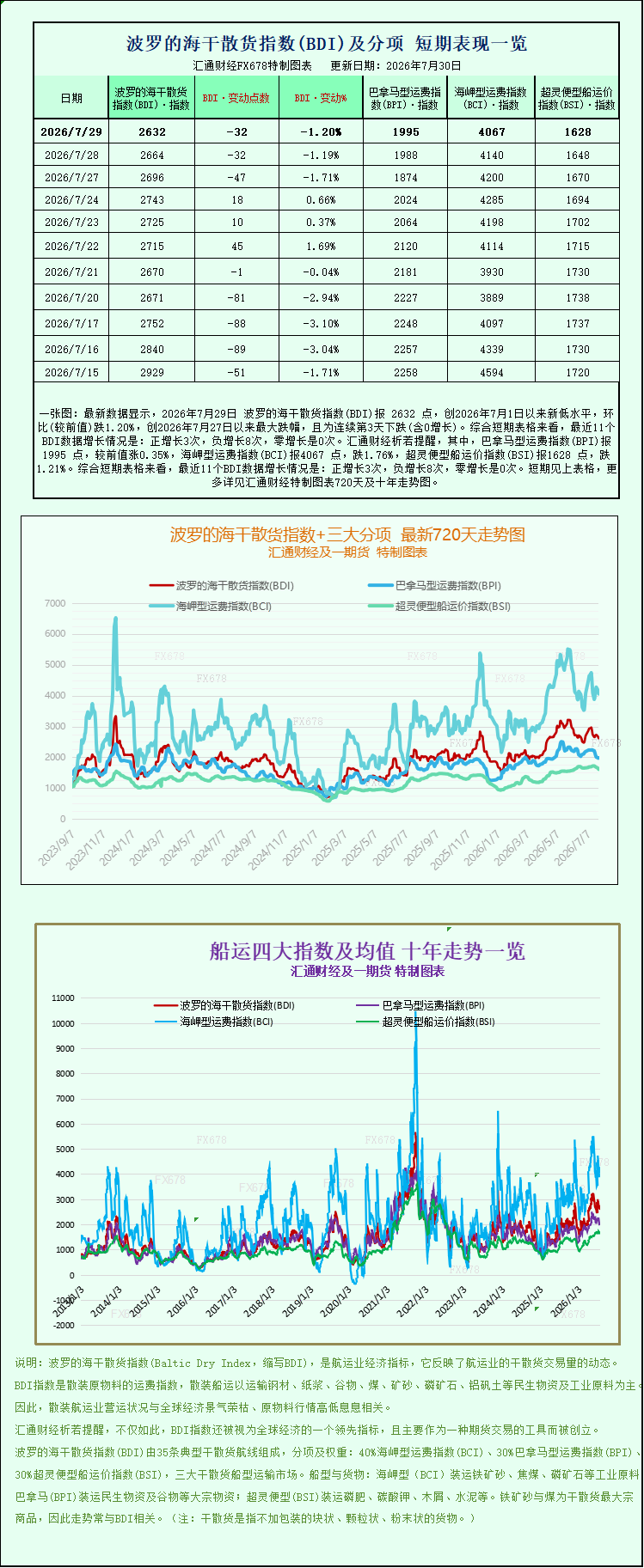 The international dry bulk shipping market has been under pressure recently, with a significant divergence in market trends. On July 29, the Baltic Dry Index (BDI) continued its decline, falling to its lowest level in four weeks since July 1. This was mainly due to a sharp drop in freight rates for the two main vessel types, Capesize and Supramax. Even a slight recovery in Panamax vessel freight rates failed to reverse the overall downward trend of the index, fully highlighting the current structural supply-demand imbalance in the global dry bulk shipping market. Data shows that the Baltic Dry Index, which tracks freight rates for the three main dry bulk vessel types (Capesize, Panamax, and Supramax), fell 32 points that day, a drop of 1.2%, ultimately closing at 2632 points, a new low in nearly four weeks. This round of index decline was not a market-wide drop, but rather exhibited a clear divergence between strong and weak performers. Freight rates for large ore and coal carriers and small general-purpose bulk carriers weakened simultaneously, with only medium-tonnage Panamax vessels experiencing a temporary recovery. The overall market demand recovery was uneven, with fluctuations in end-user commodity trade demand becoming the core factor driving freight rate trends. As the ship type with the highest market weighting, the sharp drop in Capesize (Good Hope Size) vessel freight rates was the main driver of this index decline. On that day, the Capesize index fell sharply by 73 points, a drop of 1.8%, to 4067 points, a new low since July 21st. Corresponding market earnings data showed that Capesize vessels, primarily engaged in the transportation of 150,000-tonnage bulk raw materials, saw their average daily earnings decrease by $664 to $33,384. This ship type mainly undertakes the ocean transport of basic industrial raw materials such as iron ore, thermal coal, and metallurgical coal globally, and its freight rate fluctuations are highly correlated with the global steel industry's prosperity and the activity of industrial raw material trade. The recent decline in Capesize freight rates is primarily driven by weakening demand from China's steel industry. Domestic steel mills have seen a continued contraction in profit margins, leading to a decrease in production activity and a slowdown in iron ore procurement demand. This has directly resulted in fewer ocean-going iron ore orders and downward pressure on freight rates. Currently, domestic iron ore futures prices for steelmaking are slightly lower, with a strong wait-and-see attitude in the market. However, the decline in freight rates is relatively limited, mainly due to the potential supply disruption risk at BHP Billiton's Port Hedland operations in Australia. Market expectations of tighter long-term iron ore supply have offset some of the downward pressure from weak demand, preventing a sharp drop in Capesize freight rates. The market for small and medium-tonnage vessels also performed weakly, further dragging down the overall market index. Supramax vessels, the most widely used small vessel type in the dry bulk market, saw their index fall by 20 points, a 1.2% drop, closing at 1628 points, the lowest point in nearly seven weeks since June 10th. Supramax vessels are suitable for transporting a wide range of bulk cargoes, including small-batch coal, grain, building materials, and agricultural supplies. Their routes cover global near-sea and ocean-going small-to-medium-sized trade routes. The weakening freight rates reflect overall weak demand in global small-to-medium-sized industrial and consumer bulk cargo trade, and a cooling of activity in the global mid-to-downstream real economy. Against the backdrop of widespread market pressure, Panamax vessels were the only sector to buck the trend, showing a structural recovery. Data shows that the Panamax index rose 7 points, a slight increase of 0.4%, to 1995 points, ending its previous losing streak and marking its first rebound since July 15th. The corresponding 60,000-70,000 ton Panamax vessels saw an average daily earnings increase of $57, reaching $17,953. This vessel type mainly transports bulk commodities such as thermal coal and grain, and is suitable for regional energy and food trade routes. This slight increase was mainly due to the continued peak season for global food exports and the release of energy restocking demand in some regions, leading to a slight increase in orders for medium-tonnage bulk carriers and supporting a moderate recovery in freight rates. The current dry bulk shipping market exhibits a pronounced structural differentiation. Weak demand for upstream industrial raw materials is suppressing freight rates for large vessels, while sluggish global trade in small and medium-sized bulk commodities is dragging down prices for smaller vessels. Only the food and energy sectors show resilience, supporting a slight recovery in freight rates for medium-tonnage vessels. Industry analysts point out that late July is traditionally a low season for global shipping demand, coupled with a period of adjustment in the domestic steel industry, leading to a temporary weakening of raw material seaborne demand. This is due to both seasonal and cyclical factors contributing to the index decline. The subsequent market trend will primarily depend on two core variables: first, the progress of domestic steel industry resumption of production and the pace of recovery in iron ore procurement demand, which will directly determine whether Capesize freight rates can stabilize and rebound; second, the sustainability of the global peak season for food transportation and the extent of energy restocking in Europe and the US will affect the recovery strength of Panamax vessels. Meanwhile, the stability of the Australian port supply chain and changes in global macroeconomic trade policies will continue to influence dry bulk shipping freight rates. In the short term, the Baltic Dry Index is likely to maintain a volatile adjustment pattern, and a full market recovery still requires a substantial recovery in end-user demand.
The international dry bulk shipping market has been under pressure recently, with a significant divergence in market trends. On July 29, the Baltic Dry Index (BDI) continued its decline, falling to its lowest level in four weeks since July 1. This was mainly due to a sharp drop in freight rates for the two main vessel types, Capesize and Supramax. Even a slight recovery in Panamax vessel freight rates failed to reverse the overall downward trend of the index, fully highlighting the current structural supply-demand imbalance in the global dry bulk shipping market. Data shows that the Baltic Dry Index, which tracks freight rates for the three main dry bulk vessel types (Capesize, Panamax, and Supramax), fell 32 points that day, a drop of 1.2%, ultimately closing at 2632 points, a new low in nearly four weeks. This round of index decline was not a market-wide drop, but rather exhibited a clear divergence between strong and weak performers. Freight rates for large ore and coal carriers and small general-purpose bulk carriers weakened simultaneously, with only medium-tonnage Panamax vessels experiencing a temporary recovery. The overall market demand recovery was uneven, with fluctuations in end-user commodity trade demand becoming the core factor driving freight rate trends. As the ship type with the highest market weighting, the sharp drop in Capesize (Good Hope Size) vessel freight rates was the main driver of this index decline. On that day, the Capesize index fell sharply by 73 points, a drop of 1.8%, to 4067 points, a new low since July 21st. Corresponding market earnings data showed that Capesize vessels, primarily engaged in the transportation of 150,000-tonnage bulk raw materials, saw their average daily earnings decrease by $664 to $33,384. This ship type mainly undertakes the ocean transport of basic industrial raw materials such as iron ore, thermal coal, and metallurgical coal globally, and its freight rate fluctuations are highly correlated with the global steel industry's prosperity and the activity of industrial raw material trade. The recent decline in Capesize freight rates is primarily driven by weakening demand from China's steel industry. Domestic steel mills have seen a continued contraction in profit margins, leading to a decrease in production activity and a slowdown in iron ore procurement demand. This has directly resulted in fewer ocean-going iron ore orders and downward pressure on freight rates. Currently, domestic iron ore futures prices for steelmaking are slightly lower, with a strong wait-and-see attitude in the market. However, the decline in freight rates is relatively limited, mainly due to the potential supply disruption risk at BHP Billiton's Port Hedland operations in Australia. Market expectations of tighter long-term iron ore supply have offset some of the downward pressure from weak demand, preventing a sharp drop in Capesize freight rates. The market for small and medium-tonnage vessels also performed weakly, further dragging down the overall market index. Supramax vessels, the most widely used small vessel type in the dry bulk market, saw their index fall by 20 points, a 1.2% drop, closing at 1628 points, the lowest point in nearly seven weeks since June 10th. Supramax vessels are suitable for transporting a wide range of bulk cargoes, including small-batch coal, grain, building materials, and agricultural supplies. Their routes cover global near-sea and ocean-going small-to-medium-sized trade routes. The weakening freight rates reflect overall weak demand in global small-to-medium-sized industrial and consumer bulk cargo trade, and a cooling of activity in the global mid-to-downstream real economy. Against the backdrop of widespread market pressure, Panamax vessels were the only sector to buck the trend, showing a structural recovery. Data shows that the Panamax index rose 7 points, a slight increase of 0.4%, to 1995 points, ending its previous losing streak and marking its first rebound since July 15th. The corresponding 60,000-70,000 ton Panamax vessels saw an average daily earnings increase of $57, reaching $17,953. This vessel type mainly transports bulk commodities such as thermal coal and grain, and is suitable for regional energy and food trade routes. This slight increase was mainly due to the continued peak season for global food exports and the release of energy restocking demand in some regions, leading to a slight increase in orders for medium-tonnage bulk carriers and supporting a moderate recovery in freight rates. The current dry bulk shipping market exhibits a pronounced structural differentiation. Weak demand for upstream industrial raw materials is suppressing freight rates for large vessels, while sluggish global trade in small and medium-sized bulk commodities is dragging down prices for smaller vessels. Only the food and energy sectors show resilience, supporting a slight recovery in freight rates for medium-tonnage vessels. Industry analysts point out that late July is traditionally a low season for global shipping demand, coupled with a period of adjustment in the domestic steel industry, leading to a temporary weakening of raw material seaborne demand. This is due to both seasonal and cyclical factors contributing to the index decline. The subsequent market trend will primarily depend on two core variables: first, the progress of domestic steel industry resumption of production and the pace of recovery in iron ore procurement demand, which will directly determine whether Capesize freight rates can stabilize and rebound; second, the sustainability of the global peak season for food transportation and the extent of energy restocking in Europe and the US will affect the recovery strength of Panamax vessels. Meanwhile, the stability of the Australian port supply chain and changes in global macroeconomic trade policies will continue to influence dry bulk shipping freight rates. In the short term, the Baltic Dry Index is likely to maintain a volatile adjustment pattern, and a full market recovery still requires a substantial recovery in end-user demand.
- Risk Warning and Disclaimer
- The market involves risk, and trading may not be suitable for all investors. This article is for reference only and does not constitute personal investment advice, nor does it take into account certain users’ specific investment objectives, financial situation, or other needs. Any investment decisions made based on this information are at your own risk.