The Federal Reserve maintained interest rates, but hawkish divisions intensified, leading to a slight rebound in gold prices, which remained range-bound.
2026-07-30 09:32:57
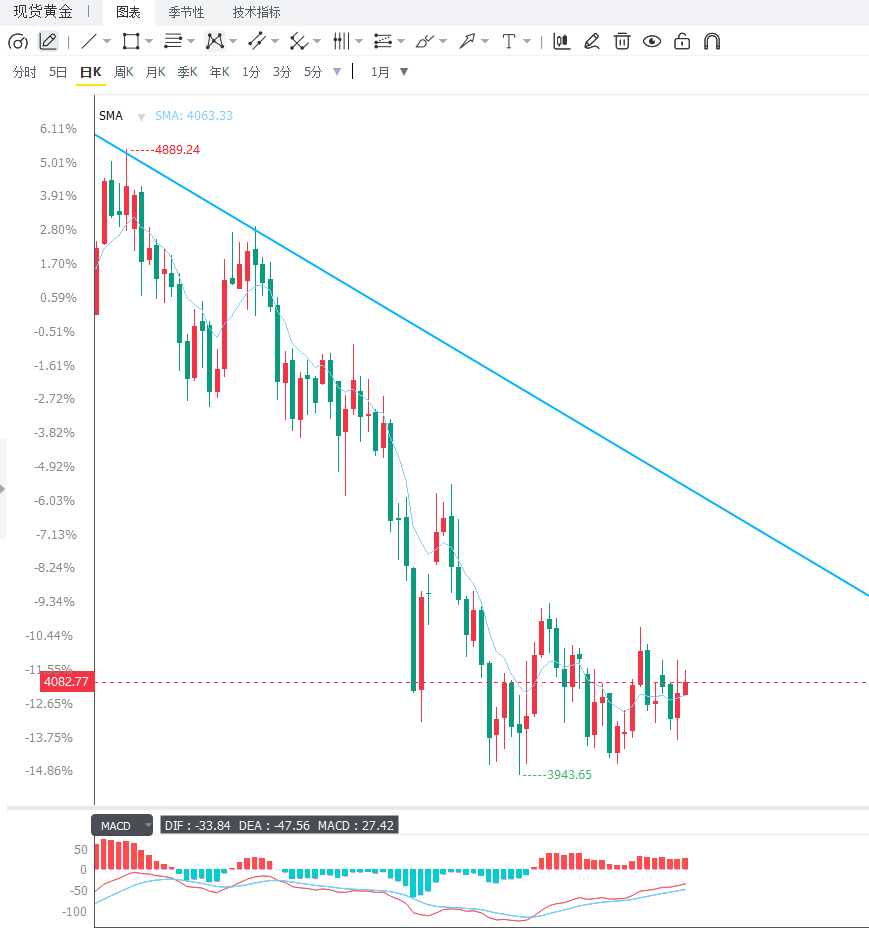
International gold prices rebounded during Asian trading hours on Thursday, with spot gold (XAU/USD) rising to around $4,080. The market was primarily influenced by the Federal Reserve's interest rate decision and rising global risk aversion. Gold prices had previously undergone a period of adjustment, but buying in precious metals recovered as the Fed signaled policy divergence and the market refocused on geopolitical risks.  The Federal Reserve decided to maintain the target range for the federal funds rate at 3.50%-3.75% at its July monetary policy meeting. This result was in line with market expectations, but the internal disagreements in the policy statement became the focus of market attention. The meeting showed that three members of the Federal Open Market Committee supported a 25-basis-point rate hike, indicating that some policymakers remain highly vigilant about persistent inflationary pressures. Fed Chairman Kevin Warsh stated at the press conference that the tightening of financial market conditions has already had some effect on economic and policy adjustments, while emphasizing that the Fed would act swiftly if inflationary pressures accelerate again. This statement shows that while the Fed has not adjusted interest rates yet, it has not completely ruled out the possibility of further tightening in the future. From a market perspective, the hawkish division within the Fed has limited short-term gains in gold prices and lowered market expectations for significant future easing. However, some institutions believe that the market's pricing in the Fed's subsequent rate hike path may be too aggressive. Analysts at Commerzbank pointed out that the recent weakness in gold prices may have exceeded reasonable levels and believe that if the Fed ultimately maintains stable interest rates, gold still has room for further recovery. The agency expects the Federal Reserve to keep interest rates unchanged for the remainder of the year, which will provide some support for gold prices. Meanwhile, renewed international safe-haven demand is also a significant factor driving the gold rebound. Market news indicates that tensions in the Middle East have escalated again, with related military actions raising concerns among investors about energy supplies and global economic stability. Since gold has long been considered a safe-haven asset, it typically attracts capital inflows during periods of increased risk events. However, the market is also aware that geopolitical risks could affect global inflation expectations through energy prices. If oil prices continue to rise due to supply concerns, it could force major central banks to maintain higher interest rates for a longer period, thereby increasing the opportunity cost of holding non-yielding gold assets. Currently, market focus is shifting to future economic data, including US inflation indicators, employment market data, and subsequent speeches by Federal Reserve officials. If economic data shows that inflation continues to cool while the employment market further slows, the market may re-strengthen expectations of interest rate cuts, thus providing new upward momentum for gold. Conversely, if inflationary pressures persist and the Federal Reserve maintains a tight stance, gold may still face downward pressure in the short term. Looking at the dollar's performance, the uncertainty surrounding the Federal Reserve's interest rate path has kept the dollar index in a volatile state. Generally, a stronger dollar increases the cost of holding gold, putting downward pressure on prices; conversely, a weaker dollar favors precious metals. The market is currently awaiting more macroeconomic signals to determine the next direction for gold. From a daily chart perspective, spot gold has shown signs of stabilization and rebound after recent high-level consolidation, with prices now back around $4080, indicating that bullish funds are attempting to regain control. The overall trend remains in a high-level consolidation phase. If gold prices can stably hold above the $4100 level, they may further test the resistance zone of $4125 to $4150. On the downside, the area around $4050 forms a crucial short-term support zone; a break below this level could lead to a retest of the psychological level of $4000. While market momentum has improved somewhat, the hawkish signals from the Federal Reserve suggest that the gold rally may be accompanied by significant volatility. From a 4-hour chart perspective, gold prices have formed a rebound structure after a rapid pullback, with short-term moving averages gradually converging, and market buying pressure is strengthening. Technical indicators suggest that short-term momentum has rebounded somewhat, but prices still need to break above $4,100 to confirm a continuation of the rebound. If the breakout is successful, the short-term target could be around $4,130; if the rebound is met with resistance, a pullback to the $4,050 area is possible. Investors should pay close attention to the impact of the US dollar's movements, US Treasury yield trends, and the situation in the Middle East on safe-haven flows.
  Editor's Summary: Gold's current price movement is influenced by a triple factor: divergent Fed policies, safe-haven demand, and changes in interest rate expectations. While the Fed maintained its current interest rate, signals from three officials supporting rate hikes indicate a cautious policy environment, limiting short-term upside for gold. However, market debate persists regarding whether future rate hike expectations are overpriced. If subsequent economic data continues to support easing inflation, gold may regain upward momentum. The key to the future gold market lies in the Fed's policy direction, the strength of the US dollar, and the development of global risk events. If high interest rate pressures gradually ease while safe-haven funds continue to flow in, gold is expected to maintain medium- to long-term support. However, if inflation rebounds and pushes up real interest rates, gold prices may face a risk of a temporary correction. Overall, gold remains in a phase of mixed bullish and bearish factors; investors should pay attention to key technical levels and changes in macroeconomic data to seize trading opportunities amidst volatility.
The Federal Reserve decided to maintain the target range for the federal funds rate at 3.50%-3.75% at its July monetary policy meeting. This result was in line with market expectations, but the internal disagreements in the policy statement became the focus of market attention. The meeting showed that three members of the Federal Open Market Committee supported a 25-basis-point rate hike, indicating that some policymakers remain highly vigilant about persistent inflationary pressures. Fed Chairman Kevin Warsh stated at the press conference that the tightening of financial market conditions has already had some effect on economic and policy adjustments, while emphasizing that the Fed would act swiftly if inflationary pressures accelerate again. This statement shows that while the Fed has not adjusted interest rates yet, it has not completely ruled out the possibility of further tightening in the future. From a market perspective, the hawkish division within the Fed has limited short-term gains in gold prices and lowered market expectations for significant future easing. However, some institutions believe that the market's pricing in the Fed's subsequent rate hike path may be too aggressive. Analysts at Commerzbank pointed out that the recent weakness in gold prices may have exceeded reasonable levels and believe that if the Fed ultimately maintains stable interest rates, gold still has room for further recovery. The agency expects the Federal Reserve to keep interest rates unchanged for the remainder of the year, which will provide some support for gold prices. Meanwhile, renewed international safe-haven demand is also a significant factor driving the gold rebound. Market news indicates that tensions in the Middle East have escalated again, with related military actions raising concerns among investors about energy supplies and global economic stability. Since gold has long been considered a safe-haven asset, it typically attracts capital inflows during periods of increased risk events. However, the market is also aware that geopolitical risks could affect global inflation expectations through energy prices. If oil prices continue to rise due to supply concerns, it could force major central banks to maintain higher interest rates for a longer period, thereby increasing the opportunity cost of holding non-yielding gold assets. Currently, market focus is shifting to future economic data, including US inflation indicators, employment market data, and subsequent speeches by Federal Reserve officials. If economic data shows that inflation continues to cool while the employment market further slows, the market may re-strengthen expectations of interest rate cuts, thus providing new upward momentum for gold. Conversely, if inflationary pressures persist and the Federal Reserve maintains a tight stance, gold may still face downward pressure in the short term. Looking at the dollar's performance, the uncertainty surrounding the Federal Reserve's interest rate path has kept the dollar index in a volatile state. Generally, a stronger dollar increases the cost of holding gold, putting downward pressure on prices; conversely, a weaker dollar favors precious metals. The market is currently awaiting more macroeconomic signals to determine the next direction for gold. From a daily chart perspective, spot gold has shown signs of stabilization and rebound after recent high-level consolidation, with prices now back around $4080, indicating that bullish funds are attempting to regain control. The overall trend remains in a high-level consolidation phase. If gold prices can stably hold above the $4100 level, they may further test the resistance zone of $4125 to $4150. On the downside, the area around $4050 forms a crucial short-term support zone; a break below this level could lead to a retest of the psychological level of $4000. While market momentum has improved somewhat, the hawkish signals from the Federal Reserve suggest that the gold rally may be accompanied by significant volatility. From a 4-hour chart perspective, gold prices have formed a rebound structure after a rapid pullback, with short-term moving averages gradually converging, and market buying pressure is strengthening. Technical indicators suggest that short-term momentum has rebounded somewhat, but prices still need to break above $4,100 to confirm a continuation of the rebound. If the breakout is successful, the short-term target could be around $4,130; if the rebound is met with resistance, a pullback to the $4,050 area is possible. Investors should pay close attention to the impact of the US dollar's movements, US Treasury yield trends, and the situation in the Middle East on safe-haven flows. Editor's Summary: Gold's current price movement is influenced by a triple factor: divergent Fed policies, safe-haven demand, and changes in interest rate expectations. While the Fed maintained its current interest rate, signals from three officials supporting rate hikes indicate a cautious policy environment, limiting short-term upside for gold. However, market debate persists regarding whether future rate hike expectations are overpriced. If subsequent economic data continues to support easing inflation, gold may regain upward momentum. The key to the future gold market lies in the Fed's policy direction, the strength of the US dollar, and the development of global risk events. If high interest rate pressures gradually ease while safe-haven funds continue to flow in, gold is expected to maintain medium- to long-term support. However, if inflation rebounds and pushes up real interest rates, gold prices may face a risk of a temporary correction. Overall, gold remains in a phase of mixed bullish and bearish factors; investors should pay attention to key technical levels and changes in macroeconomic data to seize trading opportunities amidst volatility.
- Risk Warning and Disclaimer
- The market involves risk, and trading may not be suitable for all investors. This article is for reference only and does not constitute personal investment advice, nor does it take into account certain users’ specific investment objectives, financial situation, or other needs. Any investment decisions made based on this information are at your own risk.