Crude oil trading alert: Escalating tensions in the Middle East coupled with a sharp drop in US inventories supported a rebound in oil prices, but short-term trading may continue within a range.
2026-07-30 09:46:50
West Texas Intermediate (WTI) crude oil prices edged lower in Asian trading on Thursday, currently trading around $83.80. This pullback followed a period of rising prices as some investors took profits. However, given the increasing global supply risks and a significant decline in U.S. crude oil inventories, the downside for oil prices remains limited.  The crude oil market has recently been influenced by multiple factors, with the Federal Reserve's monetary policy becoming a short-term focus. At its July policy meeting, the Fed decided to maintain the target range for the federal funds rate at 3.50%-3.75%, a result in line with market expectations. Fed Chairman Kevin Warsh stated after the meeting that the Fed would not reveal future policy direction in advance, but would take necessary measures to ensure inflation returns to the 2% target level. The market believes that while the Fed's pause in adjusting interest rates has reduced uncertainty in financial markets, the high-interest-rate environment may still affect global economic growth expectations, thus limiting the growth potential of energy demand. Following the interest rate decision, some crude oil investors chose to lock in previous gains, causing WTI prices to fall in the short term. However, supply-side risks are once again becoming an important factor driving oil prices. Escalating tensions in the Middle East have raised concerns about the security of crude oil transportation. Market news indicates an increased risk of related military conflict, prompting investors to reassess the stability of energy supplies in the Middle East. As the region bears a significant share of global energy supply, disruptions to the supply chain could lead to a rapid rise in international crude oil prices. In the US, following escalating actions, the market remains highly concerned about regional crude oil transportation risks. Meanwhile, shipping safety issues in the Red Sea continue to impact energy market sentiment. The market is focused on the Houthi rebels in Yemen's potential plans to further increase costs for commercial vessels transiting the Bab el-Mandeb Strait. Connecting the southern Red Sea to the Gulf of Aden, the Bab el-Mandeb Strait is a crucial global shipping route; increased shipping risks could drive up energy transportation costs and affect market supply expectations. Besides geopolitical factors, US inventory data also provided significant support for oil prices. Data from the US Energy Information Administration (EIA) showed that US crude oil inventories decreased by 7.167 million barrels in the week ending July 24, far exceeding market expectations of a decrease of approximately 2.5 million barrels . The previous week, US crude oil inventories had actually increased by approximately 2.011 million barrels, indicating a slight easing of domestic crude oil supply pressure. Decreasing inventories typically signify strong market demand or a contraction in supply. Currently, US refinery activity, export demand, and inventory adjustments are all contributing to the decline in crude oil inventories. Investors are watching to see if these inventory changes are sustainable to determine if the upward trend in oil prices has a solid foundation. However, further increases in oil prices still face certain resistance. On the one hand, the Federal Reserve's maintenance of a high-interest-rate environment may dampen global economic growth expectations; on the other hand, if global economic data is weak, the market may again worry about a slowdown in energy demand. Currently, the market is in a mixed state: geopolitical risks and declining inventories are driving oil prices higher, while monetary policy pressures and profit-taking are limiting short-term gains. The future trend of WTI will depend heavily on changes in supply risks, US economic data performance, and global energy demand expectations. From a daily chart perspective, WTI crude oil has maintained a clear rebound trend recently, with prices trading above $83 after breaking through a key area, and the bullish structure still holds the advantage. Currently, the resistance level to watch is the $84.50 to $86.00 area; if oil prices break through further, it may open up space towards $90. On the downside, the area around $81.00 forms short-term support; if this area is broken, a pullback to test the $78.50 to $79.00 area may occur. Overall, the daily trend is bullish, but profit-taking pressure has increased after continuous gains, and market momentum needs new fundamental factors to drive it. From a 4-hour chart perspective, WTI prices have undergone a technical correction after a rapid rise, with short-term momentum cooling somewhat, but overall they remain within an upward channel. Technical indicators show that buying power has not weakened significantly. If prices can hold the support around $82 and break through the resistance at $84.50, they may continue to challenge the $86 area in the short term; if they fall below $82, further pullback is possible, with a target around $80. In the short term, key factors to watch include developments in the Middle East, EIA inventory trends, and the impact of the US dollar's performance on risk assets.
 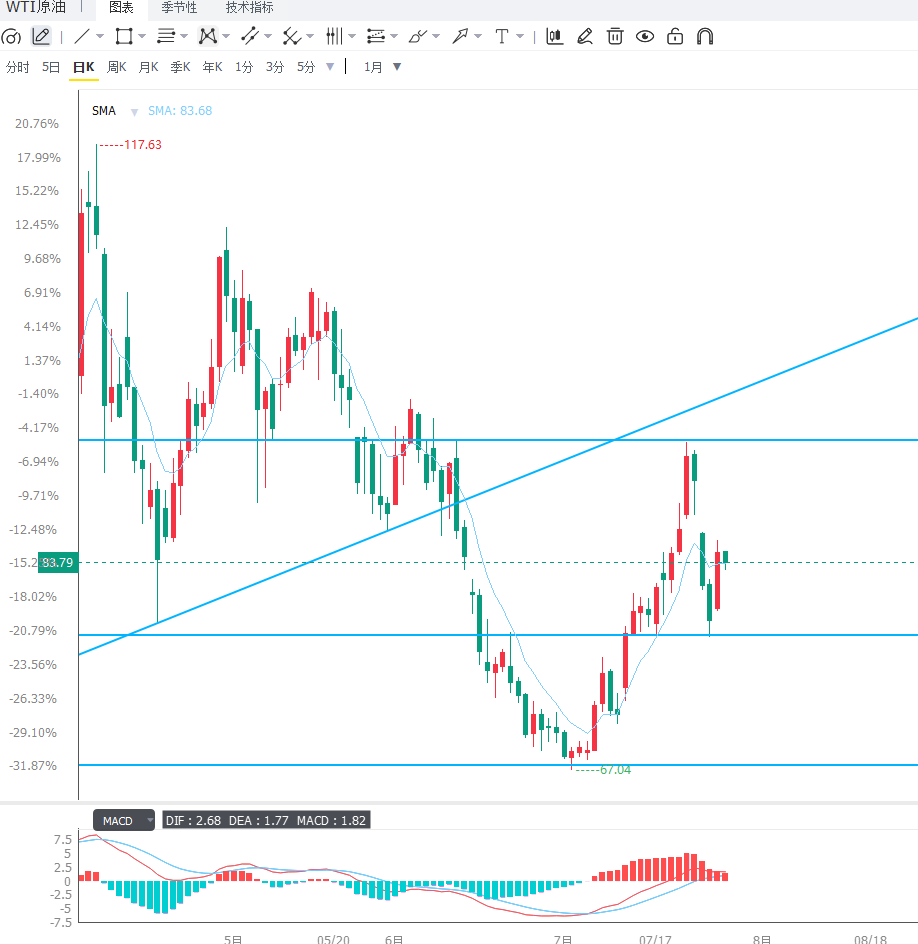 The editor summarizes that WTI crude oil is currently supported by two major positive factors: supply risks and declining inventories. However, the Fed's high-interest-rate environment still limits market optimism regarding future energy demand growth. Recent oil price increases are more driven by supply-side risk premiums than by pure demand growth. Looking ahead, if the situation in the Middle East continues to deteriorate, coupled with a continued decline in US inventories, WTI may further test higher resistance levels; however, if risk events ease while global economic growth pressures increase, oil prices may face renewed downward pressure. Overall, the crude oil market remains in a highly volatile phase, with supply security, inventory changes, and central bank policies jointly determining the next direction. Investors need to pay attention to key technical levels and be wary of rapid price changes triggered by unforeseen events.
The crude oil market has recently been influenced by multiple factors, with the Federal Reserve's monetary policy becoming a short-term focus. At its July policy meeting, the Fed decided to maintain the target range for the federal funds rate at 3.50%-3.75%, a result in line with market expectations. Fed Chairman Kevin Warsh stated after the meeting that the Fed would not reveal future policy direction in advance, but would take necessary measures to ensure inflation returns to the 2% target level. The market believes that while the Fed's pause in adjusting interest rates has reduced uncertainty in financial markets, the high-interest-rate environment may still affect global economic growth expectations, thus limiting the growth potential of energy demand. Following the interest rate decision, some crude oil investors chose to lock in previous gains, causing WTI prices to fall in the short term. However, supply-side risks are once again becoming an important factor driving oil prices. Escalating tensions in the Middle East have raised concerns about the security of crude oil transportation. Market news indicates an increased risk of related military conflict, prompting investors to reassess the stability of energy supplies in the Middle East. As the region bears a significant share of global energy supply, disruptions to the supply chain could lead to a rapid rise in international crude oil prices. In the US, following escalating actions, the market remains highly concerned about regional crude oil transportation risks. Meanwhile, shipping safety issues in the Red Sea continue to impact energy market sentiment. The market is focused on the Houthi rebels in Yemen's potential plans to further increase costs for commercial vessels transiting the Bab el-Mandeb Strait. Connecting the southern Red Sea to the Gulf of Aden, the Bab el-Mandeb Strait is a crucial global shipping route; increased shipping risks could drive up energy transportation costs and affect market supply expectations. Besides geopolitical factors, US inventory data also provided significant support for oil prices. Data from the US Energy Information Administration (EIA) showed that US crude oil inventories decreased by 7.167 million barrels in the week ending July 24, far exceeding market expectations of a decrease of approximately 2.5 million barrels . The previous week, US crude oil inventories had actually increased by approximately 2.011 million barrels, indicating a slight easing of domestic crude oil supply pressure. Decreasing inventories typically signify strong market demand or a contraction in supply. Currently, US refinery activity, export demand, and inventory adjustments are all contributing to the decline in crude oil inventories. Investors are watching to see if these inventory changes are sustainable to determine if the upward trend in oil prices has a solid foundation. However, further increases in oil prices still face certain resistance. On the one hand, the Federal Reserve's maintenance of a high-interest-rate environment may dampen global economic growth expectations; on the other hand, if global economic data is weak, the market may again worry about a slowdown in energy demand. Currently, the market is in a mixed state: geopolitical risks and declining inventories are driving oil prices higher, while monetary policy pressures and profit-taking are limiting short-term gains. The future trend of WTI will depend heavily on changes in supply risks, US economic data performance, and global energy demand expectations. From a daily chart perspective, WTI crude oil has maintained a clear rebound trend recently, with prices trading above $83 after breaking through a key area, and the bullish structure still holds the advantage. Currently, the resistance level to watch is the $84.50 to $86.00 area; if oil prices break through further, it may open up space towards $90. On the downside, the area around $81.00 forms short-term support; if this area is broken, a pullback to test the $78.50 to $79.00 area may occur. Overall, the daily trend is bullish, but profit-taking pressure has increased after continuous gains, and market momentum needs new fundamental factors to drive it. From a 4-hour chart perspective, WTI prices have undergone a technical correction after a rapid rise, with short-term momentum cooling somewhat, but overall they remain within an upward channel. Technical indicators show that buying power has not weakened significantly. If prices can hold the support around $82 and break through the resistance at $84.50, they may continue to challenge the $86 area in the short term; if they fall below $82, further pullback is possible, with a target around $80. In the short term, key factors to watch include developments in the Middle East, EIA inventory trends, and the impact of the US dollar's performance on risk assets. The editor summarizes that WTI crude oil is currently supported by two major positive factors: supply risks and declining inventories. However, the Fed's high-interest-rate environment still limits market optimism regarding future energy demand growth. Recent oil price increases are more driven by supply-side risk premiums than by pure demand growth. Looking ahead, if the situation in the Middle East continues to deteriorate, coupled with a continued decline in US inventories, WTI may further test higher resistance levels; however, if risk events ease while global economic growth pressures increase, oil prices may face renewed downward pressure. Overall, the crude oil market remains in a highly volatile phase, with supply security, inventory changes, and central bank policies jointly determining the next direction. Investors need to pay attention to key technical levels and be wary of rapid price changes triggered by unforeseen events.
- Risk Warning and Disclaimer
- The market involves risk, and trading may not be suitable for all investors. This article is for reference only and does not constitute personal investment advice, nor does it take into account certain users’ specific investment objectives, financial situation, or other needs. Any investment decisions made based on this information are at your own risk.