The US dollar is supported by hawkish sentiment, and calls for the Bank of Japan to combat inflation are intensifying, putting the yen at a policy turning point.
2026-07-30 12:06:51
On Thursday (July 30) during Asian trading hours, the US dollar rose slightly against the Japanese yen, currently trading around 163.50. The Federal Reserve held rates steady 9-3, with three hawks dissenting, and Warsh's hawkish statement that "we will not waver in achieving our 2% inflation target" supported the dollar. While the dollar temporarily holds the upper hand in the policy game, calls within Japan for the central bank to accelerate interest rate hikes are growing—this could become the next key variable in the yen's trajectory. Watanabe Tsutomu, professor emeritus at the University of Tokyo and a former Bank of Japan official, said on Wednesday that the Bank of Japan may shift from a "tolerating inflation" stance to a "proactive anti-inflation" mode before December, meaning a faster pace of interest rate hikes. He pointed out that Japan is experiencing a third wave of inflation triggered by the Middle East conflict—the first wave was triggered by the Russia-Ukraine situation, and the second wave was driven by rising domestic wages and rice prices. Although the third wave may be milder than the previous two, "the real concern is that underlying inflation is clearly rising and is now quite close to 2%," which requires the Bank of Japan to adjust its current strategy of slow interest rate hikes. 
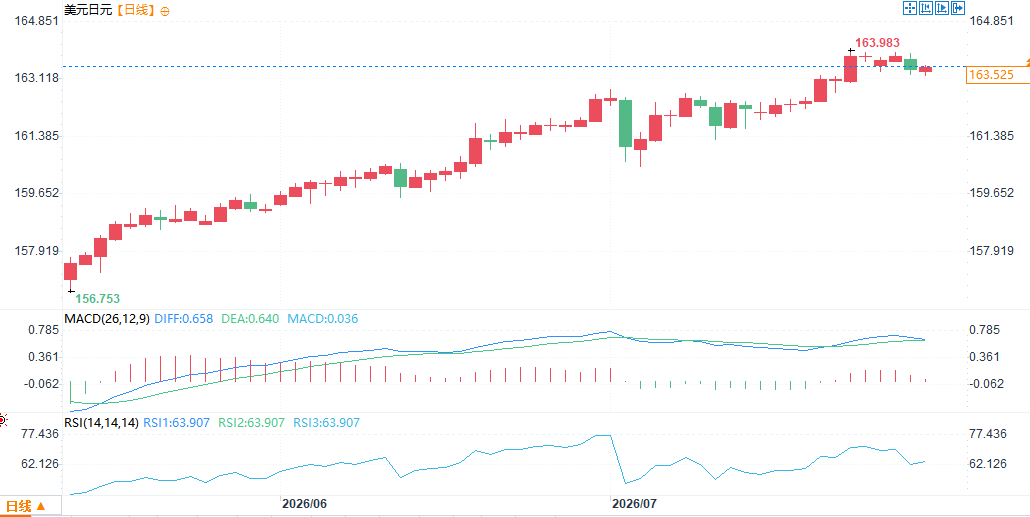 (USD/JPY daily chart, source: FX678) At 12:04 Beijing time on July 30, the USD/JPY exchange rate was 163.52/53.
Underlying inflation has "clearly risen," and a slow pace of interest rate hikes faces risks.
Watanabe Tsutomu stated that, based on price data estimates, if the Bank of Japan maintains its current slow pace of interest rate hikes, underlying inflation could overshoot to 2.2% around July next year. "This would be quite troublesome, potentially forcing the Bank of Japan to aggressively raise interest rates later, something the central bank absolutely wants to avoid." He believes the central bank has likely realized the need to shift from a passive stance of "tolerating inflation" to a proactive stance of "focusing on combating inflation." A key variable is the wage outlook for next year—if statements from unions and business leaders indicate that wage growth next year will be comparable to recent years, the Bank of Japan could shift to an "inflation-fighting mode" as early as December, at which point the pace of interest rate hikes would accelerate from approximately twice a year to once a quarter.The Bank of Japan's "credibility challenge"—a paradigm shift from fighting deflation to fighting inflation.
Tsutomu Watanabe warned that Japan's challenge in combating inflation may be more daunting than that of other countries. Having focused on fighting deflation for decades, the Bank of Japan lacks experience in combating inflation, and its slow pace of interest rate hikes so far has led to market doubts about its credibility in fighting inflation. Watanabe stated, "The market is questioning whether the Bank of Japan truly has the resolve and ability to keep inflation around 2%. It needs to send a clear signal—that it will implement monetary policy under different rules. The Bank of Japan has successfully de-anchored inflation from zero, but the challenge of re-anchoring inflation to 2% has only just begun."Impact on the Japanese Yen and Markets – Hawkish Shift May Accelerate Yen Appreciation
If the Bank of Japan shifts to a "proactive inflation-fighting" mode as predicted by Tsutomu Watanabe, the accelerated pace of interest rate hikes will significantly impact the yen. Currently, the USD/JPY exchange rate is around 163.50, and the USD/JPY interest rate differential remains the core variable dominating the exchange rate. If the Bank of Japan shifts its policy stance in December and accelerates its rate hikes, it will gradually narrow the USD/JPY interest rate differential, providing medium-term support for the yen. However, this logic is predicated on the Federal Reserve simultaneously slowing its rate hike pace—if the Fed continues to price in a September rate hike, the yen's appreciation potential will be limited. For traders, signs of a shift in the Bank of Japan's policy paradigm will be a key variable in the yen's movement in the coming months.The Bank of Japan is at a policy crossroads.
Watanabe's analysis reveals a core challenge facing the Bank of Japan: after decades of deflation, the central bank is learning how to combat inflation. A clear rise in underlying inflation demands a shift from "tolerance" to "proactive" measures, but global geopolitical uncertainties and domestic wage prospects make the timing of this transition highly uncertain. If the Bank of Japan shifts to an anti-inflationary mode in December, it will mark a fundamental reshaping of its policy framework—potentially a significant medium-term turning point for the yen. But as Watanabe argues, the challenge of re-anchoring inflation at 2% is only just beginning. (USD/JPY daily chart, source: FX678) At 12:04 Beijing time on July 30, the USD/JPY exchange rate was 163.52/53.
- Risk Warning and Disclaimer
- The market involves risk, and trading may not be suitable for all investors. This article is for reference only and does not constitute personal investment advice, nor does it take into account certain users’ specific investment objectives, financial situation, or other needs. Any investment decisions made based on this information are at your own risk.