Holding steady is not "inaction"—signals of a September rate hike behind three hawkish opposition figures.
2026-07-30 14:12:54
On Thursday (July 30) during Asian trading hours, the US dollar index rebounded slightly after hitting a new low of 100.74 since July 21, and is currently trading around 100.95. The Federal Reserve kept interest rates unchanged, with three hawkish members voting against the decision in a 9-3 vote. Warsh clearly stated that the Fed would "never waver in achieving its 2% inflation target." The dollar initially faced selling pressure after the decision, but renewed escalation of tensions in the Middle East—the US military launched strikes against Iran on Wednesday night in retaliation for Iranian missile attacks on US forces in the region—provided support for the dollar due to renewed safe-haven demand. 
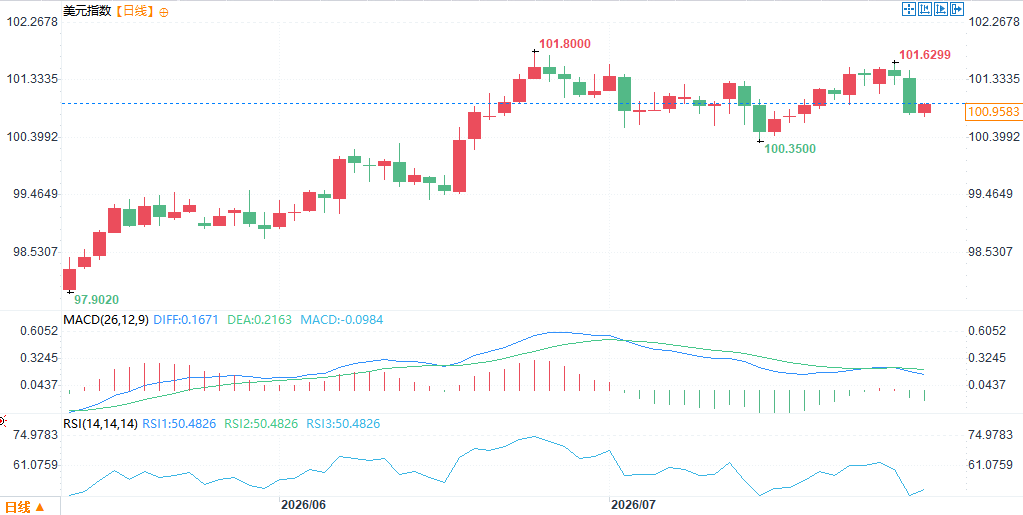 (US Dollar Index Daily Chart, Source: FX678) At 14:10 Beijing time on July 30, the US Dollar Index was at 100.97.
The Fed's decision triggered a brief sell-off, but three hawkish dissenters suggested upside risks.
On Wednesday, the Federal Reserve, as expected, kept interest rates unchanged at 3.50%-3.75%, marking the fifth consecutive day of inaction. However, three FOMC members—Cleveland Fed President Hammark, Minneapolis Fed President Kashkari, and Dallas Fed President Logan—voted against the call, advocating for a 25-basis-point rate hike. Fed Chairman Warsh stated clearly at the press conference that the committee is "firmly committed to price stability" and "will not hesitate to act." This hawkish signal suggests that despite the July rate freeze, the possibility of a September rate hike remains, providing medium-term support for the dollar.Escalating conflict in the Middle East boosts demand for safe-haven assets, providing support for the US dollar.
The immediate catalyst for the dollar's rebound was the renewed escalation of geopolitical conflicts in the Middle East. According to media reports, the US military launched strikes against Iran on Wednesday night in retaliation for Iran's missile attack on US forces in the region. This followed Trump's earlier threat to accelerate military action in retaliation for Iran's "surprise attack" on US troops. The escalating geopolitical risks directly boosted safe-haven buying of the dollar, helping it stabilize and rebound amidst the sell-off following the Federal Reserve's decision.The US dollar has more short-term support factors.
The current dollar trend is primarily driven by three key variables. If the situation in the Middle East escalates further, risk aversion will significantly increase, attracting buying interest in the dollar as a traditional safe-haven currency and pushing the dollar index higher. Meanwhile, expectations of a Federal Reserve rate hike remain a core variable. If the market continues to price in a September rate hike, the dollar will receive direct interest rate support, further consolidating its strong position. Furthermore, US economic data is crucial. If employment, inflation, or growth data remain strong, it will reinforce the rationale for the Fed to maintain its tightening policy, delaying expectations of easing and thus providing additional support for the dollar. In summary, the upside risk for the dollar has increased in the short term, and volatility may increase significantly. The direction will depend on geopolitical developments and data confirmation results.The US dollar seeks a balance between policy divergence and geopolitical risks.
The US dollar index stabilized and rebounded amid a sell-off following the Fed's decision, with safe-haven demand driven by escalating Middle East conflict offsetting the short-term pressure on the dollar from the decision itself. The Fed's 9-3 vote and Warsh's statement that he "will not hesitate to act" mean that a September rate hike remains a possibility. In the short term, the dollar index is likely to consolidate within its current range. If the situation in the Middle East deteriorates further, the dollar may break through recent resistance; if geopolitical risks subside and the market continues to price in a less pronounced September rate hike, the dollar may retest key support levels. Amid this tug-of-war between bullish and bearish factors, the dollar's direction depends on marginal changes in geopolitical risks and policy expectations. Today's trading session will also focus on the performance of the US June PCE data and the US Q2 GDP data, as well as the Bank of England's interest rate decision. (US Dollar Index Daily Chart, Source: FX678) At 14:10 Beijing time on July 30, the US Dollar Index was at 100.97.
- Risk Warning and Disclaimer
- The market involves risk, and trading may not be suitable for all investors. This article is for reference only and does not constitute personal investment advice, nor does it take into account certain users’ specific investment objectives, financial situation, or other needs. Any investment decisions made based on this information are at your own risk.