Three committee members called for an interest rate hike, but the dollar weakened. What does this indicate about the internal rifts within the Federal Reserve?
2026-07-30 15:06:49
On Thursday, July 30, the Federal Reserve maintained the target range for the federal funds rate at 3.50% to 3.75%, consistent with the June meeting. However, the vote changed from unanimous approval to 9 in favor and 3 against, with three members advocating for a 25 basis point rate hike. This was the most significant addition to the meeting, quickly transforming what was initially a routine meeting lacking economic forecasts and a dot plot into a test of policy credibility. The market's real focus wasn't on whether interest rates would be adjusted, but rather on whether Chairman Kevin Warsh could explain three questions: Why not raise rates when inflation remains above the 2% target? Do the three dissenting votes reflect differences in risk assessment or a split in the policy framework? And under what conditions would the Fed initiate its next move if energy prices and inflation rebound? The press conference failed to provide a clear response function. Warsh suggested that inflation indicators other than the personal consumption expenditures price index could be considered, implying that rate hikes are not the only tool for controlling inflation, and that the previous tightening of financial markets had already done some of the work for the Fed. These statements weakened market certainty regarding a near-term rate hike, but did not alleviate concerns about medium- to long-term inflation. 
 Technical analysis shows that the 101.59-101.63 area has formed a short-term dense resistance zone, while 100.74 and the lower Bollinger Band at 100.55 constitute the lower observation area. In the MACD indicator, the DIFF is 0.1684, lower than the DEA at 0.2165, and the histogram is -0.0964, indicating that the previous rebound momentum is weakening, but a one-sided breakout of the medium-to-long-term trend has not yet been formed. More notably, the rise in long-term yields has not driven a corresponding strengthening of the US dollar. This is because the current yield increase is mainly due to term premiums, policy uncertainty, and inflation risk compensation, rather than a synchronized upward revision of economic growth expectations or the recent policy interest rate path. When rising interest rates are interpreted as a decline in policy credibility, the support for the US dollar is usually weaker than the support brought by the widening of real interest rate differentials.
A steeper yield curve is a price-in of the policy path, rather than a single decision.
The bond market reacted sharply to the meeting. The decline in the two-year Treasury yield suggests the market has lowered its expectations for the extent of short-term tightening; the rise in the 30-year yield to approximately 5.14% and the 10-year yield to approximately 4.62% indicates a simultaneous increase in term premium and long-term inflation compensation. This combination of a decline in the short end and an increase in the long end does not necessarily mean the market has simply assumed a shift towards easing. A more accurate explanation is that traders believe the Fed may continue to wait in the short term, but the cost of this waiting could be the need to maintain higher interest rates in the future, or even tighten again with greater力度. The yield curve thus reflects two judgments: insufficient policy constraints in the near term and rising policy costs in the long term. The three dissenting votes on the rate hike further amplified this contradiction. If inflation risks are insufficient to prompt committee action, why did several members demand an immediate rate hike? If the risks are already significant enough, why did the chairman avoid clearly explaining the basis for the pause in action? The lack of a coherent explanation between the policy decision and the internal vote forces the market to absorb uncertainty by increasing the long-term risk premium.The US dollar index fell below the Bollinger Middle Band, and the interest rate advantage failed to translate into exchange rate support.
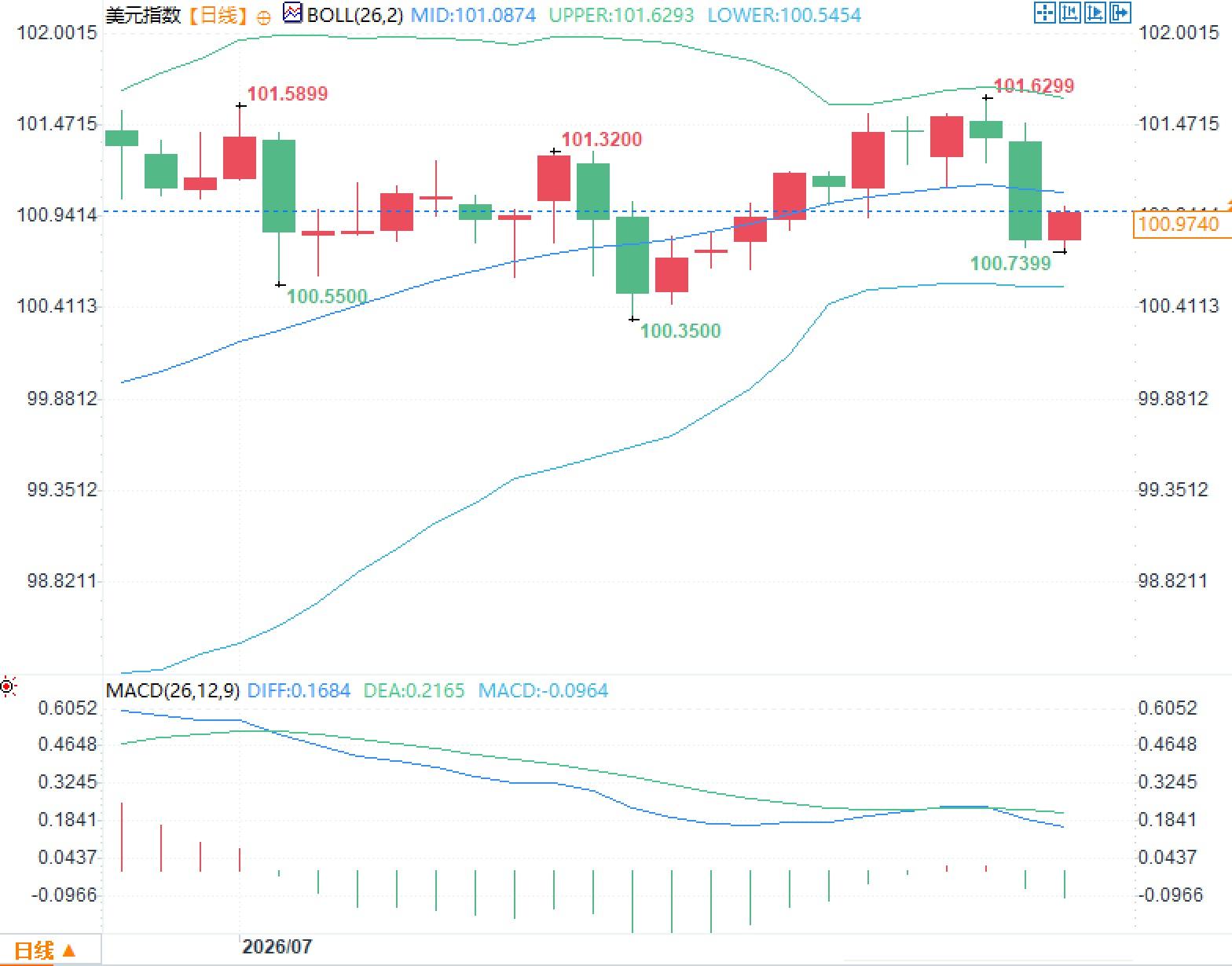
The US dollar index is currently trading around 100.97, with the Bollinger Band middle line at 101.0874, the upper line at 101.6293, and the lower line at 100.5454. The index previously encountered resistance around 101.6299 and subsequently fell rapidly, with the latest price now below the middle line. Technical analysis shows that the 101.59-101.63 area has formed a short-term dense resistance zone, while 100.74 and the lower Bollinger Band at 100.55 constitute the lower observation area. In the MACD indicator, the DIFF is 0.1684, lower than the DEA at 0.2165, and the histogram is -0.0964, indicating that the previous rebound momentum is weakening, but a one-sided breakout of the medium-to-long-term trend has not yet been formed. More notably, the rise in long-term yields has not driven a corresponding strengthening of the US dollar. This is because the current yield increase is mainly due to term premiums, policy uncertainty, and inflation risk compensation, rather than a synchronized upward revision of economic growth expectations or the recent policy interest rate path. When rising interest rates are interpreted as a decline in policy credibility, the support for the US dollar is usually weaker than the support brought by the widening of real interest rate differentials.Risky assets are under pressure as the core variable shifts from interest rate levels to policy predictability.
The Nasdaq 100 fell about 2.1% on the day of the decision, a pullback of more than 10% from its June 2 high, entering a technical correction phase; the Dow Jones Industrial Average fell about 1,152 points, and the S&P 500 fell about 1.5%. This reaction indicates that the market did not view the pause in rate hikes as a purely positive development. For highly valued assets, pricing is influenced not only by policy rates, but also by long-term risk-free rates, risk premiums, and the discounted stability of future cash flows. While lower short-term rates could alleviate financing pressures, the rapid rise in long-term yields increased the valuation discount rate, and the ambiguity of the policy path expanded the risk compensation requirements; both factors combined suppressed risk appetite. The key in the next phase is no longer whether a rate hike occurs at a particular meeting, but whether the Fed can re-establish a verifiable policy framework. If inflation, employment, and energy prices continue to send conflicting signals, the communication challenges at the September meeting may be even greater. The market had already priced in a high probability of at least one rate hike this year, but this press conference did not provide a list of conditions sufficient to stabilize expectations.- Risk Warning and Disclaimer
- The market involves risk, and trading may not be suitable for all investors. This article is for reference only and does not constitute personal investment advice, nor does it take into account certain users’ specific investment objectives, financial situation, or other needs. Any investment decisions made based on this information are at your own risk.