The Fed's favorite inflation gauge has cooled down! But with economic growth at only 1.5%, how should this "report card" be valued?
2026-07-30 20:44:50
On Thursday (July 30), at 8:30 PM Beijing time, the U.S. Department of Commerce released the June PCE price index and preliminary Q2 GDP data. Core PCE rose 0.1% month-over-month, lower than the market expectation of +0.2%; overall PCE fell 0.1% month-over-month, in line with expectations; core PCE rose 3.3% year-over-year, also in line with expectations. Meanwhile, the preliminary annualized growth rate of real GDP in Q2 was 1.5%, significantly lower than the market consensus of 2.1%, compared to the previous value of 2.1%.  Prior to the data release, the market was highly focused on the inflation path. The Federal Reserve had previously maintained interest rates and emphasized its commitment to combating inflation, coupled with fluctuations in energy prices, leading to a significant correction in the bond market. Following the release, spot gold briefly surged by nearly $10/ounce before retreating by about $15/ounce. The US dollar index initially bottomed out at 100.6119 before rebounding, while US stock index futures continued their upward trend, with Dow Jones futures, S&P 500 futures, and Nasdaq 100 futures all extending their gains.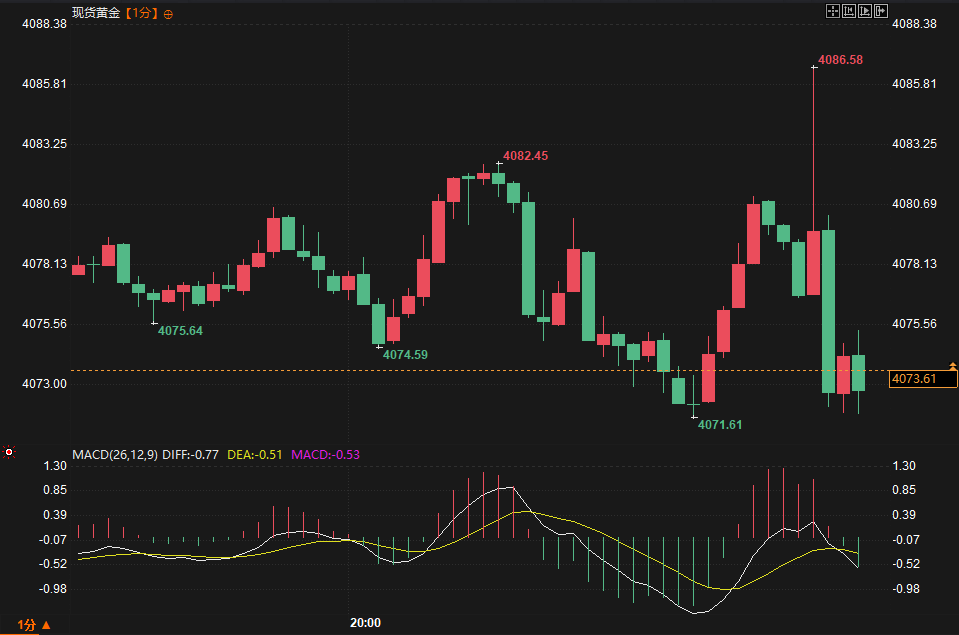
Prior to the data release, the market was highly focused on the inflation path. The Federal Reserve had previously maintained interest rates and emphasized its commitment to combating inflation, coupled with fluctuations in energy prices, leading to a significant correction in the bond market. Following the release, spot gold briefly surged by nearly $10/ounce before retreating by about $15/ounce. The US dollar index initially bottomed out at 100.6119 before rebounding, while US stock index futures continued their upward trend, with Dow Jones futures, S&P 500 futures, and Nasdaq 100 futures all extending their gains. Deep interconnect analysis
This data presents a combination of "slower growth and moderate inflation." GDP growth was lower than expected, mainly reflecting a temporary adjustment in consumption and investment momentum. Meanwhile, the personal savings rate fell from 2.8% to 2.7%, indicating that residents' willingness to spend remains supported. In the PCE data, core service prices excluding food, energy, and housing rose only 0.1% month-on-month, a significant slowdown from the previous value, indicating that potential inflationary pressures have eased, especially given the short-term decline in energy prices. Historically, core PCE year-on-year growth has mostly remained above 3% over the past year, contrasting sharply with the previous highs. The latest quotes show that while inflation remains above the Fed's 2% target, the downward trend leaves room for observation in monetary policy. Technically, the dollar index rebounded after the data release, indicating short-term profit-taking, but overall it remains under pressure. Gold showed profit-taking characteristics during its rise and fall. The extended gains in stock index futures reflect a positive market interpretation of potential policy expectations related to the slowdown in growth. Prior to the data release, institutional views were generally cautious, focusing on the upward pressure on long-term bond yields from the Federal Reserve's continued tightening stance. Some analysts believed that the stickiness of inflation still needed to be monitored. Retail investors largely expected the data to reinforce the "soft landing" narrative. After the release, institutions quickly adjusted their stance, acknowledging that lower-than-expected core inflation eased the need for further tightening by the Fed, but also cautioned against the risk of slowing growth. Retail investors, on the other hand, interpreted it more optimistically as a boon to risk assets, with short-term sentiment driving stock index futures higher. The overall expectation discrepancy lies in the fact that previous market concerns about the stickiness of inflation were slightly higher, while the actual data provided some room for downward revision. Fundamentals and technicals corroborate each other: the month-on-month slowdown in inflation supported a phase of adjustment for the US dollar, while lower-than-expected GDP reinforced the market's dual considerations of economic resilience and policy flexibility. The long-term and short-term logics are converging—short-term volatility has increased, while the medium-term focus is on the marginal impact of the data on monetary policy expectations.Trend Outlook
Market movements indicate that the market quickly priced in a scenario of "moderate inflation + slowing growth" after the data release. The US dollar index rebounded but failed to break through recent highs, gold fluctuated at high levels, and stock index futures maintained a relatively strong trend. If inflation continues to decline moderately, long-term bond yields may face downward pressure; conversely, if energy prices fluctuate again, pushing up inflation expectations, the US dollar and long-term bonds may regain support. Overall, the market will revolve around the Fed's subsequent communications and global central bank actions, and short-term volatility is likely to remain at a high level.Frequently Asked Questions
Q: What are the main reasons for the lower-than-expected PCE data? A: Primarily due to the short-term decline in energy prices, coupled with a significant slowdown in core service prices month-on-month. Overall PCE decreased by 0.1% month-on-month, while core PCE only increased by 0.1%, indicating some easing of potential pressure. However, year-on-year growth remains above 3%, still some distance from the policy target. Q: What does the lower-than-expected 1.5% GDP growth mean for the economy? A: It reflects a slowdown in growth momentum in the second quarter compared to the first quarter, but consumption and investment still contributed, and the overall economy maintained positive growth. Whether this is a temporary phenomenon needs to be observed in conjunction with subsequent data. Q: What is the short-term impact of the data on the US dollar and gold? The US dollar index fell first and then rose, indicating an initial mix of risk aversion and subsequent profit-taking; gold rose sharply before falling back, a typical post-data profit-taking characteristic. Both reflect the market's rapid adjustment in policy expectations. Q: Where do the differences lie between institutional and retail investors' views? Before the data release, institutions were more concerned about the risk of sticky inflation, while retail investors were more optimistic. After the data release, institutions acknowledged the slowdown in inflation but warned of growth risks, while retail investors viewed it more directly as a positive for risk assets, driving up stock index futures. Q: What variables should the market focus on going forward? A: It's necessary to track energy price trends, subsequent inflation data verification, and the tone of the Federal Reserve's communications. The actions of other major central banks globally will also have a ripple effect, jointly shaping the medium-term market environment.- Risk Warning and Disclaimer
- The market involves risk, and trading may not be suitable for all investors. This article is for reference only and does not constitute personal investment advice, nor does it take into account certain users’ specific investment objectives, financial situation, or other needs. Any investment decisions made based on this information are at your own risk.