One chart: Large vessel freight rates surged, with the Baltic Dry Index achieving a monthly increase in July.
2026-07-31 23:50:51
Latest data shows that the Baltic Dry Index (BDI) reached 2732 points on July 31, 2026, a five-day high, up 2.21% month-on-month (compared to the previous value), marking the largest increase since July 8, 2026, and the second consecutive day of increase (including zero growth). Looking at the short-term charts, the recent 11 BDI data points show: 5 positive increases, 6 negative increases, and 0 zero increases. Specifically, the Panamax Freight Index (BPI) was 2087 points, up 2.30% from the previous value; the Capesize Freight Index (BCI) was 4296 points, up 3.10%; and the Supramax Freight Index (BSI) was 1609 points, down 0.06%. For detailed 720-day and 10-year trend charts of the Baltic Dry Index and its three sub-indices, please refer to the charts specially created by FX678. 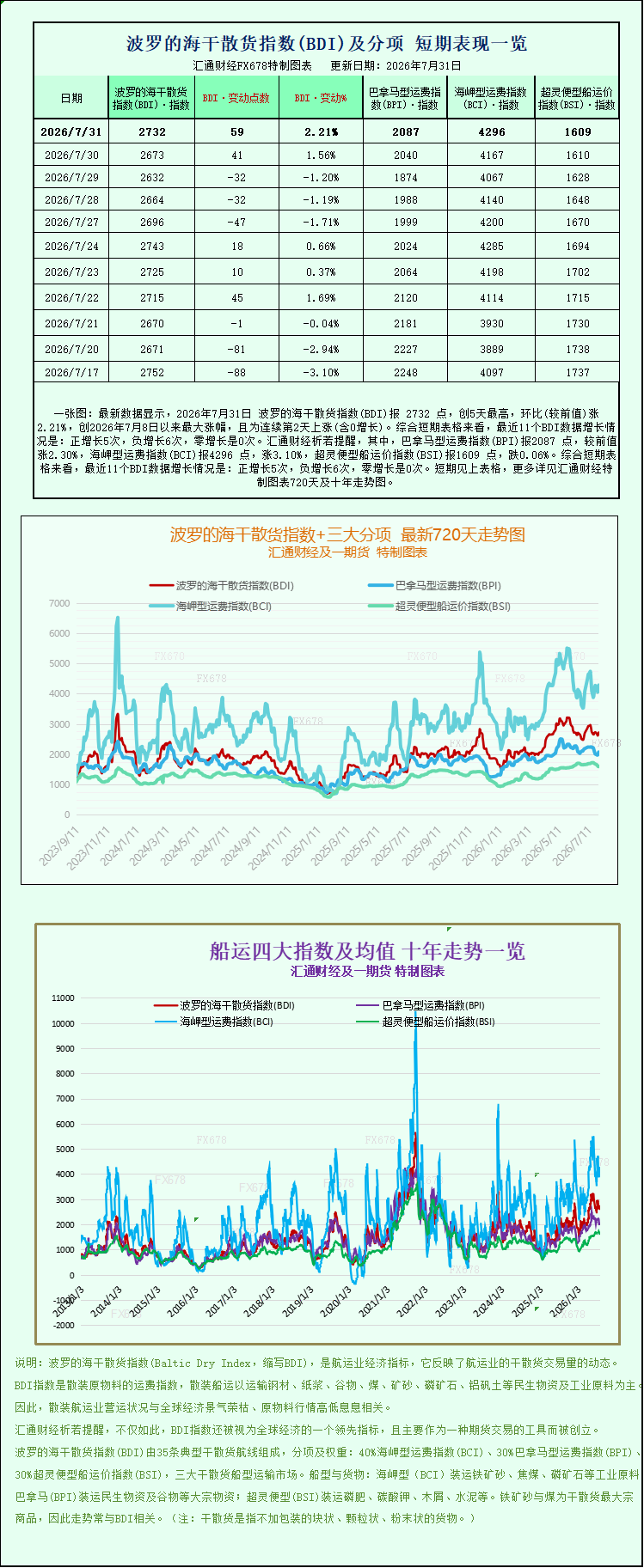 On July 31, 2026, the latest shipping market data showed that the Baltic Dry Index (BADI), a core indicator of international dry bulk shipping, continued its upward trend on Friday, marking its second consecutive day of gains and ultimately recording its overall monthly increase for July. This month, the shipping market exhibited significant structural differentiation. Freight rates for Capesize and Panamax vessels, which handle large-scale industrial raw material transport, rebounded strongly, becoming the core driver of the index's rise. Meanwhile, freight rates for Supramax vessels, suitable for short-haul, small-volume general cargo transport, continued to weaken, falling to an eight-week low. This divergence in vessel types highlights the differentiated supply and demand characteristics of the current global dry bulk shipping market. As a core indicator reflecting the global dry bulk shipping market's health, the Baltic Dry Index (BADI) comprehensively tracks the freight rate trends of the three major dry bulk vessel types: Capesize, Panamax, and Supramax, and possesses strong market reference value. The most outstanding performer this month was the Capesize bulk carrier market, a core pillar supporting the Baltic Dry Index's monthly rise. Data shows that the BACI (Bay Area Index for Capesize vessels) surged 129 points, or 3.1%, to 4296 points, a new high since July 17th, with a cumulative monthly increase of 21%, making it the best-performing category among the three vessel types. Capesize vessels primarily carry ultra-large volumes of cargo up to 150,000 tons, mainly transporting essential industrial raw materials such as iron ore and thermal coal, primarily serving transoceanic bulk trade routes. Specifically, Capesize vessel daily earnings jumped by $1165, reaching a new daily average of $35457. This strong rebound in Capesize freight rates is primarily driven by the phased recovery of deep-sea ore and coal trade. In late July, major overseas mining companies released a series of shipping orders, significantly increasing cargo activity on key iron ore shipping routes from Brazil and Australia to China. Simultaneously, restocking demand from industrial enterprises in Eurasia boosted bulk raw material shipping orders. Coupled with the seasonal maintenance of some large ocean-going vessels, the effective capacity of Capesize vessels available globally contracted, leading to a regional supply-demand mismatch that directly pushed up both forward and spot freight rates, driving a significant monthly increase in the Panamax freight rate index. Panamax bulk carriers also saw a rebound, contributing to the overall index rise. Data shows that the Panamax Freight Index (BPNI) rose 47 points, or 2.3%, to close at 2087 points, a new high since July 23. It's worth noting that the index touched a low point since April 29 on Tuesday, showing a short-term rebound; however, dragged down by mid-month market conditions, the index still fell slightly by 3.1% overall in July. Panamax vessels, with a deadweight tonnage of 60,000 to 70,000 tons, primarily transport bulk commodities such as coal and grain, and are well-suited for regular ocean freight routes. Their average daily revenue rose by $417 to $18,780. The short-term recovery in freight rates was mainly due to the stable release of global grain trade orders and a temporary rebound in regional coal transportation demand, offsetting some of the pressure from weak demand for industrial raw materials. In stark contrast to the strong performance of larger vessels, the market for small Supramax vessels remained sluggish, becoming the only vessel type to continue weakening this month. The Supramax Index (BSIS) fell slightly by 1 point, a decrease of 0.06%, closing at 1609 points, the lowest level in more than eight weeks since June 8th, with a cumulative decline of 3.5% in July. This vessel type is smaller and more flexible, mainly used for short-distance, small-volume general cargo and scattered raw material transportation, with market demand more dependent on the activity of regional scattered trade. The current global recovery in small and medium-sized industrial trade is weak, regional fragmented freight demand remains sluggish, and the supply of small vessels is relatively abundant. This loose supply-demand situation continues to suppress freight rates, leading to a significant divergence between the shipping market and the market for larger vessels. It is noteworthy that the shipping market is moving in tandem with the spot and futures markets for commodities. On July 31, Dalian iron ore futures declined for the sixth consecutive trading day, with market concerns about demand continuing to intensify. The core reason for this weakness in iron ore futures is the unexpected contraction in domestic manufacturing and industrial activity, which has strengthened market expectations of a slowdown in raw material demand from the downstream steel industry. At the same time, the BHP Billiton strike at Port Dland continues to escalate, increasing uncertainty on the global iron ore supply side and intensifying the battle between bulls and bears in the market, further dragging down sentiment in the commodity market and adding uncertainty to the future trend of the shipping market. In summary, the monthly increase in the Baltic Dry Index in July 2026 is essentially a reflection of a structural market trend: a recovery in demand for large-scale ocean freight and sluggish demand for small-scale regional freight. Capesize vessels saw a significant increase thanks to the temporary boost from the long-distance ore and coal trade, while Panamax vessels experienced a short-term bottoming out and recovery, jointly supporting the overall market index's rise. Supramax vessels, however, continued to weaken due to sporadic demand. Looking ahead, industry insiders believe that the future trend of the shipping market will continue to depend on the pace of recovery in domestic industrial demand, the progress of global mine shipments, and the deployment of long-distance shipping capacity. Fluctuations in the supply and demand of bulk commodities are likely to continue to drive the dry bulk shipping market to maintain a structurally differentiated pattern.
On July 31, 2026, the latest shipping market data showed that the Baltic Dry Index (BADI), a core indicator of international dry bulk shipping, continued its upward trend on Friday, marking its second consecutive day of gains and ultimately recording its overall monthly increase for July. This month, the shipping market exhibited significant structural differentiation. Freight rates for Capesize and Panamax vessels, which handle large-scale industrial raw material transport, rebounded strongly, becoming the core driver of the index's rise. Meanwhile, freight rates for Supramax vessels, suitable for short-haul, small-volume general cargo transport, continued to weaken, falling to an eight-week low. This divergence in vessel types highlights the differentiated supply and demand characteristics of the current global dry bulk shipping market. As a core indicator reflecting the global dry bulk shipping market's health, the Baltic Dry Index (BADI) comprehensively tracks the freight rate trends of the three major dry bulk vessel types: Capesize, Panamax, and Supramax, and possesses strong market reference value. The most outstanding performer this month was the Capesize bulk carrier market, a core pillar supporting the Baltic Dry Index's monthly rise. Data shows that the BACI (Bay Area Index for Capesize vessels) surged 129 points, or 3.1%, to 4296 points, a new high since July 17th, with a cumulative monthly increase of 21%, making it the best-performing category among the three vessel types. Capesize vessels primarily carry ultra-large volumes of cargo up to 150,000 tons, mainly transporting essential industrial raw materials such as iron ore and thermal coal, primarily serving transoceanic bulk trade routes. Specifically, Capesize vessel daily earnings jumped by $1165, reaching a new daily average of $35457. This strong rebound in Capesize freight rates is primarily driven by the phased recovery of deep-sea ore and coal trade. In late July, major overseas mining companies released a series of shipping orders, significantly increasing cargo activity on key iron ore shipping routes from Brazil and Australia to China. Simultaneously, restocking demand from industrial enterprises in Eurasia boosted bulk raw material shipping orders. Coupled with the seasonal maintenance of some large ocean-going vessels, the effective capacity of Capesize vessels available globally contracted, leading to a regional supply-demand mismatch that directly pushed up both forward and spot freight rates, driving a significant monthly increase in the Panamax freight rate index. Panamax bulk carriers also saw a rebound, contributing to the overall index rise. Data shows that the Panamax Freight Index (BPNI) rose 47 points, or 2.3%, to close at 2087 points, a new high since July 23. It's worth noting that the index touched a low point since April 29 on Tuesday, showing a short-term rebound; however, dragged down by mid-month market conditions, the index still fell slightly by 3.1% overall in July. Panamax vessels, with a deadweight tonnage of 60,000 to 70,000 tons, primarily transport bulk commodities such as coal and grain, and are well-suited for regular ocean freight routes. Their average daily revenue rose by $417 to $18,780. The short-term recovery in freight rates was mainly due to the stable release of global grain trade orders and a temporary rebound in regional coal transportation demand, offsetting some of the pressure from weak demand for industrial raw materials. In stark contrast to the strong performance of larger vessels, the market for small Supramax vessels remained sluggish, becoming the only vessel type to continue weakening this month. The Supramax Index (BSIS) fell slightly by 1 point, a decrease of 0.06%, closing at 1609 points, the lowest level in more than eight weeks since June 8th, with a cumulative decline of 3.5% in July. This vessel type is smaller and more flexible, mainly used for short-distance, small-volume general cargo and scattered raw material transportation, with market demand more dependent on the activity of regional scattered trade. The current global recovery in small and medium-sized industrial trade is weak, regional fragmented freight demand remains sluggish, and the supply of small vessels is relatively abundant. This loose supply-demand situation continues to suppress freight rates, leading to a significant divergence between the shipping market and the market for larger vessels. It is noteworthy that the shipping market is moving in tandem with the spot and futures markets for commodities. On July 31, Dalian iron ore futures declined for the sixth consecutive trading day, with market concerns about demand continuing to intensify. The core reason for this weakness in iron ore futures is the unexpected contraction in domestic manufacturing and industrial activity, which has strengthened market expectations of a slowdown in raw material demand from the downstream steel industry. At the same time, the BHP Billiton strike at Port Dland continues to escalate, increasing uncertainty on the global iron ore supply side and intensifying the battle between bulls and bears in the market, further dragging down sentiment in the commodity market and adding uncertainty to the future trend of the shipping market. In summary, the monthly increase in the Baltic Dry Index in July 2026 is essentially a reflection of a structural market trend: a recovery in demand for large-scale ocean freight and sluggish demand for small-scale regional freight. Capesize vessels saw a significant increase thanks to the temporary boost from the long-distance ore and coal trade, while Panamax vessels experienced a short-term bottoming out and recovery, jointly supporting the overall market index's rise. Supramax vessels, however, continued to weaken due to sporadic demand. Looking ahead, industry insiders believe that the future trend of the shipping market will continue to depend on the pace of recovery in domestic industrial demand, the progress of global mine shipments, and the deployment of long-distance shipping capacity. Fluctuations in the supply and demand of bulk commodities are likely to continue to drive the dry bulk shipping market to maintain a structurally differentiated pattern.- Risk Warning and Disclaimer
- The market involves risk, and trading may not be suitable for all investors. This article is for reference only and does not constitute personal investment advice, nor does it take into account certain users’ specific investment objectives, financial situation, or other needs. Any investment decisions made based on this information are at your own risk.