A dramatic data reversal! Expectations of a September rate hike were dampened by both GDP and PCE figures.
2026-07-30 21:02:56
The Federal Reserve has kept interest rates unchanged for the fifth consecutive time, exacerbating internal hawkish divisions. However, newly released data has dampened expectations of a rate hike. Key points: On Thursday morning, the Federal Reserve's FOMC meeting concluded two days of consultations, announcing that it would maintain the benchmark interest rate at around 3.6%, marking the fifth consecutive time the rate has been kept stable. Coincidentally, the latest Q2 GDP and June PCE data both support the Fed's decision to keep rates unchanged, as Q2 GDP growth significantly missed expectations, falling to only 1.5% instead of the projected 2.1%, and PCE growth also slowed more than expected. Data released by the US government on Thursday showed that the PCE price index, the Fed's most closely watched inflation gauge, fell 0.1% month-over-month in June, the first monthly negative growth since 2020, with the year-over-year increase falling to 3.7% from 4.1% in May. Core PCE rose only 0.1% month-over-month, lower than market expectations, and the year-over-year increase fell to 3.3% from 3.4%. In his latest statement, Warsh explicitly emphasized that the PCE is the Fed's core/benchmark reference indicator, and the Fed will continue to use it. This reaffirms the Fed's adherence to the current basic framework for assessing inflation, indicating that the PCE still holds an important position in interest rate decisions and measuring the overall direction of inflation. Coincidentally, the PCE data released subsequently supported the Fed's interest rate decision. This decision broke with previous internal consensus, with the presidents of the Cleveland, Minneapolis, and Dallas regional Feds casting hawkish dissenting votes, advocating for an immediate rate hike, highlighting a clear divergence within the Fed regarding high inflation management and the path of monetary policy. Fed Chairman Warsh stated that this frank and open exchange of views was a healthy game that could effectively contribute to scientific decision-making. Although some Wall Street institutions and economists had previously predicted that the Fed would raise interest rates by 25 basis points, the central bank ultimately chose to wait and see. However, the benefits of stable interest rates for ordinary people are extremely limited. Currently, the average interest rate for credit cards in the United States is close to 20%, and mortgage rates have reached a new high since August last year, meaning that the overall cost of credit for residents remains high. 
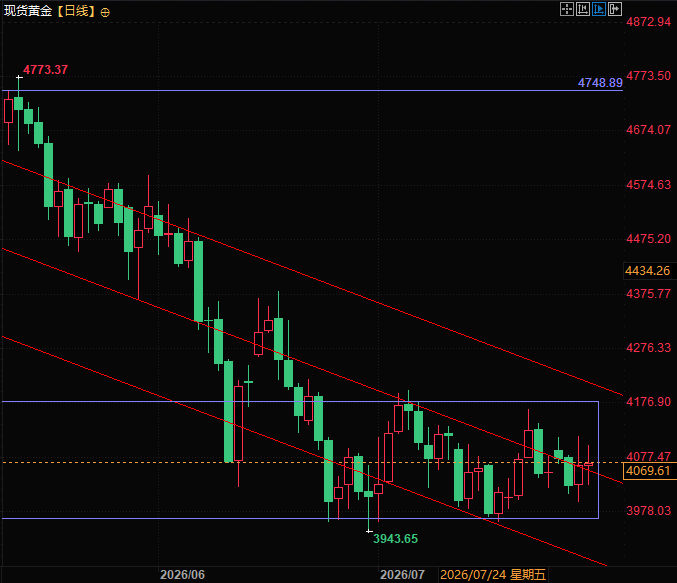 (Spot gold daily chart, source: EasyTrade) At 20:58 Beijing time, spot gold is currently trading at $4072 per ounce.
Stubbornly high inflation and multiple pressures constrain monetary policy.
US inflation has remained above the Federal Reserve's 2% policy target for five consecutive years, with the price cooling process stalled and multiple factors continuing to exert upward pressure on inflation. Geopolitically, the US-Israel military action and Iran's blockade of the Strait of Hormuz, a crucial shipping route carrying one-fifth of the world's oil and gas, has disrupted oil supply in unprecedented terms. Currently, the average international crude oil price is $10 to $15 per barrel higher than the same period last year, leading to continued imported inflation. Industrially, US technology companies are significantly increasing capital expenditure on artificial intelligence, boosting manufacturing activity while pushing up prices for commodities such as chips and electricity. Policy-wise, the Trump administration's tariffs on foreign goods continue to increase inflationary pressure, putting the Federal Reserve in a dilemma. Looking back at this inflation cycle, the US economy overheated after the pandemic in early 2021, causing inflation to surge. In mid-2022, inflation briefly exceeded 9%. While the Federal Reserve's 11 rounds of interest rate hikes from 2022 to 2023 briefly suppressed prices, the subsequent cooling process essentially stalled. Even though core inflation eased slightly in June due to short-term declines in rents and oil prices, overall prices remain highly resilient and unlikely to continue declining.Internal hawkish signals are clear; the battle against inflation is far from over.
The three regional Federal Reserve presidents who voted against the rate hike had all previously signaled a hawkish stance, firmly advocating for suppressing stubborn inflation through rate increases. Market analysts interpreted these three dissenting votes as clearly conveying the core message that the Fed has not yet completely won the battle against inflation and that easing is unlikely in the short term. A majority of Fed members also maintain a hawkish position, believing that passively observing the market is insufficient to bring inflation back to the 2% target, and that further rate hikes and tightening policies are necessary. This was not unexpected, as these three bank presidents had previously formed a coalition in April opposing the inclusion of forward-looking statements or a "dodging bias" in the committee's press release.The Federal Reserve weakens policy guidance, and market-driven pricing takes shape.
Warsh's current leadership is pushing the Federal Reserve to tighten forward communication and weaken policy guidance. His core logic is to reduce the public output of officials' views, avoid solidifying market expectations, and ensure that subsequent monetary policy can be flexibly adjusted based on economic data. Against the backdrop of significantly tightened central bank policy guidance, the US financial market has achieved autonomous interest rate pricing, with US Treasury yields rising steadily in recent weeks. The 10-year Treasury yield climbed from 4.50% in mid-June to 4.64% on the eve of the interest rate decision. Warsh affirms this, believing that the market has moved away from excessive reliance on policy statements and has begun to trade independently based on fundamentals. However, his ambiguous statements at this press conference have been questioned by several economists. Industry insiders believe that his vague wording further increases the difficulty of predicting Fed policy and makes market trends even more unpredictable.The market had initially expected a shift to a September rate hike, but both PCE and GDP data were disappointing.
Prior to this policy meeting, Wall Street traders priced in only a 33% probability of a rate hike, with most funds betting that the Fed would maintain interest rates, avoiding the shock to financial markets from a hasty rate hike. However, CME Group data shows that market expectations have shifted rapidly, with the mainstream view predicting that the Fed will resume rate hikes in September. Furthermore, Trump, who has long pressured the Fed to cut rates, publicly supported Warsh this time, acknowledging his professional abilities, while also admitting that there is a division within the Fed Committee, with the high-interest-rate camp dominating. Currently, the Fed is adhering to a data-driven decision-making logic, postponing policy adjustments and awaiting key economic data. The U.S. Commerce Department released the preliminary second-quarter GDP figure on Thursday, and the Fed's key focus, the June PCE personal consumption expenditure price index, was also released simultaneously. Both sets of key data do not support a further rate hike. The second-quarter GDP was significantly lower than expected, and the year-on-year and month-on-month PCE figures also fell short of expectations.Institutional Viewpoint:
Regarding the Federal Reserve's decision in July to keep interest rates unchanged despite heightened internal hawkish divisions, mainstream Wall Street research institutions generally believe that while the Fed chose to hold rates steady, its stance against inflation remains extremely firm. Morningstar and SMC Global strategy teams pointed out that the three dissenting votes indicate a lack of complete consensus within the Fed regarding persistent inflation, effectively opening the door to a September rate hike. Morgan Stanley and other institutions emphasized that Chairman Warsh's "new broom sweeps clean" approach of reducing forward guidance, while intended to allow the market to price based on fundamentals, also pushed up Treasury yields and led to higher market volatility, creating a situation of "achieving a tightening effect without raising rates." Furthermore, Indeed Hiring Lab and other macro teams added that under the dual pressures of global energy supply disruptions and high capital expenditures on artificial intelligence, the Fed has prioritized inflation control over the labor market; the upcoming PCE data and preliminary GDP figures will be key tests of this "data-driven" policy path. Faced with the latest disappointing second-quarter GDP growth (1.5%) and PCE inflation data, mainstream Wall Street research institutions generally believe that this combination has temporarily disrupted the market's previously aggressive pricing of a "September rate hike restart," providing the Federal Reserve with a valuable window of opportunity. Analysts from institutions such as S&P Global and Morgan Stanley point out that the decline in PCE indicates that inflationary pressures have peaked for the time being, while the slowdown in GDP confirms that high interest rates have begun to have a significant crowding-out effect on the real economy. This has largely weakened the confidence of hawkish officials within the Fed to advocate for an "immediate rate hike," allowing Warsh's "data-driven" strategy to continue. However, UBS and Wells Fargo also warn that the market is facing a shift in perspective from "inflation risk" to "profit slowdown risk"—although the decline in risk-free interest rates provides short-term valuation support for assets such as technology stocks, if the third-quarter economic growth continues to fall below the potential trend (2%), the pressure on corporate fundamentals may bring new market volatility. Technically, spot gold has risen to a key price level. (Spot gold daily chart, source: EasyTrade) At 20:58 Beijing time, spot gold is currently trading at $4072 per ounce.
- Risk Warning and Disclaimer
- The market involves risk, and trading may not be suitable for all investors. This article is for reference only and does not constitute personal investment advice, nor does it take into account certain users’ specific investment objectives, financial situation, or other needs. Any investment decisions made based on this information are at your own risk.