US stocks plummeted! The Japanese yen experienced a rapid safe-haven rally, with arbitrage selling reshaping its future trend.
2026-07-30 21:38:51
On Thursday (July 30), during the European and American trading sessions, the USD/JPY pair weakened throughout the day before accelerating its decline. Previous articles had already pointed out that the yen was at a critical level and risked a reversal, and today the USD/JPY pair indeed experienced a sharp drop. Recently, the yen exchange rate has once again entered a period of significant volatility, with the USD/JPY pair repeatedly breaking through key psychological levels. Under the watchful eyes of global capital markets, the Bank of Japan's (BOJ) monetary policy direction, the significant interest rate differential between the USD and Japan, and the dynamics of global carry trades are collectively pushing the yen into a complex macroeconomic game. Why is the yen unable to escape its downward trend? How do market institutions view the future market? By analyzing the main theme of interest rate differentials, institutional disagreements, and short-term hedging mechanisms, we can clearly reconstruct the full picture of this "yen defense battle." 
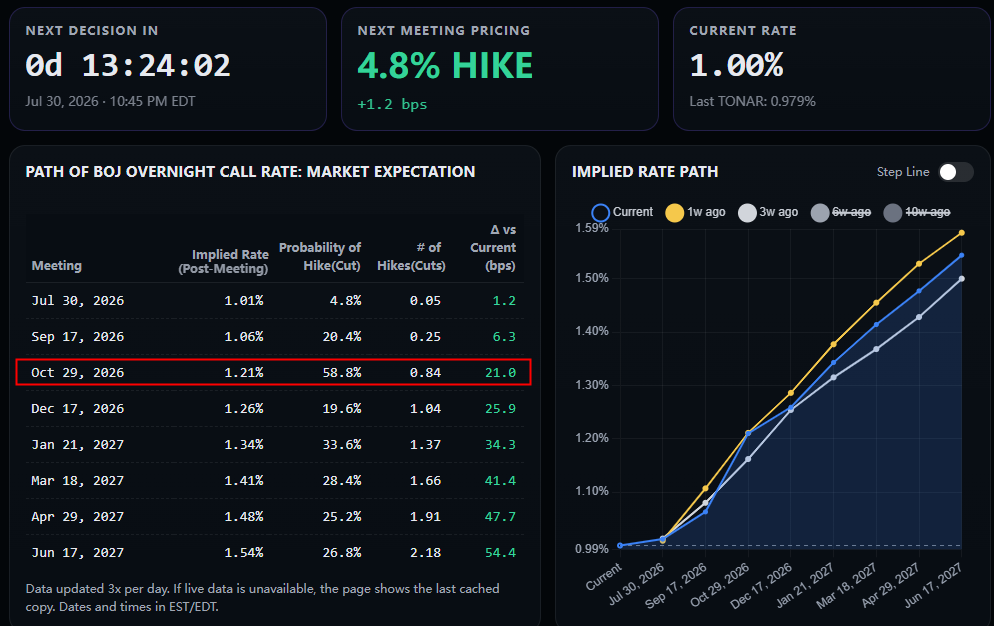 Marcel Thieliant, head of Asia Pacific at Capital Economics, holds a similar view. He stated that driven by energy prices and imported inflationary pressures, the Bank of Japan is preparing for an October rate hike, and as interest rates gradually return to normal, the yen is expected to have a breather in the medium to long term. JPMorgan, however, is more cautious, noting that at the end of the G10 central bank easing cycle, a small rate hike or foreign exchange intervention by the Bank of Japan alone is unlikely to completely reverse the trend; close attention still needs to be paid to the coordination between Japanese fiscal policy and the global macroeconomic environment.
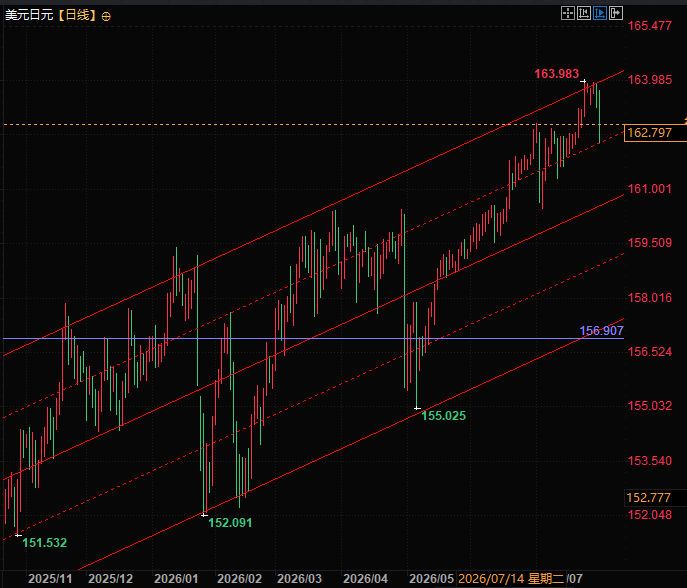 (USD/JPY daily chart, source: FX678) At 21:35 Beijing time, USD/JPY is currently trading at 162.73/74.
The fundamental driver: the unbridgeable interest rate differential between the US and Japan and the arbitrage frenzy.
The core underlying logic of the weakening yen lies in the still significant risk-free yield differential between the US and Japan. Although the Bank of Japan has ended its ultra-loose policy and started raising interest rates, its current policy interest rate level remains extremely loose compared to major central banks such as the Federal Reserve. Lured by this huge interest rate differential, global funds are engaging in massive "yen carry trades"—borrowing yen at low interest rates and selling it for higher-yield assets like the US dollar to profit from the interest rate differential. This continuous selling pressure in the foreign exchange market constitutes the main downward pressure on the yen's exchange rate in the long term. While interest rate differentials and central bank policies determine the yen's long-term depreciation trend, in the short term, the yen possesses a very strong and explosive "safe-haven reversal" characteristic. When US stocks (especially tech stocks and the broader market) experience a sharp decline or global risk-off sentiment deteriorates, the market instantly triggers "carry trade unwinding": this unwinding often has a "stampede effect"—the faster the yen appreciates, the more highly leveraged carry trades are forced to stop losses and exit, thus erasing weeks of losses in a short period. With the sharp drop in US stocks yesterday, many technical traders will choose to exit the market.Institutional Viewpoint: Concerns about holding steady and the shadow of the 170 mark
On the eve of the central bank's interest rate decision, Wall Street and top institutions offered highly divergent yet logically sound predictions about the yen's trajectory: 1. Short-term caution: a test of the "depreciation abyss" at 165 or even 170. Takafumi Onodera, head of sales and trading at MUTB in New York, pointed out that if the Bank of Japan chooses to maintain its interest rate at its latest meeting, it will directly push the USD/JPY exchange rate to the 165 level and drastically increase the risk of government intervention. "USD/JPY may briefly test 165, but as market concerns about intervention intensify, the upside should be limited," Onodera added, suggesting that the Bank of Japan may have to release hawkish signals to curb the yen's decline. However, he also warned that if the Bank of Japan completely abandons further interest rate hikes this year, while the Federal Reserve maintains high interest rates or raises rates again, the USD/JPY exchange rate could surge to the extreme level of 170. In contrast to the short-term pessimism, some medium- to long-term asset management companies are optimistic about a yen rebound. According to analysts at asset management firm Aberdeen Investments, the Bank of Japan is more likely to raise interest rates in October. At that time, with the confirmation of inflation data and the clarification of policy implementation, the rate hike will provide a substantial boost to the yen. Marcel Thieliant, head of Asia Pacific at Capital Economics, holds a similar view. He stated that driven by energy prices and imported inflationary pressures, the Bank of Japan is preparing for an October rate hike, and as interest rates gradually return to normal, the yen is expected to have a breather in the medium to long term. JPMorgan, however, is more cautious, noting that at the end of the G10 central bank easing cycle, a small rate hike or foreign exchange intervention by the Bank of Japan alone is unlikely to completely reverse the trend; close attention still needs to be paid to the coordination between Japanese fiscal policy and the global macroeconomic environment.Summary and Outlook: Finding Balance Amidst Two-Way Pull
Overall, the Japanese yen is currently caught in a tug-of-war between "long-term structural suppression" and "short-term event-driven rebound": Suppression line (downward): The huge interest rate differential between the US and Japan, coupled with the Bank of Japan's extremely cautious pace of interest rate hikes, has attracted carry trade funds to continuously build short positions (selling yen and buying dollars). Support line (upward): The threat of official intervention at the 165/170 level, carry trade unwinding triggered by the US stock market correction, and expectations of an October interest rate hike forcing short covering (buying yen and selling dollars). With the Ministry of Finance of Japan issuing increasingly strong warnings, the risk of intervention reaching a critical point, and the increased volatility in US stocks, investors need to be highly vigilant about the risk of a sharp pullback in the yen after its recent plunge, triggered by carry trade unwinding or a shift towards a hawkish policy stance. (USD/JPY daily chart, source: FX678) At 21:35 Beijing time, USD/JPY is currently trading at 162.73/74.
- Risk Warning and Disclaimer
- The market involves risk, and trading may not be suitable for all investors. This article is for reference only and does not constitute personal investment advice, nor does it take into account certain users’ specific investment objectives, financial situation, or other needs. Any investment decisions made based on this information are at your own risk.