A chart shows the Baltic Dry Index rebounding, ending a three-day losing streak, indicating a significant structural divergence in the shipping market.
2026-07-30 23:16:49
Latest data shows that the Baltic Dry Index (BDI) reached 2673 points on July 30, 2026, a three-day high, up 1.56% month-on-month (compared to the previous value), marking the largest increase since July 22, 2026. Looking at the short-term charts, the BDI has seen positive growth 4 times, negative growth 7 times, and zero growth 0 times in the last 11 BDI data points. Specifically, the Panamax Freight Index (BPI) was 2040 points, up 2.26% from the previous value; the Capesize Freight Index (BCI) was 4167 points, up 2.46%; and the Supramax Freight Index (BSI) was 1610 points, down 1.11%. For detailed charts of the latest 720-day and 10-year trends of the Baltic Dry Index and its three main sub-indices, please refer to the charts specially created by FX678. 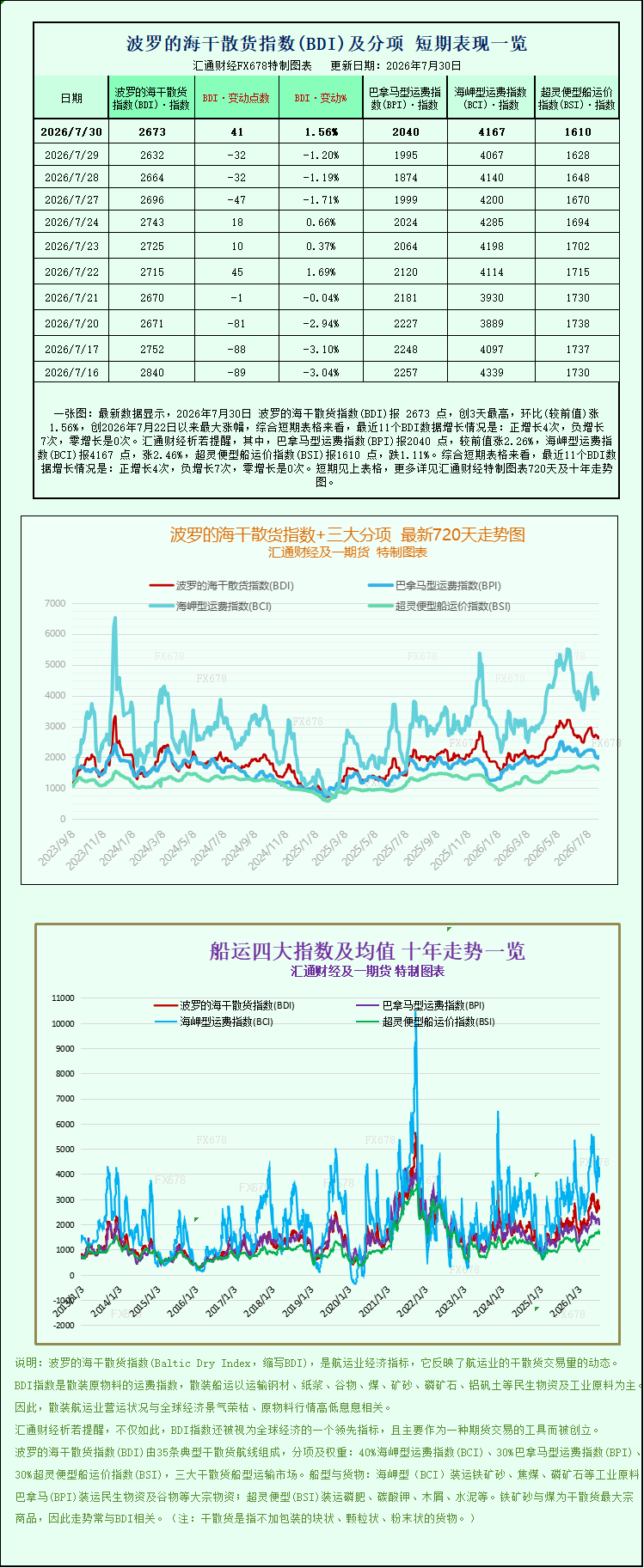 On July 30, 2026, the international dry bulk shipping market showed signs of stabilization, with the Baltic Dry Index (BADI) reversing its three-day downward trend and rebounding. This market movement exhibited a clear structural divergence, with freight rates for large Capesize and Panamax vessels rebounding strongly from recent lows, driving the overall market index higher. Meanwhile, the capacity of small and medium-sized Supramax vessels continued to weaken, with freight rates hitting new lows in eight weeks, clearly demonstrating the current supply-demand mismatch in the global dry bulk shipping market. Data shows that the core Baltic Dry Index rose 41 points, or 1.6%, to close at 2673 points, marking its first increase since July 24. Prior to this, the index had been trending downwards, reaching its lowest point in nearly a month on Wednesday. Market pessimism subsided, and short-term valuation repair demand, coupled with a recovery in bulk raw material shipping orders, propelled the market's rebound against the trend. As a core indicator of the global dry bulk shipping market, the Baltic Dry Index's rebound not only reflects a marginal improvement in international demand for bulk raw materials by sea, but also a slight adjustment in the short-term supply and demand pattern of the shipping market. The large vessel sector was the core driver of this rebound, with Capesize vessels performing the best. The Capesize Index (BACI), which tracks the price of 150,000-ton large bulk carriers, surged 100 points, or 2.5%, to close at 4167 points, successfully ending its three-day losing streak. This vessel type primarily carries core industrial bulk raw materials such as iron ore and thermal coal, and is a core carrier in the global industrial supply chain's maritime shipping segment. Its freight rate fluctuations are highly correlated with global heavy industrial production and raw material replenishment demand. Along with the index rise, the operating income of Capesize vessels also recovered significantly, and the market's profit atmosphere improved markedly. Data shows that the average daily revenue of Capesize vessels increased by $908, with the latest daily revenue reaching $34,292. Industry analysts point out that the recent rebound in large ore carrier freight rates is mainly due to the release of pent-up orders for international iron ore and coal ocean trade, concentrated shipments from some overseas mines, a slight recovery in restocking demand for industrial raw materials in Eurasia, and limited short-term capacity turnover on some ocean routes, all of which have driven a rebound in spot freight rates for large dry bulk carriers. The Panamax shipping sector also strengthened, helping the overall market index stabilize and recover. The Panamax Index (BPNI) rose 45 points, or 2.3%, to 2040 points, a new high since July 24. Previously, the index had been sluggish, hitting its lowest level since April 29 on Tuesday, indicating strong upward momentum after the market oversold. This type of vessel, with a tonnage between 60,000 and 70,000 tons, primarily transports bulk commodities such as coal, grains, and fertilizers, while also catering to the maritime demand for industrial raw materials and agricultural products. Its routes cover major global trade channels, making it highly sensitive to market fluctuations. Profitability data improved simultaneously, with average daily revenue for Panamax vessels rising by $410 to $18,363. This round of Panamax freight rate recovery was supported by two factors: firstly, stable global grain shipping orders, with remaining orders from the end of the peak season for grain transportation in the Northern Hemisphere continuing to be released; secondly, a slight recovery in coal restocking demand in the Asia-Pacific and European regions, leading to increased cargo volume on medium- and long-haul routes, effectively offsetting some market headwinds and driving a steady recovery in freight rates. In stark contrast to the rebound in large vessels, the market for small and medium-sized Supramax vessels continued to be under pressure, weakening against the trend. The Supramax Index (BSIS) fell 18 points, a 1.1% drop, closing at 1610 points, a near eight-week low since June 9th, becoming the only weak link dragging down the overall market. Supramax vessels are smaller in tonnage and primarily engage in short-haul regional shipping and small-volume bulk cargo transportation; their market performance depends more on regional trade activity and is less affected by global long-haul bulk trade. Industry analysts believe the core reason for the continued weakness in Supramax vessels lies in the sluggish demand for small and medium-sized bulk cargo transportation, coupled with relatively ample regional market capacity and a loose supply-demand balance. Currently, the pace of global regional trade recovery is slowing, with insufficient orders for bulk cargo shipping such as small-volume building materials, agricultural supplies, and light industrial raw materials. This, combined with the high turnover rate of small and medium-sized vessels and a large amount of idle capacity, has led to fierce market competition and a continued decline in freight rates, creating a stark contrast with the strong rebound of large vessels. It is noteworthy that this structural trend in the shipping market is in stark contrast to the trend in the domestic commodity market. On Thursday, domestic iron ore futures in Dalian continued to decline, falling to their lowest point in a year, with the core pressure stemming from the operational difficulties of the domestic steel industry. Currently, losses at domestic steel mills continue to widen, leading to weak production intentions and further downward revisions in pig iron production expectations. This results in weak short-term iron ore procurement demand, suppressing domestic spot and futures prices. However, the international iron ore shipping market, supported by overseas mine shipments and international demand, has rebounded independently, highlighting the difference in demand rhythms between domestic and international markets. Overall, the global dry bulk shipping market has entered a phase of structural differentiation. Large industrial raw material transport vessels are benefiting from the marginal recovery in international bulk commodity trade and short-term capacity disruptions, leading to a valuation recovery. Meanwhile, small and medium-sized regional transport vessels continue to operate under pressure due to weak demand and overcapacity. Future market trends will depend heavily on the progress of domestic steel industry resumption of production, the pace of global coal and grain trade order releases, and factors such as weather changes in the Northern Hemisphere and capacity fluctuations caused by ship maintenance cycles.
On July 30, 2026, the international dry bulk shipping market showed signs of stabilization, with the Baltic Dry Index (BADI) reversing its three-day downward trend and rebounding. This market movement exhibited a clear structural divergence, with freight rates for large Capesize and Panamax vessels rebounding strongly from recent lows, driving the overall market index higher. Meanwhile, the capacity of small and medium-sized Supramax vessels continued to weaken, with freight rates hitting new lows in eight weeks, clearly demonstrating the current supply-demand mismatch in the global dry bulk shipping market. Data shows that the core Baltic Dry Index rose 41 points, or 1.6%, to close at 2673 points, marking its first increase since July 24. Prior to this, the index had been trending downwards, reaching its lowest point in nearly a month on Wednesday. Market pessimism subsided, and short-term valuation repair demand, coupled with a recovery in bulk raw material shipping orders, propelled the market's rebound against the trend. As a core indicator of the global dry bulk shipping market, the Baltic Dry Index's rebound not only reflects a marginal improvement in international demand for bulk raw materials by sea, but also a slight adjustment in the short-term supply and demand pattern of the shipping market. The large vessel sector was the core driver of this rebound, with Capesize vessels performing the best. The Capesize Index (BACI), which tracks the price of 150,000-ton large bulk carriers, surged 100 points, or 2.5%, to close at 4167 points, successfully ending its three-day losing streak. This vessel type primarily carries core industrial bulk raw materials such as iron ore and thermal coal, and is a core carrier in the global industrial supply chain's maritime shipping segment. Its freight rate fluctuations are highly correlated with global heavy industrial production and raw material replenishment demand. Along with the index rise, the operating income of Capesize vessels also recovered significantly, and the market's profit atmosphere improved markedly. Data shows that the average daily revenue of Capesize vessels increased by $908, with the latest daily revenue reaching $34,292. Industry analysts point out that the recent rebound in large ore carrier freight rates is mainly due to the release of pent-up orders for international iron ore and coal ocean trade, concentrated shipments from some overseas mines, a slight recovery in restocking demand for industrial raw materials in Eurasia, and limited short-term capacity turnover on some ocean routes, all of which have driven a rebound in spot freight rates for large dry bulk carriers. The Panamax shipping sector also strengthened, helping the overall market index stabilize and recover. The Panamax Index (BPNI) rose 45 points, or 2.3%, to 2040 points, a new high since July 24. Previously, the index had been sluggish, hitting its lowest level since April 29 on Tuesday, indicating strong upward momentum after the market oversold. This type of vessel, with a tonnage between 60,000 and 70,000 tons, primarily transports bulk commodities such as coal, grains, and fertilizers, while also catering to the maritime demand for industrial raw materials and agricultural products. Its routes cover major global trade channels, making it highly sensitive to market fluctuations. Profitability data improved simultaneously, with average daily revenue for Panamax vessels rising by $410 to $18,363. This round of Panamax freight rate recovery was supported by two factors: firstly, stable global grain shipping orders, with remaining orders from the end of the peak season for grain transportation in the Northern Hemisphere continuing to be released; secondly, a slight recovery in coal restocking demand in the Asia-Pacific and European regions, leading to increased cargo volume on medium- and long-haul routes, effectively offsetting some market headwinds and driving a steady recovery in freight rates. In stark contrast to the rebound in large vessels, the market for small and medium-sized Supramax vessels continued to be under pressure, weakening against the trend. The Supramax Index (BSIS) fell 18 points, a 1.1% drop, closing at 1610 points, a near eight-week low since June 9th, becoming the only weak link dragging down the overall market. Supramax vessels are smaller in tonnage and primarily engage in short-haul regional shipping and small-volume bulk cargo transportation; their market performance depends more on regional trade activity and is less affected by global long-haul bulk trade. Industry analysts believe the core reason for the continued weakness in Supramax vessels lies in the sluggish demand for small and medium-sized bulk cargo transportation, coupled with relatively ample regional market capacity and a loose supply-demand balance. Currently, the pace of global regional trade recovery is slowing, with insufficient orders for bulk cargo shipping such as small-volume building materials, agricultural supplies, and light industrial raw materials. This, combined with the high turnover rate of small and medium-sized vessels and a large amount of idle capacity, has led to fierce market competition and a continued decline in freight rates, creating a stark contrast with the strong rebound of large vessels. It is noteworthy that this structural trend in the shipping market is in stark contrast to the trend in the domestic commodity market. On Thursday, domestic iron ore futures in Dalian continued to decline, falling to their lowest point in a year, with the core pressure stemming from the operational difficulties of the domestic steel industry. Currently, losses at domestic steel mills continue to widen, leading to weak production intentions and further downward revisions in pig iron production expectations. This results in weak short-term iron ore procurement demand, suppressing domestic spot and futures prices. However, the international iron ore shipping market, supported by overseas mine shipments and international demand, has rebounded independently, highlighting the difference in demand rhythms between domestic and international markets. Overall, the global dry bulk shipping market has entered a phase of structural differentiation. Large industrial raw material transport vessels are benefiting from the marginal recovery in international bulk commodity trade and short-term capacity disruptions, leading to a valuation recovery. Meanwhile, small and medium-sized regional transport vessels continue to operate under pressure due to weak demand and overcapacity. Future market trends will depend heavily on the progress of domestic steel industry resumption of production, the pace of global coal and grain trade order releases, and factors such as weather changes in the Northern Hemisphere and capacity fluctuations caused by ship maintenance cycles.- Risk Warning and Disclaimer
- The market involves risk, and trading may not be suitable for all investors. This article is for reference only and does not constitute personal investment advice, nor does it take into account certain users’ specific investment objectives, financial situation, or other needs. Any investment decisions made based on this information are at your own risk.