Wall Street warns the Federal Reserve is facing a "blow to its credibility due to inflation," and US Treasury yields continue to rise.
2026-07-31 01:18:50
On Thursday (July 30), long-term US Treasury yields remained high. Even though the Federal Reserve kept its benchmark interest rate unchanged as expected, the market did not react favorably, instead continuing to sell long-term bonds and push up long-term yields. Investors are deeply digesting the Fed's decision to maintain interest rates, while major Wall Street institutions have collectively voiced their opinions, pointing to a serious crisis of policy credibility facing the core US central bank.  The 10-year Treasury yield rose to 4.66%, and the 30-year Treasury yield reached 5.21%, once again hitting a new high since the 2007 subprime mortgage crisis. The continued rise in long-term interest rates indicates a pessimistic market outlook regarding long-term inflation risks. During Federal Reserve Chairman Kevin Warsh's press conference on Wednesday, the 2-year Treasury yield fell by 4 basis points, but the 10-year and 30-year yields rose slightly, showing a clear divergence between short- and long-term interest rate trends. This clearly reflects the misalignment between short-term policy expectations and long-term inflation concerns. The rise in long-term yields sends a clear signal: investors are worried that the Federal Reserve is lagging behind in its efforts to combat inflation, with its policy pace lagging behind market changes, and unable to effectively suppress persistent and stubborn inflationary pressures. Therefore, they demand a higher yield premium in order to lock up funds and hold long-term Treasury assets. Bank of America Global Research economist Aditya Bawe and her team wrote, "Market movements after the FOMC meeting confirm that central banks are facing a blow to their credibility regarding inflation." The team added, "Ironically, all else being equal, the urgent need to rebuild credibility has actually increased the likelihood of a September rate hike by the Fed." The market generally believes that if the Fed continues to allow inflation expectations to rise, it can only restore market confidence through further rate hikes. The bank predicts that the Fed will raise rates by 25 basis points at each of its remaining three FOMC meetings this year. This aggressive rate hike expectation further supports the current upward trend in US Treasury yields. After the Warsh conference, the probability of a September rate hike on the Polymarket prediction platform rose to 56%, market expectations for a rate hike rose rapidly, and speculative sentiment on the trading side continued to heat up.
 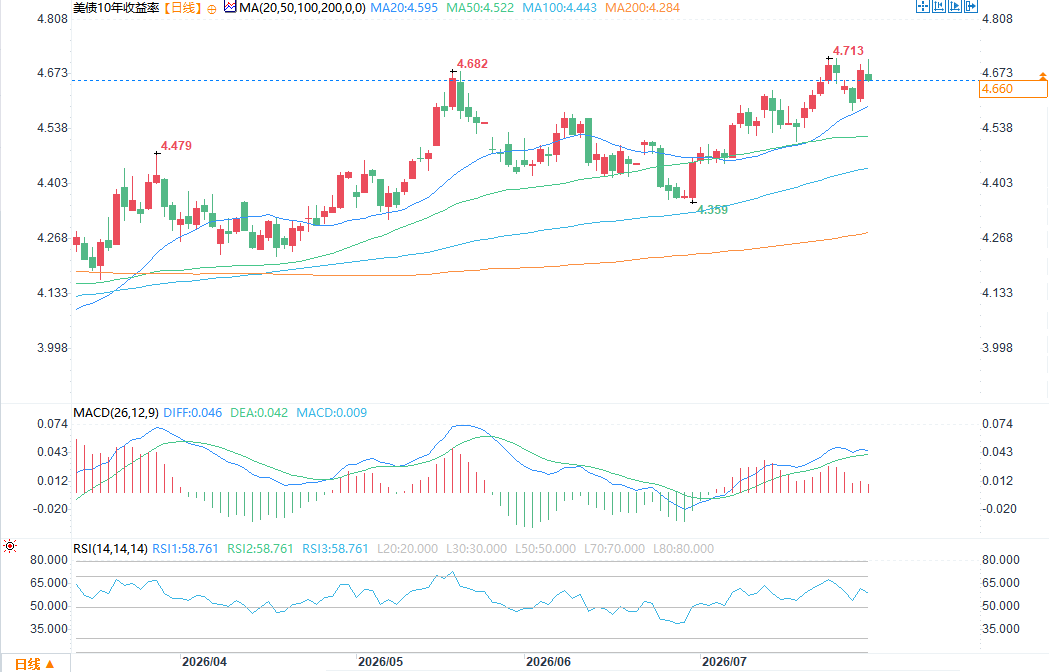 (Daily chart of 10-year US Treasury yield) Federal Reserve Chairman Kevin Warsh stated that he would not provide fixed forward guidance on monetary policy to allow the market to react and price itself. This move broke with the Fed's previous communication practices and deprived the market of a stable policy reference anchor. Although Warsh reiterated the Fed's commitment to bringing inflation back to its long-term core target of 2%, the wording in the press conference showed a clear shift. Bank of America economists pointed out that "the limited information he released was generally dovish," with a clear policy inclination towards easing and stability, failing to demonstrate a strong and resolute attitude towards combating inflation. Warsh mentioned that the Fed currently still uses personal consumption expenditures (PCE) inflation as its core monitoring target; however, this core inflation monitoring indicator may be adjusted after the data assessment task force he specifically formed submits its research recommendations. Bank of America economists commented: "This opens up space for the Fed to selectively choose favorable indicators to support a dovish easing policy stance." The market is concerned that the Fed may beautify inflation data by adjusting statistical standards, weakening the strength of its anti-inflation policy. Warsh also released a key signal: raising interest rates is not the only policy tool to suppress inflation. He repeatedly implied that the recent rise in long-term US Treasury yields and the market's spontaneous increase in overall financing costs, with simultaneous increases in real estate, corporate credit, and household borrowing costs, indicate that the market is tightening financial conditions on its own, effectively doing the tightening work for the Federal Reserve. Analysts warn: "However, we believe that the Federal Reserve cannot rely solely on strong rhetoric and endlessly depend on the market to complete the tightening. Ultimately, it must be consistent in its words and actions, implementing substantial tightening policies; otherwise, it will face a huge risk of continued loss of public trust." Once the central bank's credibility is completely weakened, long-term inflation expectations will spiral out of control, triggering wider financial volatility.
The 10-year Treasury yield rose to 4.66%, and the 30-year Treasury yield reached 5.21%, once again hitting a new high since the 2007 subprime mortgage crisis. The continued rise in long-term interest rates indicates a pessimistic market outlook regarding long-term inflation risks. During Federal Reserve Chairman Kevin Warsh's press conference on Wednesday, the 2-year Treasury yield fell by 4 basis points, but the 10-year and 30-year yields rose slightly, showing a clear divergence between short- and long-term interest rate trends. This clearly reflects the misalignment between short-term policy expectations and long-term inflation concerns. The rise in long-term yields sends a clear signal: investors are worried that the Federal Reserve is lagging behind in its efforts to combat inflation, with its policy pace lagging behind market changes, and unable to effectively suppress persistent and stubborn inflationary pressures. Therefore, they demand a higher yield premium in order to lock up funds and hold long-term Treasury assets. Bank of America Global Research economist Aditya Bawe and her team wrote, "Market movements after the FOMC meeting confirm that central banks are facing a blow to their credibility regarding inflation." The team added, "Ironically, all else being equal, the urgent need to rebuild credibility has actually increased the likelihood of a September rate hike by the Fed." The market generally believes that if the Fed continues to allow inflation expectations to rise, it can only restore market confidence through further rate hikes. The bank predicts that the Fed will raise rates by 25 basis points at each of its remaining three FOMC meetings this year. This aggressive rate hike expectation further supports the current upward trend in US Treasury yields. After the Warsh conference, the probability of a September rate hike on the Polymarket prediction platform rose to 56%, market expectations for a rate hike rose rapidly, and speculative sentiment on the trading side continued to heat up. (Daily chart of 10-year US Treasury yield) Federal Reserve Chairman Kevin Warsh stated that he would not provide fixed forward guidance on monetary policy to allow the market to react and price itself. This move broke with the Fed's previous communication practices and deprived the market of a stable policy reference anchor. Although Warsh reiterated the Fed's commitment to bringing inflation back to its long-term core target of 2%, the wording in the press conference showed a clear shift. Bank of America economists pointed out that "the limited information he released was generally dovish," with a clear policy inclination towards easing and stability, failing to demonstrate a strong and resolute attitude towards combating inflation. Warsh mentioned that the Fed currently still uses personal consumption expenditures (PCE) inflation as its core monitoring target; however, this core inflation monitoring indicator may be adjusted after the data assessment task force he specifically formed submits its research recommendations. Bank of America economists commented: "This opens up space for the Fed to selectively choose favorable indicators to support a dovish easing policy stance." The market is concerned that the Fed may beautify inflation data by adjusting statistical standards, weakening the strength of its anti-inflation policy. Warsh also released a key signal: raising interest rates is not the only policy tool to suppress inflation. He repeatedly implied that the recent rise in long-term US Treasury yields and the market's spontaneous increase in overall financing costs, with simultaneous increases in real estate, corporate credit, and household borrowing costs, indicate that the market is tightening financial conditions on its own, effectively doing the tightening work for the Federal Reserve. Analysts warn: "However, we believe that the Federal Reserve cannot rely solely on strong rhetoric and endlessly depend on the market to complete the tightening. Ultimately, it must be consistent in its words and actions, implementing substantial tightening policies; otherwise, it will face a huge risk of continued loss of public trust." Once the central bank's credibility is completely weakened, long-term inflation expectations will spiral out of control, triggering wider financial volatility.- Risk Warning and Disclaimer
- The market involves risk, and trading may not be suitable for all investors. This article is for reference only and does not constitute personal investment advice, nor does it take into account certain users’ specific investment objectives, financial situation, or other needs. Any investment decisions made based on this information are at your own risk.