The yen surged by more than 3% ahead of the meeting, raising suspicions of government intervention. The Bank of Japan is expected to hold rates steady. Will Kazuo Ueda be able to send a sufficiently hawkish signal?
2026-07-31 09:56:50
Central banks worldwide are simultaneously focusing on the energy shock and inflation risks stemming from the Middle East conflict. While the Federal Reserve kept interest rates unchanged at its July meeting on Wednesday (July 29), three policymakers unusually called for a rate hike. Following closely, the Bank of Japan is set to announce its interest rate decision on Friday (July 31). The market has already priced in the expectation of a 1% rate unchanged; the real suspense lies in this complex backdrop: with the yen falling to a 40-year low, Tokyo inflation accelerating towards the 2% target, and suspected pre-meeting intervention in the foreign exchange market, can Kazuo Ueda deliver sufficiently hawkish communication to both appease expectations of yen depreciation and avoid jeopardizing the fragile economic recovery? This will be the core focus of this meeting and the subsequent press conference. 
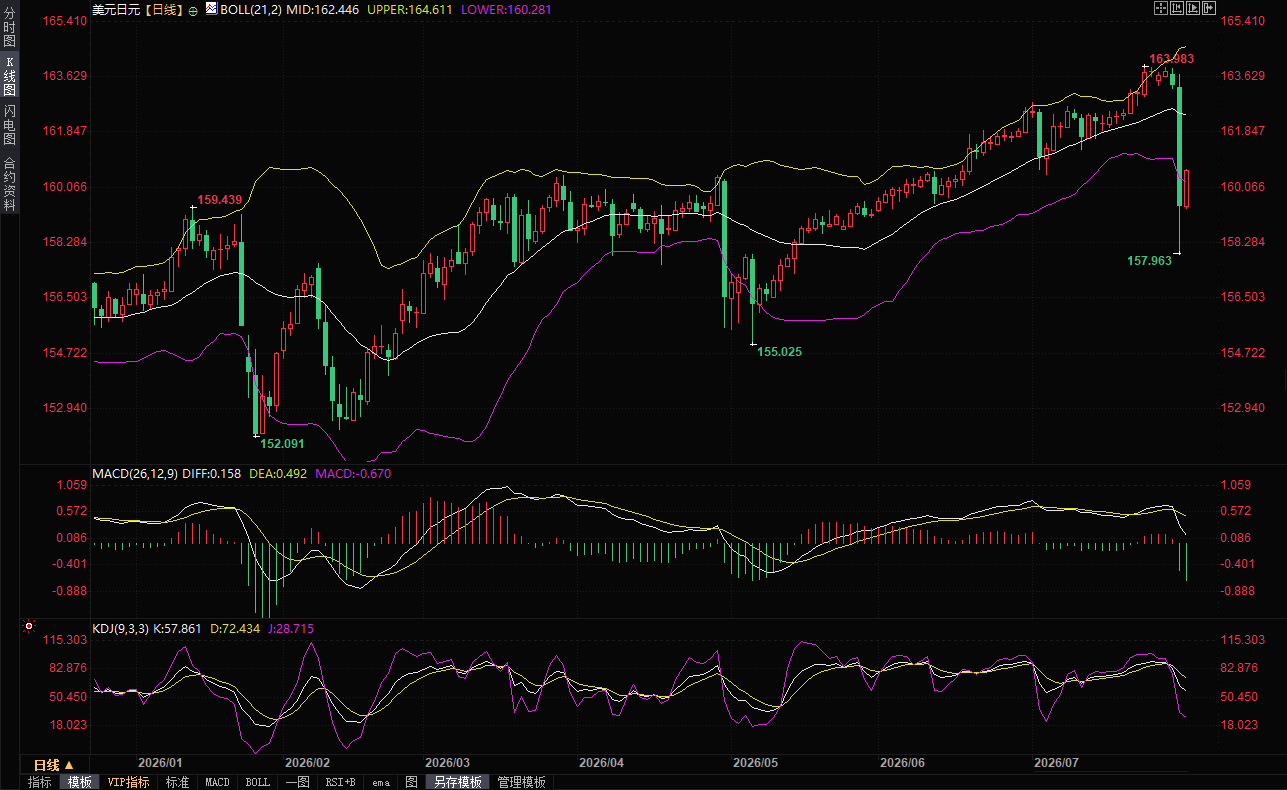 (USD/JPY daily chart, source: FX678) At 09:52 Beijing time, USD/JPY is currently trading at 160.69/70.
I. Interest Rate Decision: Holding rates steady is almost a certainty; hawkish committee members may vote against it.
The Bank of Japan (BOJ) will announce the results of its monetary policy meeting around noon on July 31 (approximately 11:00 AM Beijing time). The market widely expects that, following the June increase in the policy rate from 0.75% to 1.0%, the BOJ will maintain the short-term interest rate at 1%. The June rate hike pushed Japan's policy rate to its highest level in 31 years, marking the first time the bank has returned to the 1% rate era since 1995. Given the recent rate hike, the BOJ needs time to assess the actual impact of the previous increase on the economy and inflation. However, holding steady does not necessarily indicate a shift towards a more dovish policy stance. Analysts predict that hawkish policymaker Hajime Takada may disagree at this meeting, proposing a rate hike to 1.25%. This potential disagreement itself constitutes a hawkish signal, suggesting a growing desire within the central bank for further monetary tightening. This BOJ meeting follows the Federal Reserve's July policy meeting. The Fed voted 9-3 to keep rates unchanged, but three policymakers voted against a 25 basis point increase. The simultaneous release of hawkish signals by major central banks around the world reflects a shared concern about the energy shock and inflation risks triggered by the Middle East conflict.II. Outlook Report: Economic growth forecast revised upward, inflation forecast slightly lowered.
The Bank of Japan will release its quarterly "Economic and Price Outlook Report" concurrently with this meeting, which is considered a more important market focus than the interest rate decision itself. According to sources, the Bank of Japan is expected to raise its economic growth forecast for fiscal year 2026 while slightly lowering its core inflation forecast. Regarding economic growth, the median forecast for real GDP growth in fiscal year 2026 in the April outlook report was +0.5%. This expectation will be slightly revised upwards, benefiting from strong global AI demand, easing concerns about the Middle East conflict, and lower oil prices easing energy cost pressures on businesses. Regarding inflation forecasts, the median forecast for core CPI (excluding fresh food) growth in fiscal year 2026 in the April outlook report was +2.8%, a significant upward revision of 0.9 percentage points from +1.9% in January, mainly due to the surge in oil prices caused by tensions in the Middle East. However, this forecast is expected to be lowered at this meeting. Reasons for the downward revision include the effect of government subsidies, the decline in oil prices from their April highs, and the shift in rice prices from a year-on-year increase of over 100% last year to -4.9% in May this year, exerting a downward pressure on CPI of approximately 0.66 percentage points. The Japan Research Institute projects that the median forecast for core CPI in fiscal year 2026 may be revised downward by 0.3 to 0.4 percentage points. However, sources familiar with the matter emphasized that the downward revision will be small – volatility in the oil market and rising import costs due to a weaker yen will continue to put upward pressure on prices. The Bank of Japan will remain highly vigilant about the risk of inflation rising more than expected. Kei Fujimoto, senior economist at SuMi Trust, noted, “Although the inflation forecast may be revised downward, stronger economic growth will strengthen the Bank of Japan’s confidence that the economy can withstand further policy normalization.” He maintained his basic expectation of raising interest rates approximately once every six months, but also stated that given the improved growth outlook and accelerating import price inflation, the possibility of accelerating the pace of tightening cannot be ruled out.III. Inflation Data and the Yen's Movement: Core CPI rebounded in June, and Tokyo's inflation accelerated towards the target in July.
Inflation data provided crucial context for this meeting. Data released by Japan's Ministry of Internal Affairs and Communications on July 24 showed that the core CPI, excluding fresh food, rose 1.6% year-on-year in June, the first increase in three months, in line with market expectations. This marked the 58th consecutive month of year-on-year increases in the core CPI. The "core-core CPI," excluding fresh food and energy, rose 1.7% year-on-year, with the overall CPI also increasing by 1.7%. Although the June core CPI remained below the Bank of Japan's 2% target, it accelerated significantly from May's 1.4%, indicating that rising energy prices and a weaker yen are being transmitted to the consumer end. Japan's producer price index surged 7.1% year-on-year in June, highlighting significant upstream cost pressures. More crucially, the Tokyo inflation data released on July 31 showed that Tokyo's core CPI, excluding fresh food, rose 1.9% year-on-year in July, higher than June's 1.6% and economists' expectations of 1.7%. The "core-core CPI," excluding fresh food and energy, and the overall CPI both rose 2.0%. The Tokyo CPI is considered a leading indicator of national price trends, and this better-than-expected reading suggests that national inflation may be accelerating in the near future, approaching or even exceeding the central bank's 2% target.IV. Yen Intervention: Emergency Measures Taken Before the Meeting, Market Games Intensify
The yen's exchange rate was one of the core factors behind this meeting. During the New York trading session on July 30, the yen surged as much as 3.3% to 157.96 against the dollar, marking its largest single-day gain since December 2023. The market widely speculated that Japanese authorities intervened in the New York market by buying yen and selling dollars. According to Citigroup monitoring, approximately $8.1 billion in USD/JPY sell orders were triggered within a 10-minute window. This intervention was Japan's first since it intervened in the foreign exchange market with a cumulative total of 11.73 trillion yen (approximately $73.2 billion) between April and May 2024. Earlier this month, the yen had fallen below a 40-year low of 163 against the dollar. US Treasury Secretary Bessenter publicly stated that the yen "appears to be severely undervalued." During the Asian trading session on Friday (July 31), the dollar/yen pair rebounded above 160 after the intervention, currently trading around 160.70, a gain of approximately 0.75%. Analysts pointed out that Kazuo Ueda faces the challenge of curbing yen bearish sentiment through hawkish communication. However, political pressure from the dovish government and the potential economic impact of the 7.1 magnitude earthquake in Kumamoto Prefecture on July 28 could weaken market expectations for a shift towards a hawkish stance by the central bank.V. Market Game: Citigroup Bets on a Rebound in USD/JPY
Ahead of the Bank of Japan's (BOJ) decision, Citigroup's foreign exchange strategy team offered clear trading advice. Daniel Tobon, Senior FX and Macro Strategist at Citigroup, stated that Kazuo Ueda is unlikely to adopt a more hawkish stance than the market expects, which could disappoint the market. Citigroup recommends buying a one-month USD/JPY call option spread of 160.50/162 – taking profits if USD/JPY rebounds above 160.50, with profits capped at 162. Citigroup analysts pointed out that the sharp decline in USD/JPY is "consistent with previous interventions," but "Governor Ueda's inability to send a hawkish signal beyond market expectations could lead to market disappointment." They believe there is room for a rebound in USD/JPY and further upward momentum. JPMorgan strategists offered a different perspective, suggesting that the Japanese authorities' intervention before the BOJ decision reflects an anticipation that Ueda might release a dovish tone, triggering another yen sell-off. At this stage, it is difficult to release a clear signal on the pace of interest rate hikes, and the market has largely priced in rate hike expectations; "there is a risk that this policy communication could be interpreted as dovish by the market."VI. Kazuo Ueda's press conference: The degree of hawkishness becomes a key variable.
Market attention has shifted entirely to Governor Kazuo Ueda's press conference. The Bank of Japan typically releases its policy decisions and quarterly outlook report around noon Tokyo time, and Ueda's press conference will begin at 3:30 PM local time. This is Ueda's first press conference since his discharge from the hospital, making his statements particularly significant. Regarding the timing of the next interest rate hike, the market has differing opinions. Market analysts believe that considering the recent continued depreciation of the yen, the next rate hike may occur as early as September. ANZ Bank expects the Bank of Japan to raise rates by 25 basis points as early as October, but also indicates that if the yen continues to weaken, the central bank may act sooner. Most market analysts expect the Bank of Japan to raise rates again to 1.25% by the end of the year. Currently, the market prices the probability of a rate hike in September and October at approximately 24% and 68%, respectively. Economists at Mizuho Securities point out that the core risk of this press conference is not that it is "not hawkish enough," but rather that it is "not specific enough"—vague hawkish statements and clear dovish signals may not be fundamentally different in the eyes of the market. Mark Dowding, chief investment officer at RBC BlueBay, said: “If Ueda’s stance is not hawkish enough, the yen could fall below 165 against the dollar. I think Ueda will open the door for a rate hike in September or October, but his hawkishness is not enough to drive a significant rebound in the yen.”Editor's Summary
The Bank of Japan (BOJ) is almost certain to keep interest rates unchanged at 1% at its July meeting, but the real focus of market speculation lies in the "hawkish stance of holding steady." A combination of factors—an upward revision of growth expectations and a slight downward revision of inflation expectations, potential objections from hawkish committee members, and Tokyo's July inflation accelerating faster than expected to 1.9%, nearing the BOJ's target—collectively paints a picture of a policy scenario where "pausing rate hikes does not mean stopping rate hikes altogether." The weakness of the yen remains the core issue: the government's emergency intervention before the meeting highlights its declining tolerance for currency depreciation, and the wording of Kazuo Ueda's press conference will be a key indicator of the timing of the next rate hike. The differing predictions by Citigroup and JPMorgan Chase regarding the hawkishness of Ueda's remarks reflect the core uncertainty currently priced into the market—whether the BOJ can find a balance between pressure from a dovish government, the economic impact of the earthquake, and rising inflation, and whether it can use sufficiently hawkish communication to curb expectations of yen depreciation. The success or failure of this balance will directly determine the medium-term trend of the yen's exchange rate and the pace of normalization of Japan's monetary policy. (USD/JPY daily chart, source: FX678) At 09:52 Beijing time, USD/JPY is currently trading at 160.69/70.
- Risk Warning and Disclaimer
- The market involves risk, and trading may not be suitable for all investors. This article is for reference only and does not constitute personal investment advice, nor does it take into account certain users’ specific investment objectives, financial situation, or other needs. Any investment decisions made based on this information are at your own risk.