Vale's financial results for the second quarter of 2026
2026-07-31 10:42:53
Vale today released its financial results for the second quarter of 2026. Rio de Janeiro, Brazil, July 30, 2026 – “All of our businesses delivered solid year-over-year results, with iron ore production reaching its highest second quarter since 2018 and copper production its best second quarter in nine years. Strong EBITDA and cash flow generation demonstrate Vale’s strength and resilience in a volatile global environment, thanks to our high-quality assets and our continued commitment to operational excellence and efficiency. We are also moving forward with a series of high-return, low-capital-intensive projects. The 20 million tonnes per annum capacity expansion project at Nanling has commenced operation, which will further solidify our most competitive iron ore position.” The status of the S11D operating area. Regarding the copper business, the Bakkaba project is progressing faster than planned, marking a significant milestone towards our goal of doubling copper production by 2035. Based on solid results in the first half of 2026, the Board of Directors approved a $1.7 billion dividend and capital interest payment and extended our share repurchase program, demonstrating our strong belief in Vale's long-term value. "I am confident in Vale's future. We will continue to maintain stable asset operations, invest in high-return projects, and create value for society while rewarding shareholders," said Mr. Gustavo Pimenta, CEO of Vale. 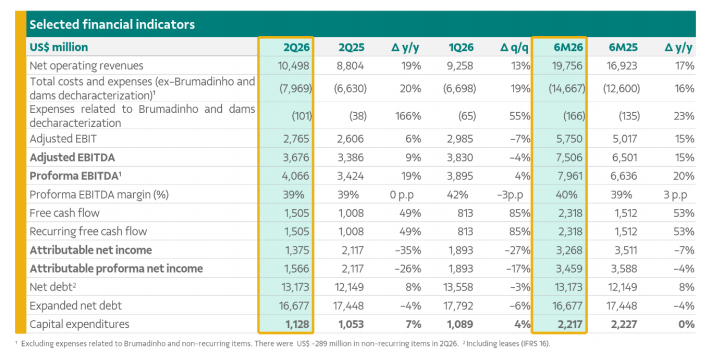
Performance Highlights
Sales volume increased across all business segments. Iron ore, copper, and nickel sales increased by 3% (2 million tons), 10% (9,000 tons), and 7% (3,000 tons) year-on-year, respectively. Base metal prices rose month-on-month; iron ore prices remained stable. The average real price of iron ore fines was US$95.0/ton (down 1% month-on-month, up 12% year-on-year). The real price of copper was US$14,062/ton (up 7% month-on-month, up 57% year-on-year). The real price of nickel was US$18,061/ton (up 6% month-on-month, up 14% year-on-year). Iron ore costs were affected by the Brazilian Real and marine fuel prices. C1 cash costs were US$24.1/ton (up 9% year-on-year), mainly reflecting the impact of the Brazilian Real's appreciation; total costs were US$61.6/ton (up 18% year-on-year), further impacted by rising shipping costs. The guidance targets for C1 cash cost and total cost were revised to $22.5-23.5/tonne and $58-62/tonne, respectively, primarily reflecting expectations of a stronger Brazilian real and rising oil prices. The competitiveness of the base metals business significantly improved. Total copper cost improved to -$257/tonne, and total nickel cost decreased by 17% year-on-year to $10,340/tonne, mainly due to strong by-product revenue. The guidance targets for total cash cost for copper and nickel were revised to $0-500/tonne and $10,000-11,500/tonne, respectively, primarily due to expectations of rising by-product prices and solid operating performance, but partially offset by additional cost pressures from fuel prices and expectations of a stronger Brazilian real. Formal EBITDA (earnings before interest, taxes, depreciation, and amortization) was $4.1 billion, up 19% year-on-year and 4% quarter-on-quarter, driven by actual price increases and volume growth, which offset the impact of external cost factors. Total capital expenditures amounted to $1.1 billion, in line with the full-year 2026 guidance of $5.4 billion to $5.7 billion. Recurring free cash flow was $1.505 billion, an increase of $497 million year-over-year, driven by strong formal EBITDA. Net debt totaled $16.7 billion at the end of the quarter, a decrease of $1.1 billion sequentially, driven by cash flow generation capabilities. $140 million worth of shares, approximately 8.77 million shares, were repurchased during the quarter as part of the share repurchase program announced in February 2025. A new share repurchase program has been approved, which could repurchase up to 100 million shares. $1.701 billion in dividends and capital gains will be paid in September, reflecting the shareholder return policy applicable to the first half of 2026 results.- Risk Warning and Disclaimer
- The market involves risk, and trading may not be suitable for all investors. This article is for reference only and does not constitute personal investment advice, nor does it take into account certain users’ specific investment objectives, financial situation, or other needs. Any investment decisions made based on this information are at your own risk.