Strategist: With funds flowing back from the AI bubble, a new round of price increases for gold is brewing.
2026-07-31 11:08:51
As investors begin to reassess the massive valuation bubble in artificial intelligence, the months-long gold price correction is likely forming a significant medium- to long-term bottom. Fred Hickey, founder of the well-known investment newsletter *High-Tech Strategist*, argues that while the AI sector has attracted massive outflows of funds from the precious metals market, the underlying logic supporting the AI rally has weakened, and funds may flow back into gold in the future. Meanwhile, gold mining stocks remain attractively valued, and multiple structural positive factors continue to support a long-term bull market for gold.
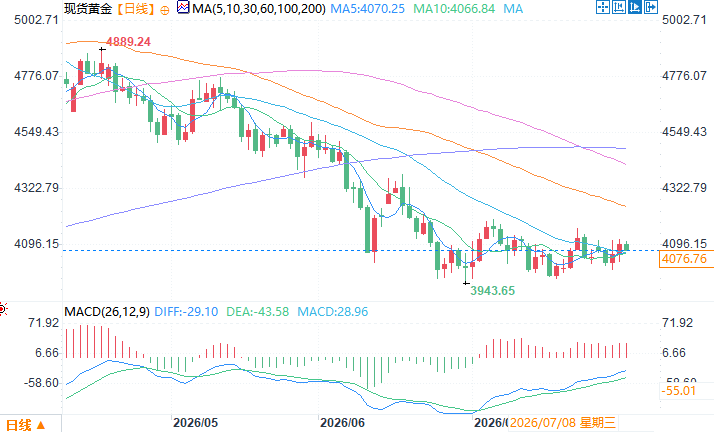 Spot gold daily chart source: FX678. At 11:06 AM Beijing time on July 31, spot gold was trading at $4075.16 per ounce.
The risks of an AI bubble are becoming apparent, and the market is showing signs of an impending style shift reminiscent of the 1990s.
Hickey points out that almost all stock market valuation metrics have now surpassed the extremes of the dot-com boom. AI-related companies account for nearly half the market capitalization of the S&P 500, yet their corresponding economic output is extremely low, indicating a severe disconnect between the financial market and the real economy. He states that the stock market is currently in a massive bubble. The current market environment is highly similar to that of the late 1990s, when funds abandoned gold to chase tech stocks, but there is a key difference: gold had just ended a two-decade-long bear market in 2000, while the current gold bull market remains unshaken. The operating environment for the generative AI industry continues to deteriorate, with low-cost open-source models constantly compressing the industry's pricing space. Large amounts of capital are continuously being invested in computing infrastructure, but the expected improvements in production efficiency have yet to materialize. Tech companies' profits rely more on accounting manipulation and related-party revolving financing than on genuine end-user demand. Hickey believes this boom is built on numerous unrealistic expectations, making it difficult for investments to generate reasonable returns. The bubble may last longer than the market expects, but signs of a recession are increasingly emerging. The weakening stock prices of the "Glamour Seven," the expansion of debt among tech companies, the slowdown in the semiconductor sector's growth, and the increased difficulty in financing AI infrastructure all indicate that the market's speculative enthusiasm for the technology sector is gradually cooling down.Gold prices have undergone a thorough correction, with the $4,000 level providing strong support.
While a large influx of funds flowed into the technology sector, gold experienced a sharp correction. After surging to a record high of $5,600 per ounce in January, gold prices fell steadily, briefly dipping below $4,000 before stabilizing. Hickey believes that with the large-scale exit of speculative positions, this round of correction is nearing its end. Short sellers' repeated attempts to push gold prices below $4,000 have failed, while physical gold buying in Asia has continued to be strong, with demand from major Asian markets being particularly crucial. Following the concentrated selling in the spring, outflows from gold ETFs have essentially stopped; futures speculative positions have fallen to multi-year lows, and the speculative bubble accumulated in the market earlier has been fully cleared. All these signals indicate that the gold market is bottoming out. This round of gains is clearly distinct from historical bull market peaks, consistently lacking the characteristics of frenzied retail speculation. Ordinary investors have not entered the market on a large scale, small gold mining stocks have not seen a buying frenzy, and gold ETF inflows have remained moderate over the long term. The core support for this round of gains has consistently come from central bank gold purchases.With a solid long-term underlying logic, capital rotation will help push gold prices up again.
Global central bank gold purchases have consistently exceeded 1,000 tons annually, and the trend of de-dollarization continues. These long-term structural factors have not changed due to short-term gold price adjustments. The ever-expanding US government debt, persistently high fiscal deficits, and continued geopolitical tensions, coupled with declining global confidence in dollar reserves, continue to guarantee long-term demand for physical gold. Hickey stated that it is precisely these core supports that have allowed gold prices to hold the key $4,000 level, laying the foundation for further gains. In terms of asset allocation, Hickey remains optimistic about gold mining stocks. Even with record-high mining company profits, the sector's valuation remains historically low. Near the gold price peak in January, he significantly reduced his mining assets and has recently repositioned himself as sector sentiment has improved. Even during periods of sharp gold price declines, he has maintained a core holding of physical gold.Summarize
Looking ahead, a new major upward trend in gold prices is likely to begin simultaneously with the decline of the AI rally. Historical experience suggests a shift in market style following the bursting of the dot-com bubble. When investors' illusions about overvalued tech stocks shattered and they suffered significant losses, funds continuously sought new investment opportunities. Gold, a tangible asset with currently low valuations, was poised to attract a new wave of incremental capital. Spot gold daily chart source: FX678. At 11:06 AM Beijing time on July 31, spot gold was trading at $4075.16 per ounce.
- Risk Warning and Disclaimer
- The market involves risk, and trading may not be suitable for all investors. This article is for reference only and does not constitute personal investment advice, nor does it take into account certain users’ specific investment objectives, financial situation, or other needs. Any investment decisions made based on this information are at your own risk.