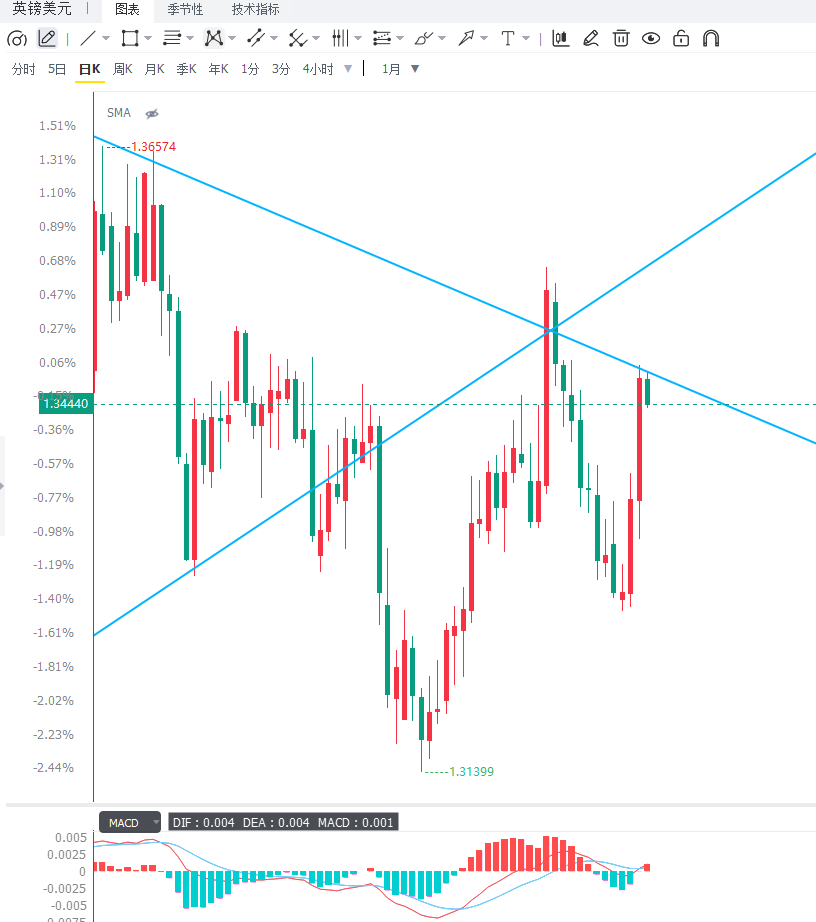
The British pound encountered resistance near the downtrend line against the US dollar and is awaiting a directional move.
2026-07-31 14:00:51
GBP/USD fell in Asian trading on Friday, retreating to around 1.3450, mainly due to a short-term strengthening of the US dollar. The pound had previously risen for three consecutive trading days against the dollar, but as the market reassessed the Federal Reserve's policy signals, the dollar gained some support, leading to profit-taking pressure on the pound.  The Federal Reserve's latest policy meeting decided to keep interest rates unchanged for the fifth consecutive time, in line with market expectations. However, the voting results in the policy statement revealed significant divisions within the Federal Open Market Committee (FOMC), with a 9-3 vote reflecting differing views among some officials on the future policy path. Some institutions believe that while the Fed maintained stable interest rates, the internal divergence increased market uncertainty regarding future policy direction. On the one hand, some officials are concerned about inflation risks and hope to maintain restrictive policies; on the other hand, others are more concerned about the pressure of slowing economic growth. This hawkish stance provides short-term support for the dollar, especially given that the market still expects the Fed to continue adjusting interest rate policy this year. However, if future US economic data continues to weaken, the dollar's upside potential may be limited. Meanwhile, improved global risk sentiment may weaken the dollar's safe-haven advantage, providing an opportunity for a rebound in the pound. Recent market concerns about further escalation of the Middle East situation have eased, with progress in communication between the US and Iran regarding regional stability and shipping security causing some safe-haven funds to flow back into risk assets. Furthermore, US President Donald Trump's announcement of an agreement concerning the Gaza situation boosted market risk appetite. If global markets continue to reduce safe-haven demand, the risk premium previously enjoyed by the US dollar may further decline. Changes in Bank of England policy also affect the pound's performance. The Bank of England previously kept interest rates unchanged, but the vote was divided 6-3, with one previously cautious member joining the pro-rate-hike camp, surprising the market. Some institutions believe that while the Bank of England's decision shows internal discussion about inflation risks, apart from the voting disagreement, most committee members still prefer to maintain policy stability because current inflation data has not yet shown significant second-growth pressure. The Bank of England's future policy path will still depend on wage growth, service sector inflation, and economic growth. If inflation continues to decline, the central bank may maintain a wait-and-see attitude; however, if price pressures strengthen again, expectations of a rate hike may resurface, supporting the pound. Currently, the GBP/USD exchange rate is influenced by both expectations of US dollar policy and the outlook for UK interest rates. In the short term, the pause in the Fed's hawkish stance has limited the pound's rise, but improved global risk sentiment and reduced safe-haven demand for the dollar have provided some buffer for the exchange rate. Going forward, attention will be focused on US economic data, speeches by Fed officials, UK inflation data, and developments in global risk events to determine the next direction of GBP/USD. From a daily chart perspective, GBP/USD has undergone a correction after a continuous rise, currently falling back to around 1.3450. Short-term momentum has weakened, but the overall structure remains one of slightly bullish consolidation. After breaking through a key area, the pair has remained near major moving averages, indicating the uptrend has not been completely broken. Resistance is seen in the 1.3500-1.3550 area; a break above this area could lead to a further test of the 1.3600 resistance level. Support is initially seen around 1.3400, followed by 1.3350 and the 1.3300 area. Technical indicators suggest that recent upward momentum has cooled somewhat, but no clear trend reversal signal has yet formed. On the 4-hour chart, GBP/USD has entered a short-term consolidation phase, with the price breaking below some short-term moving averages, indicating increased profit-taking by long positions. If the exchange rate can hold the 1.3400 support level and break through the 1.3480 area again, it may resume its upward trend and rebound towards 1.3550; if it falls below 1.3400, the correction may extend to around 1.3350. Currently, the 4-hour chart is still influenced by the strength of the US dollar, and the short-term direction depends on changes in expectations regarding the Federal Reserve's policy and market risk appetite.
  In summary, the GBP/USD pair is currently in a balance between support from US dollar policy and improved risk sentiment. A pause in the Fed's hawkish stance and increased internal policy disagreements are providing short-term momentum for the dollar, but declining global risk aversion could weaken its advantage. In the UK, the Bank of England kept interest rates unchanged, but internal voting disagreements indicate policymakers remain concerned about inflation risks. The future direction of the pound will depend on whether UK economic data supports expectations of further tightening. Overall, the GBP/USD pair is likely to continue its short-term consolidation pattern. If global risk sentiment improves further, the pound could rebound; however, if the dollar strengthens again due to expectations of Fed policy changes, the exchange rate will still face downward pressure. Investors should pay close attention to the differences in monetary policy between the US and Europe and key technical support areas.
The Federal Reserve's latest policy meeting decided to keep interest rates unchanged for the fifth consecutive time, in line with market expectations. However, the voting results in the policy statement revealed significant divisions within the Federal Open Market Committee (FOMC), with a 9-3 vote reflecting differing views among some officials on the future policy path. Some institutions believe that while the Fed maintained stable interest rates, the internal divergence increased market uncertainty regarding future policy direction. On the one hand, some officials are concerned about inflation risks and hope to maintain restrictive policies; on the other hand, others are more concerned about the pressure of slowing economic growth. This hawkish stance provides short-term support for the dollar, especially given that the market still expects the Fed to continue adjusting interest rate policy this year. However, if future US economic data continues to weaken, the dollar's upside potential may be limited. Meanwhile, improved global risk sentiment may weaken the dollar's safe-haven advantage, providing an opportunity for a rebound in the pound. Recent market concerns about further escalation of the Middle East situation have eased, with progress in communication between the US and Iran regarding regional stability and shipping security causing some safe-haven funds to flow back into risk assets. Furthermore, US President Donald Trump's announcement of an agreement concerning the Gaza situation boosted market risk appetite. If global markets continue to reduce safe-haven demand, the risk premium previously enjoyed by the US dollar may further decline. Changes in Bank of England policy also affect the pound's performance. The Bank of England previously kept interest rates unchanged, but the vote was divided 6-3, with one previously cautious member joining the pro-rate-hike camp, surprising the market. Some institutions believe that while the Bank of England's decision shows internal discussion about inflation risks, apart from the voting disagreement, most committee members still prefer to maintain policy stability because current inflation data has not yet shown significant second-growth pressure. The Bank of England's future policy path will still depend on wage growth, service sector inflation, and economic growth. If inflation continues to decline, the central bank may maintain a wait-and-see attitude; however, if price pressures strengthen again, expectations of a rate hike may resurface, supporting the pound. Currently, the GBP/USD exchange rate is influenced by both expectations of US dollar policy and the outlook for UK interest rates. In the short term, the pause in the Fed's hawkish stance has limited the pound's rise, but improved global risk sentiment and reduced safe-haven demand for the dollar have provided some buffer for the exchange rate. Going forward, attention will be focused on US economic data, speeches by Fed officials, UK inflation data, and developments in global risk events to determine the next direction of GBP/USD. From a daily chart perspective, GBP/USD has undergone a correction after a continuous rise, currently falling back to around 1.3450. Short-term momentum has weakened, but the overall structure remains one of slightly bullish consolidation. After breaking through a key area, the pair has remained near major moving averages, indicating the uptrend has not been completely broken. Resistance is seen in the 1.3500-1.3550 area; a break above this area could lead to a further test of the 1.3600 resistance level. Support is initially seen around 1.3400, followed by 1.3350 and the 1.3300 area. Technical indicators suggest that recent upward momentum has cooled somewhat, but no clear trend reversal signal has yet formed. On the 4-hour chart, GBP/USD has entered a short-term consolidation phase, with the price breaking below some short-term moving averages, indicating increased profit-taking by long positions. If the exchange rate can hold the 1.3400 support level and break through the 1.3480 area again, it may resume its upward trend and rebound towards 1.3550; if it falls below 1.3400, the correction may extend to around 1.3350. Currently, the 4-hour chart is still influenced by the strength of the US dollar, and the short-term direction depends on changes in expectations regarding the Federal Reserve's policy and market risk appetite. In summary, the GBP/USD pair is currently in a balance between support from US dollar policy and improved risk sentiment. A pause in the Fed's hawkish stance and increased internal policy disagreements are providing short-term momentum for the dollar, but declining global risk aversion could weaken its advantage. In the UK, the Bank of England kept interest rates unchanged, but internal voting disagreements indicate policymakers remain concerned about inflation risks. The future direction of the pound will depend on whether UK economic data supports expectations of further tightening. Overall, the GBP/USD pair is likely to continue its short-term consolidation pattern. If global risk sentiment improves further, the pound could rebound; however, if the dollar strengthens again due to expectations of Fed policy changes, the exchange rate will still face downward pressure. Investors should pay close attention to the differences in monetary policy between the US and Europe and key technical support areas.
- Risk Warning and Disclaimer
- The market involves risk, and trading may not be suitable for all investors. This article is for reference only and does not constitute personal investment advice, nor does it take into account certain users’ specific investment objectives, financial situation, or other needs. Any investment decisions made based on this information are at your own risk.