A rebound in USD/CAD was driven by renewed demand for the US dollar as a safe haven, but support from oil prices limited the upside potential for the Canadian dollar.
2026-07-31 14:10:50
The USD/CAD pair rebounded slightly in Asian trading on Friday, rising above 1.4000 and temporarily ending a three-day losing streak. Earlier, the pair had fallen to its lowest level since June 17, mainly due to a weaker US dollar and support for the Canadian dollar from oil prices.  The market is currently reassessing the impact of US economic data on the Federal Reserve's policy path. The latest US economic data shows that economic growth slowed in the second quarter, while the Personal Consumption Expenditures (PCE) price index indicated further easing of inflationary pressures. This weakened market expectations for continued Fed tightening and put pressure on the dollar. US economic analysis data showed that second-quarter GDP growth was lower than market expectations, indicating a slowdown in economic expansion. Meanwhile, the June PCE inflation data showed a decline, further reinforcing market judgments of a downward trend in inflation. However, the market has not completely abandoned the possibility of further Fed rate hikes. Investors still expect further rate hikes by the Fed before the end of the year, especially given the possibility that energy price volatility could reignite inflationary pressures. If oil prices continue to rise due to supply risks, the Fed may need to maintain a restrictive policy for a longer period, thus supporting the dollar. At the same time, the escalating situation in the Middle East further strengthens the dollar's safe-haven appeal. The recent announcement by the US of the completion of a new round of military operations against Iranian targets, following Iranian actions against US forces, has raised market concerns about a potential further escalation of regional conflict. In addition, shipping risks in the Strait of Hormuz and the Red Sea continue to impact the energy market. Iran's rejection of proposals regarding the management of the Strait of Hormuz, coupled with attacks by the Houthi rebels in Yemen near the Bab el-Mandeb Strait, the Red Sea, and the Gulf of Aden, has fueled market concerns about disruptions to global energy transport. Increased energy supply risks typically drive up crude oil prices, and since the Canadian economy is highly dependent on energy exports, stronger oil prices often support the Canadian dollar. This is a significant factor limiting the rise of USD/CAD. Recently, oil prices have remained highly volatile. If crude oil supply risks continue to increase, WTI crude oil prices may find support, further improving the Canadian dollar's performance. Simultaneously, if global risk sentiment deteriorates and demand for the US dollar as a safe haven increases, it could push USD/CAD to retest higher levels. Currently, the market is focused on two core factors: whether the Federal Reserve's future policy path will remain hawkish, and whether new supply disruptions will occur in the oil market due to geopolitical risks. The balance of power between these two factors will determine the short-term direction of USD/CAD. From a daily chart perspective, USD/CAD has experienced a technical rebound after a period of continuous decline and is currently back above the psychological level of 1.4000, but the overall trend remains weak. The exchange rate previously broke through several support areas, indicating that bears still hold a certain advantage. Current resistance is seen in the 1.4050-1.4100 area; a successful break above this level could lead to a further test of the 1.4150 resistance. Support levels are first at 1.3970, followed by 1.3900 and 1.3850. The technical structure suggests that the short-term rebound is primarily a correction; if it fails to break through key moving average resistance, it may continue to face selling pressure. Looking at the 4-hour chart, USD/CAD shows signs of bottoming out in the short term, consolidating around the 1.4000 area with some recovery in short-term momentum. A stable break above 1.4050 could open up further upside potential, moving towards the 1.4100-1.4150 area; however, a failed rebound and a break below 1.3970 support could lead to a retest of recent lows. The current 4-hour trend is still influenced by the strength of the US dollar and oil price fluctuations; the short-term direction needs further confirmation from fundamental factors.
 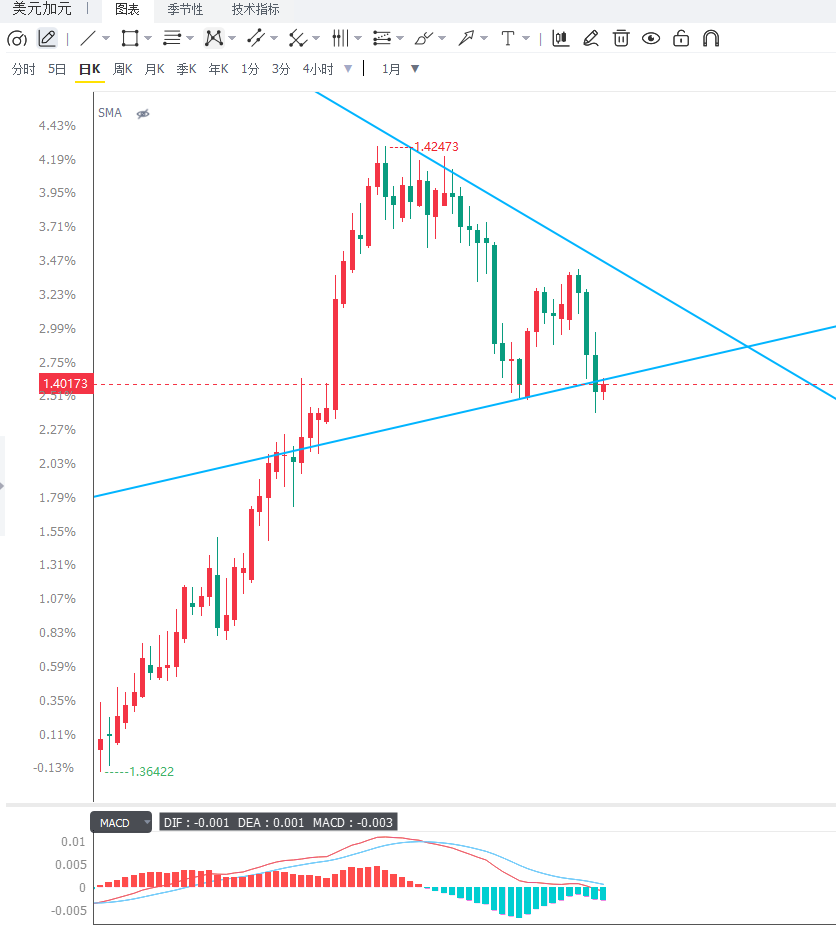 The USD/CAD pair is currently in a tug-of-war between safe-haven demand for the US dollar and support from oil prices for the Canadian dollar. Weak US economic data limits the dollar's upside potential, but expectations of potential Fed rate hikes and Middle East risks continue to support it. Meanwhile, escalating supply risks in the oil market are providing some support for the Canadian dollar, limiting a rapid rise in USD/CAD. Future exchange rate movements will depend on changes in Fed policy expectations, the performance of the US dollar index, and global energy supply risks. In the short term, USD/CAD is likely to maintain a range-bound pattern. If oil prices continue to strengthen, the Canadian dollar's advantage may persist; if geopolitical risks drive safe-haven funds back to the US dollar, the exchange rate may retest the upper resistance zone. Investors should pay close attention to changes in the energy market and Fed policy signals.
The market is currently reassessing the impact of US economic data on the Federal Reserve's policy path. The latest US economic data shows that economic growth slowed in the second quarter, while the Personal Consumption Expenditures (PCE) price index indicated further easing of inflationary pressures. This weakened market expectations for continued Fed tightening and put pressure on the dollar. US economic analysis data showed that second-quarter GDP growth was lower than market expectations, indicating a slowdown in economic expansion. Meanwhile, the June PCE inflation data showed a decline, further reinforcing market judgments of a downward trend in inflation. However, the market has not completely abandoned the possibility of further Fed rate hikes. Investors still expect further rate hikes by the Fed before the end of the year, especially given the possibility that energy price volatility could reignite inflationary pressures. If oil prices continue to rise due to supply risks, the Fed may need to maintain a restrictive policy for a longer period, thus supporting the dollar. At the same time, the escalating situation in the Middle East further strengthens the dollar's safe-haven appeal. The recent announcement by the US of the completion of a new round of military operations against Iranian targets, following Iranian actions against US forces, has raised market concerns about a potential further escalation of regional conflict. In addition, shipping risks in the Strait of Hormuz and the Red Sea continue to impact the energy market. Iran's rejection of proposals regarding the management of the Strait of Hormuz, coupled with attacks by the Houthi rebels in Yemen near the Bab el-Mandeb Strait, the Red Sea, and the Gulf of Aden, has fueled market concerns about disruptions to global energy transport. Increased energy supply risks typically drive up crude oil prices, and since the Canadian economy is highly dependent on energy exports, stronger oil prices often support the Canadian dollar. This is a significant factor limiting the rise of USD/CAD. Recently, oil prices have remained highly volatile. If crude oil supply risks continue to increase, WTI crude oil prices may find support, further improving the Canadian dollar's performance. Simultaneously, if global risk sentiment deteriorates and demand for the US dollar as a safe haven increases, it could push USD/CAD to retest higher levels. Currently, the market is focused on two core factors: whether the Federal Reserve's future policy path will remain hawkish, and whether new supply disruptions will occur in the oil market due to geopolitical risks. The balance of power between these two factors will determine the short-term direction of USD/CAD. From a daily chart perspective, USD/CAD has experienced a technical rebound after a period of continuous decline and is currently back above the psychological level of 1.4000, but the overall trend remains weak. The exchange rate previously broke through several support areas, indicating that bears still hold a certain advantage. Current resistance is seen in the 1.4050-1.4100 area; a successful break above this level could lead to a further test of the 1.4150 resistance. Support levels are first at 1.3970, followed by 1.3900 and 1.3850. The technical structure suggests that the short-term rebound is primarily a correction; if it fails to break through key moving average resistance, it may continue to face selling pressure. Looking at the 4-hour chart, USD/CAD shows signs of bottoming out in the short term, consolidating around the 1.4000 area with some recovery in short-term momentum. A stable break above 1.4050 could open up further upside potential, moving towards the 1.4100-1.4150 area; however, a failed rebound and a break below 1.3970 support could lead to a retest of recent lows. The current 4-hour trend is still influenced by the strength of the US dollar and oil price fluctuations; the short-term direction needs further confirmation from fundamental factors. The USD/CAD pair is currently in a tug-of-war between safe-haven demand for the US dollar and support from oil prices for the Canadian dollar. Weak US economic data limits the dollar's upside potential, but expectations of potential Fed rate hikes and Middle East risks continue to support it. Meanwhile, escalating supply risks in the oil market are providing some support for the Canadian dollar, limiting a rapid rise in USD/CAD. Future exchange rate movements will depend on changes in Fed policy expectations, the performance of the US dollar index, and global energy supply risks. In the short term, USD/CAD is likely to maintain a range-bound pattern. If oil prices continue to strengthen, the Canadian dollar's advantage may persist; if geopolitical risks drive safe-haven funds back to the US dollar, the exchange rate may retest the upper resistance zone. Investors should pay close attention to changes in the energy market and Fed policy signals.
- Risk Warning and Disclaimer
- The market involves risk, and trading may not be suitable for all investors. This article is for reference only and does not constitute personal investment advice, nor does it take into account certain users’ specific investment objectives, financial situation, or other needs. Any investment decisions made based on this information are at your own risk.