Attacks on Iranian energy infrastructure may impact oil prices due to prolonged conflict.
2026-07-31 16:18:50
The cycle of US-Iran military retaliation continues, with the conflict now extending to energy infrastructure. Shipping in the Strait of Hormuz remains sluggish, and the US is simultaneously escalating its shipping blockade and financial sanctions, while also planning to restart idle refineries to hedge against rising oil prices. Market expectations suggest the conflict may be protracted, and Trump's cabinet meeting at Camp David later tonight may finalize the overall strategy towards Iran, becoming a key short-term catalyst for crude oil prices. 
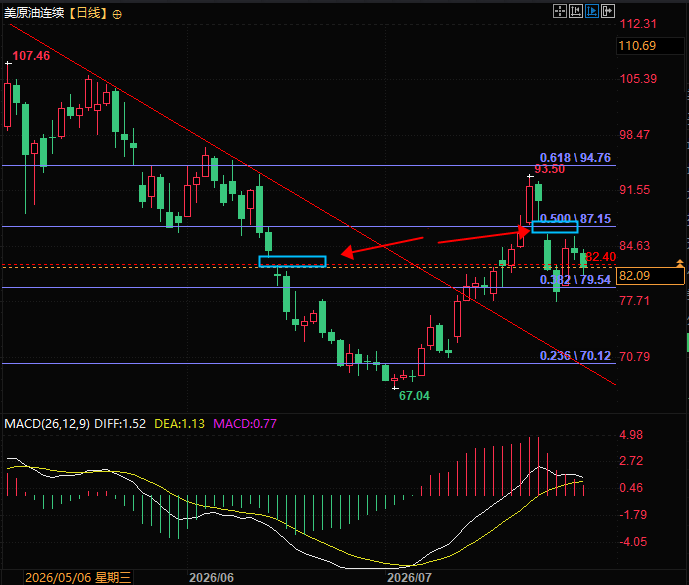 (WTI crude oil futures daily chart, source: EasyForex) At 16:16 Beijing time, WTI crude oil futures were trading at $82.08 per barrel.
The physical clashes between the two sides continued to escalate, with the scope of the attacks expanding to energy infrastructure.
The months-long military conflict between the US and Iran continues in a confrontational pattern of mutual attacks, with retaliatory actions constantly being launched. The targets of the conflict have expanded from overseas military bases to Iranian oil and gas facilities. On the evening of July 30th local time, the Iranian military announced the use of drones to attack the US military base in Sheikh Issa, Bahrain, targeting the base's generators, navigation systems, and logistics buildings. On July 31st, Iran launched a second counterattack, striking the Ahmed Jaber Air Base in Kuwait in the 27th phase of Operation Lightning, focusing on destroying aircraft hangars, satellite communication facilities, and equipment warehouses. This base is a key US air logistics hub in the Gulf region. In response to these multiple attacks, the US and Iran have engaged in fierce information warfare, with completely contradictory statements. The Iranian Revolutionary Guard claimed responsibility for the previous attack on a US military base in Jordan, destroying multiple F-35 fighter jets; the US Central Command publicly refuted this, stating that all Iranian drones and missiles were intercepted, and no US military aircraft were damaged, accusing Iran of continuously spreading false information about the war. Another significant development in the conflict is the expansion of the strikes to Iran's energy lifeline. A senior Iranian official confirmed that multiple natural gas processing facilities in the country were attacked and damaged, and the country's daily natural gas shortage is estimated to reach 100 million cubic meters this winter. Attacks on oil and gas facilities signify a further escalation of the conflict risk; if oil production and export facilities continue to be targeted, the global crude oil supply will face a direct and severe impact.The shipping landscape is showing a stark contrast: the Hormuz blockade continues, while shipping in the Red Sea is showing signs of recovery.
The diverging trends of the two major Middle Eastern shipping routes directly reflect the current risk landscape of energy transportation. The latest data from shipping agency Kpler on Thursday showed a significant recovery in traffic activity in the Bab el-Mandeb Strait, with a total of 25 commercial vessels passing through throughout the day (18 entering and 7 leaving). The fleet included two Very Large Crude Carriers (VLCCs), one Suezmax tanker, and five Aframax tankers. The concentrated tanker traffic indicates a temporary easing of risks in the Red Sea shipping lanes. In stark contrast, the Strait of Hormuz, a key global oil transportation route, remains sluggish, with only two tankers passing through during the same period, both empty, indicating that effective oil exports have not yet recovered. On the military front, the United States continues to strengthen its control over shipping in the Persian Gulf. The US Central Command disclosed that P-8 anti-submarine reconnaissance aircraft have been continuously patrolling the area, recently guiding 24 merchant ships to change course, forcing two ships to stop, and boarding and inspecting two vessels. The US also denied claims that Iranian oil tankers had broken through the blockade, emphasizing that more than 20 warships and hundreds of military aircraft remained on alert and that the blockade measures against Iranian crude oil shipping continued to be implemented.Increased sanctions + capacity hedging: The US is responding to high oil price pressure on two fronts.
Faced with upward pressure on energy prices from the conflict, the United States has introduced measures on both the financial and energy supply sides. On the financial front, Treasury Secretary Bessant stated that the Treasury Department continues to screen entities associated with the Iranian Revolutionary Guard, continuously cutting off their access to the US financial system and strengthening the economic blockade against Iran. On the supply side, the Trump administration has officially pushed for the reopening of domestically shut-down oil refining facilities to alleviate the pressure on fuel prices driven up by the Iran war. Key targets include the St. Croy refinery in the US Virgin Islands, a facility originally designed to process Venezuelan crude oil and strategically located. The White House is also discussing the reopening of idle refineries in California and other locations, clearly stating that "energy security is national security." Currently, the average price of gasoline in the US is approximately $4.10 per gallon, more than $1 higher than before the war. However, the St. Croy refinery was permanently shut down in 2021 due to environmental issues, and its reopening will face stringent environmental regulations and numerous operational challenges, making it difficult to quickly release refined oil production capacity in the short term; its role is more about stabilizing market expectations.Key Event Preview: Camp David Closed-Door Cabinet Meeting Focuses on Middle East and US-Iran Issues
Trump is scheduled to chair a full cabinet meeting at Camp David at 11:00 AM Eastern Time on Friday (11:00 PM Beijing Time). Camp David is a highly confidential location, and the choice of this venue for the cabinet meeting itself suggests that highly sensitive issues will be discussed. The market generally expects the US-Iran military standoff and overall Middle East geopolitical policy to be the core topics of the meeting. Attendees will include key cabinet officials such as the Secretary of Defense, Secretary of State, Secretary of the Treasury, and Director of Intelligence. The meeting will likely focus on several key areas: the pace of subsequent strikes against Iran, shipping blockade plans, energy price hedging policies, and assessing the inflation risks from a prolonged conflict. Based on various clues, the mainstream market expectation is that this war of attrition is likely to be protracted, making a quick and comprehensive reconciliation unlikely.Viewpoints and Technical Analysis:
The current crude oil market is caught in a whirlwind of expectations: on the one hand, the ultimate goal of both sides' extreme pressure campaigns is generally negotiation. On the other hand, the ongoing cycle of direct military retaliation between the US and Iran, the disruption of crude oil shipments from the Strait of Hormuz, and the attack on Iranian energy facilities continue to prop up geopolitical risk premiums. In the short term, oil prices will continue to be influenced by policy signals released at the Camp David meeting: if the meeting signals a willingness to ease tensions, the geopolitical premium may decline; however, if the scope of the strikes against Iran is extended or even expanded, and the existing shipping blockade is maintained, oil prices will gain upward momentum again. The key focus going forward will be on three core signals: first, public statements by Trump and White House officials after the Camp David meeting; second, whether the data on oil tanker traffic in the Strait of Hormuz can improve; and third, whether the US and Iran will launch a new round of strikes against oil and gas infrastructure. As long as the stalemate in Persian Gulf crude oil shipments cannot be substantially eased, coupled with expectations of a prolonged conflict, the central level of crude oil prices will remain relatively strong. From a technical perspective, oil prices are still consolidating near the previous gap. The key points to watch in the near term are the two gaps, one upward gap and one downward gap. The overall trend is slightly favorable for oil. The important resistance level is around 86, which is the recent downward gap. The support levels are the previous upward gap at 82.5 and the 0.382 Fibonacci retracement level at 79.5. (WTI crude oil futures daily chart, source: EasyForex) At 16:16 Beijing time, WTI crude oil futures were trading at $82.08 per barrel.
- Risk Warning and Disclaimer
- The market involves risk, and trading may not be suitable for all investors. This article is for reference only and does not constitute personal investment advice, nor does it take into account certain users’ specific investment objectives, financial situation, or other needs. Any investment decisions made based on this information are at your own risk.