Trump called off a large-scale military strike against Iran, causing Brent crude oil to plunge 7.3% to $81.55. The US and Iran are scheduled to resume negotiations on August 3.
2026-08-03 09:18:53
US President Trump called off a large-scale military strike against Iran at the last minute, saying that a preliminary framework agreement had been reached and that the US and Iran would resume negotiations on August 3. On Monday (August 3) in early Asian trading, international oil prices plummeted, with Brent crude falling as much as 7.3% to around $81.55 per barrel, a four-day low. 
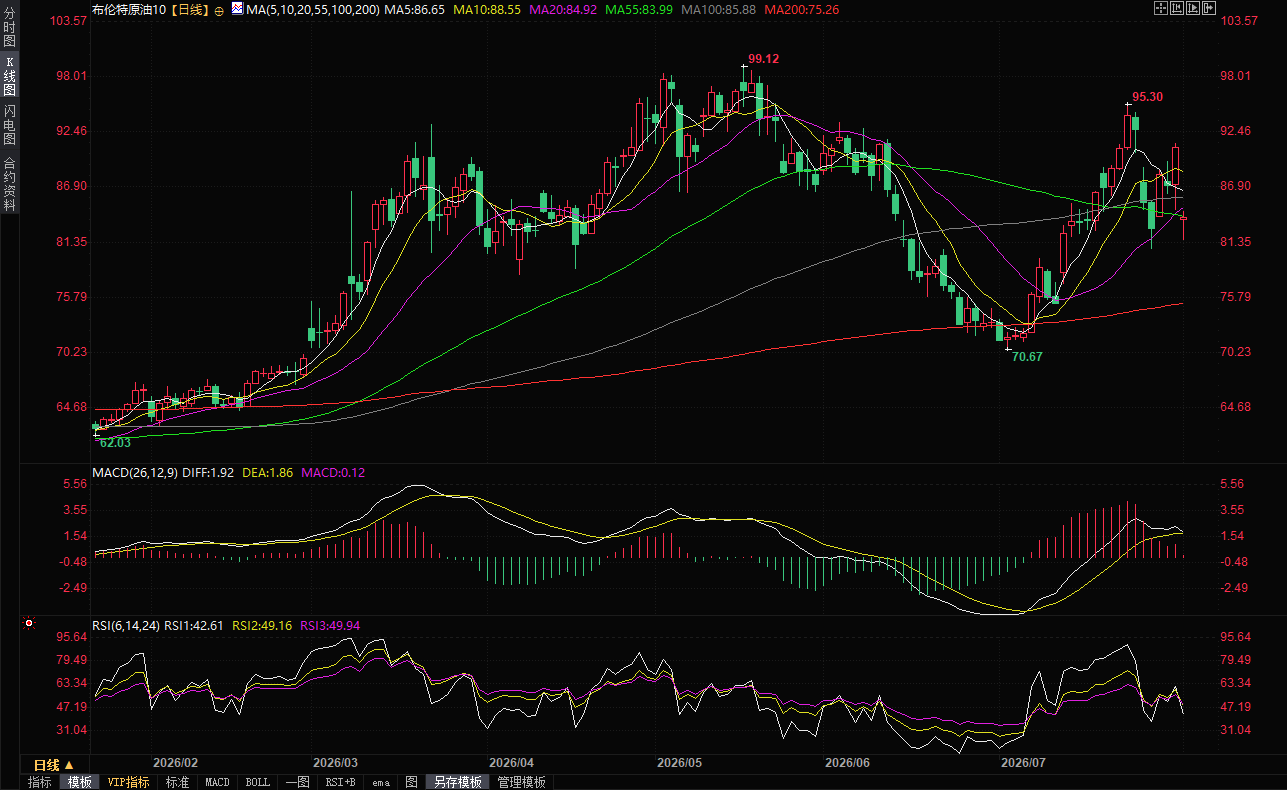 (Brent crude oil October futures daily chart, source: FX678) Looking back at the previous trend, news on July 31 that Trump was "seriously considering" launching a strike on Iranian energy facilities in the coming days briefly pushed oil prices to a one-week high. Within just a few days, oil prices experienced a dramatic reversal from a surge to a plunge. At the same time, the decline in oil prices eased inflation concerns and pressure on the Federal Reserve to raise interest rates, and the US dollar index briefly hit a one-and-a-half-month low, providing upward momentum for precious metals and the stock market. Spot gold prices rose as much as 0.9% in early trading to $4082 per ounce, but have since retreated to around $4060 per ounce. Futures for the three major US stock indices all rose, with Nasdaq 100 futures up 0.78% and S&P 500 futures up 0.44%. US 10-year Treasury futures rose 13 basis points, and 30-year Treasury futures rose 22 basis points.
I. Dramatic Reversal: From "The Most Terrifying Military Force Since World War II" to Temporary Halt
On August 1, US President Trump posted on Truth Social that the US was prepared to take action against Iran, stating that "the scale of military deterrence and force deployed is unprecedented since World War II." However, just before the operation was about to commence, Trump stated that Iran and "other Middle Eastern countries" had requested a postponement of the attack, as a preliminary framework agreement had been reached. Trump claimed that the framework included the "immediate, full, and complete" reopening of the Strait of Hormuz and the elimination of the "nuclear threat posed by Iran." He also stated that Israel had joined the movement to suspend attacks on Iran. Trump emphasized that the prerequisite for canceling the military strike was that "the parties could quickly finalize an agreement." Iran vehemently denied these claims. Iranian military officials denounced Trump's remarks as "a new lie" and emphasized that Iranian forces were "on high alert and prepared for anything." On August 2, Iran's Fars News Agency, citing sources, reported that the plan to reopen the Strait of Hormuz was pure rumor, and no agreement had yet been reached on reopening the strait. Another informed military source emphasized that the Strait of Hormuz will remain closed as long as the United States continues its hostile actions.II. Oil Price Reaction: Brent Crude Plunges 7.3%, Safe-Haven Assets Rally Across the Board
The international crude oil market experienced significant volatility at the start of the new trading week, influenced by news that the US and Iran were about to resume negotiations. On the morning of August 3rd, Beijing time, international oil prices opened sharply lower. Brent crude oil futures for October delivery fell as much as 7.3%, dropping to $81.55 per barrel, one of the largest single-day declines in recent times. WTI crude oil fell below $80 per barrel, a drop of 6.25%. As of this morning's press time, both WTI and Brent crude were down nearly 4.5%, with the international grey market crude oil market showing a decline of over 7%. (Brent crude oil October futures daily chart, source: FX678) Looking back at the previous trend, news on July 31 that Trump was "seriously considering" launching a strike on Iranian energy facilities in the coming days briefly pushed oil prices to a one-week high. Within just a few days, oil prices experienced a dramatic reversal from a surge to a plunge. At the same time, the decline in oil prices eased inflation concerns and pressure on the Federal Reserve to raise interest rates, and the US dollar index briefly hit a one-and-a-half-month low, providing upward momentum for precious metals and the stock market. Spot gold prices rose as much as 0.9% in early trading to $4082 per ounce, but have since retreated to around $4060 per ounce. Futures for the three major US stock indices all rose, with Nasdaq 100 futures up 0.78% and S&P 500 futures up 0.44%. US 10-year Treasury futures rose 13 basis points, and 30-year Treasury futures rose 22 basis points.III. Trump: Negotiations began on August 3, with no deadline set.
On August 2, upon returning to Washington from a weekend trip to New Jersey, Trump told reporters that the United States would hold negotiations with Iran on August 3. However, he did not disclose the specific location or participants. When asked if there was a deadline for reaching an agreement with Iran, Trump did not give a direct answer, only stating, "Do I prefer a deal? I don't want anyone to die. We don't want to see anyone die." Trump had previously stated on Truth Social that Iran must "reach a deal quickly." Analysts point out that Trump's decision to set a timeline for negotiations while refusing to give a specific deadline preserves flexibility for diplomatic maneuvering and retains the option of resorting to force again if negotiations break down. Trump has stated that accepting the short-term cost of increased fuel costs is worthwhile to achieve the goal of preventing Iran from acquiring nuclear weapons. However, economic pressures are forcing him to seek ways to end the conflict.IV. Iran's Diplomatic Offensive: Negotiations with Oman nearing completion, multi-channel mediation
While the US signaled its willingness to negotiate, Iran also actively engaged in diplomatic efforts. According to Iran's Mehr News Agency on August 2nd, Iranian Foreign Minister Araghchi stated that negotiations between Iran and Oman regarding the joint management of the Strait of Hormuz had entered their final stage. Iranian Foreign Ministry spokesman Baghae, speaking on Iranian state television, said that Iran was discussing with Oman the demarcation of a new shipping route in the Strait of Hormuz. Baghae emphasized that this "has nothing to do with the opening or closing of the Strait of Hormuz. That's another issue." Even if Iran and Oman reach an understanding on a new shipping route, it does not mean the opening or closing of the Strait of Hormuz; the dialogue between Iran and Oman is a bilateral matter and has nothing to do with any third party. Baghae also reiterated that the situation in the Strait of Hormuz "will not return to the state before the outbreak of conflict." He stated that if the US seeks "adventurous action," Iran will respond accordingly based on its national interests. According to Iranian state media reports, on August 2nd, Araghchi held separate telephone conversations with Saudi Foreign Minister Faisal, Pakistani Army Chief of Staff Munir, and Turkish Foreign Minister Fedan, exchanging views on the escalating regional tensions and security risks. Araghchi warned the United States against any "risky actions" and stated that Iran is fully prepared to safeguard its national sovereignty, territorial integrity, and national security. This comes after Iran publicly rejected last month a proposal from Oman, supported by Gulf states, regarding joint management of the Strait of Hormuz.V. Israel was kept in the dark: Alliance relations face a test
Trump's decision to halt the military strike against Iran has caused a strong shock in Israel. According to Israel's Channel 12 television on August 2nd, Israel was kept in the dark by the US for several hours regarding the planned joint strike against Iran. Senior Israeli officials only learned of the cancellation through social media platforms. The report quoted a senior Israeli official as saying, "Trump left us in the fog" for several hours, and Israel could only learn about the latest US developments through Trump's Truth Social platform. Senior officials, including Prime Minister Netanyahu and Defense Minister Katz, learned of the sudden cancellation of the strike plan through social media. The official said it felt like "they (the US) left us hanging." The report stated that Israel initially believed the US's sudden announcement of the cancellation was to lower Iran's guard, but after contacting the US, it was confirmed that the strike plan had indeed been halted. A senior Israeli official said, "This is frustrating; we don't understand what the US president's ultimate goal is." Given that Trump could change his mind at any time, the Israeli military remains on high alert. Israeli Energy Minister Cohen stated that Israel and the United States maintain close coordination on security and intelligence matters regarding the situation in the region. However, he also made a strong statement: "Regardless of any agreement or external commitments, if Iran attempts to restart its nuclear program or develop its ballistic missile industry, we will take action and strike."VI. Continued Production Increases by OPEC+ and the Strait of Hormuz Dilemma
As tensions between the US and Iran show signs of improvement, major OPEC+ oil-producing countries are adjusting their supply strategies. On August 2nd, the Organization of the Petroleum Exporting Countries (OPEC) issued a statement saying that the seven major OPEC+ oil-producing countries decided to increase daily crude oil production by 188,000 barrels in September and reiterated their commitment to maintaining market stability. Representatives from Saudi Arabia, Russia, Iraq, Kuwait, Kazakhstan, Algeria, and Oman held an online meeting that day to assess the current state and prospects of the global oil market. This production increase marks the sixth consecutive month of increases since major oil-producing countries began increasing production in April this year. However, analysts believe that given the continued disruption to shipping through the Strait of Hormuz, the impact of this production increase on the market in the short term will be limited. Only when crude oil exports return to normal will it have a real impact on the market. According to data from an international shipping information platform, on July 30th, the number of ships passing through the Strait of Hormuz plummeted from 22 the previous day to only 5, a decrease of 77%. Analysts point out that the Strait of Hormuz is currently largely closed or nearly closed, which will have a significant impact on the international shipping industry and energy market.Editor's Summary
Trump's last-minute halt to military action marked a new turning point in the US-Iran confrontation. However, the fundamental differences between the two sides on the opening of the Strait of Hormuz have not been eliminated—the US demands an "immediate, full, and complete" opening, while Iran insists the strait "will not return to its pre-conflict state" and denies any agreement has been reached. Trump's strategy of not setting a deadline for negotiations, while leaving room for diplomacy, also means that military options remain unresolved. Israel's strong dissatisfaction at being excluded from the decision-making process further highlights the rift in coordination within the US-Israel alliance on this issue. Coupled with the structural contradiction between OPEC+'s monthly production increases and the actual obstruction of passage through the Strait of Hormuz, the global energy market will continue to face high geopolitical uncertainty for some time to come.Frequently Asked Questions
Q1: Why did Trump call off the military strike against Iran at the last minute? A: On August 1st, Trump stated on Truth Social that Iran and "other Middle Eastern countries" had requested a halt to the attack, as a preliminary framework agreement had been reached. According to Axios, Saudi Crown Prince Mohammed bin Salman spoke with Trump that day, expressing concern about the US plan for a large-scale strike against Iran and urging Trump to de-escalate the situation. Saudi Arabia feared that a US airstrike on Iranian energy facilities would provoke reciprocal retaliation from Tehran against Saudi Arabia and other Gulf states. However, Iran denied Trump's claims, calling them "new lies." Q2: Where might the negotiations on August 3rd be held? Who will be involved? A: Trump only stated that the negotiations would begin on the afternoon of August 3rd, but did not disclose the specific location or participants. Based on past experience, indirect US-Iran negotiations are usually conducted in neutral countries. Previously, the two sides have held technical talks in Switzerland, Oman, Qatar, Doha, and other locations. Oman has been a key mediator between the US and Iran, and Iranian Foreign Minister Araghchi has stated that negotiations with Oman regarding the Strait of Hormuz have entered the final stage. Question 3: What is the current status of the Strait of Hormuz? Answer: The Strait of Hormuz is currently mostly closed or partially closed. Iranian Foreign Ministry spokesman Bagaei clearly stated that the situation in the strait "will not return to the state before the outbreak of the conflict." Iranian military sources emphasized that as long as the US continues its hostile actions, the strait will remain closed, and ships can only pass through the published routes and must obtain permission from the Iranian Islamic Revolutionary Guard Corps Navy. On July 30, the number of ships passing through the strait plummeted from 22 to 5, a decrease of 77%. Question 4: What is Iran's position on the nuclear issue? Answer: Iranian President Pezechzian previously stated clearly that Iran "will not build atomic bombs," but "will never give up its right to enrich uranium." Iranian Deputy Foreign Minister Taher-Ravanchi stated in July that Iran can show flexibility regarding its uranium enrichment capabilities and limitations, but "if the US insists on zero uranium enrichment, then we will not reach an agreement." Trump's negotiation goals include "eliminating the nuclear threat posed by Iran," but Iran insists that its right to enrich uranium is non-negotiable, which will be the core point of contention in the negotiations. Question 5: What factors will influence the future trend of international oil prices? Answer: In the short term, oil price trends will mainly depend on three variables: First, whether the US-Iran negotiations, which resumed on August 3, can achieve substantial progress—if the Strait of Hormuz gradually reopens, oil prices may fall further; second, if the negotiations break down and military conflict reignites, oil prices may surge again. Previously, some institutions believed that in extreme cases, oil prices could soar to the $120-$150/barrel range; third, the cumulative effect of monthly production increases by "OPEC+", and the pace of actual reopening of the Strait of Hormuz. The International Energy Agency believes that even if strait transport gradually resumes, global oil supply will still decline by an average of 3.9 million barrels per day in 2026. At 09:14 Beijing time, Brent crude oil futures for October were trading at $83.94/barrel.- Risk Warning and Disclaimer
- The market involves risk, and trading may not be suitable for all investors. This article is for reference only and does not constitute personal investment advice, nor does it take into account certain users’ specific investment objectives, financial situation, or other needs. Any investment decisions made based on this information are at your own risk.