WTI opened lower; Trump signaled the reopening of the Hormuz test site; OPEC+ production increase deal finalized.
2026-08-03 10:08:53
On Monday (August 3), during Asian trading hours, US crude oil futures opened sharply lower, falling as low as $78.78 per barrel, and are currently trading around $80.20 per barrel. Last Saturday, Trump stated that Iran and other Middle Eastern countries requested more time to finalize an agreement that would immediately and fully reopen the Strait of Hormuz and eliminate the Iranian nuclear threat. Meanwhile, OPEC+ approved increased production, completing the restoration of the 2023 production cut plan. 
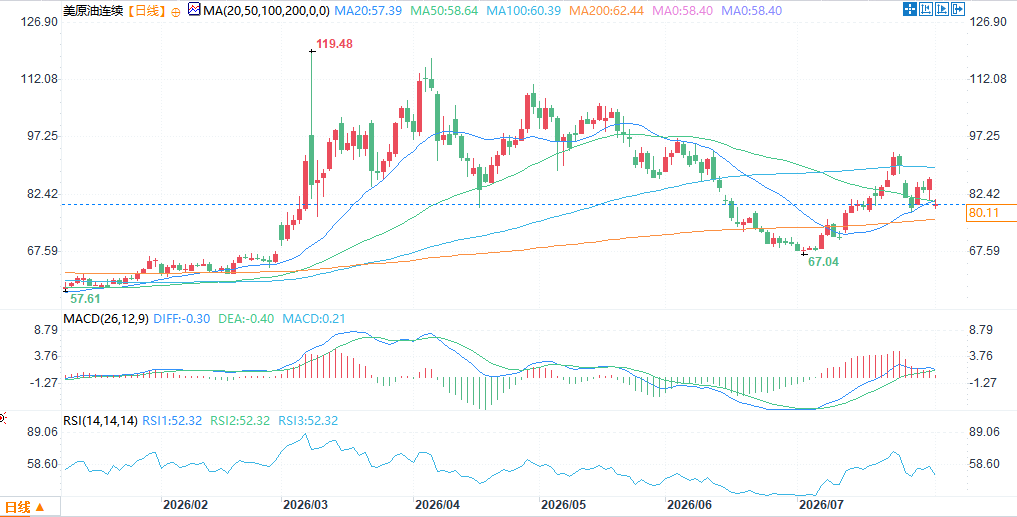 (US crude oil futures daily chart, source: FX678) At 10:06 AM Beijing time on August 3, US crude oil futures were trading at $80.08 per barrel.
Trump says Middle Eastern countries are requesting more time to finalize an agreement, and the Hormuz region is expected to fully reopen.
On Saturday, Trump posted on social media that Iran and other Middle Eastern countries had requested more time to finalize an agreement. He stated that if such an agreement were reached, it would immediately, completely, and thoroughly reopen the Strait of Hormuz and effectively eliminate the Iranian nuclear threat. This statement became the core driver of the recent oil price plunge. The market had previously accumulated a high geopolitical risk premium due to the obstruction of passage through the Strait of Hormuz and the stalemate in nuclear negotiations. Trump's statement significantly reduced concerns about supply disruptions, causing the risk premium to be rapidly eroded, and oil prices came under significant downward pressure. Investors began to reassess the prospects for Middle Eastern supply recovery, and bullish sentiment cooled rapidly. However, the agreement has not yet been finalized, and uncertainties remain in the negotiations. If subsequent progress falls short of expectations, or if the reopening of the Strait encounters setbacks, geopolitical premiums may rise again, and the risk of oil price volatility remains.Shipping data is mixed.
Shipping data presents a mixed picture, indicating that the situation in regional waterways remains complex. Over the weekend, two oil tankers carrying Saudi oil successfully passed through the Bab el-Mandeb Strait and out of the Red Sea, suggesting a recovery in the channel's efficiency and partially alleviating market concerns about Red Sea shipping disruptions. However, traffic in the Strait of Hormuz has slowed significantly due to attacks on ships, becoming a new focus of risk. The UK Maritime Trade and Operations Authority confirmed that three more oil tankers have been attacked since Saturday, further exacerbating the obstruction in the strait. This divergent pattern of "open Bab el-Mandeb Strait, blocked Hormuz" suggests that geopolitical risks have not completely dissipated, but have merely shifted between different chokepoints. While market concerns about supply disruptions have eased somewhat in the Red Sea direction, they have resurfaced in the Hormuz direction. Overall, the coexistence of localized improvements and deteriorations in shipping routes means that the oil market must remain cautious in pricing geopolitical premiums, and subsequent ship traffic data and developments in attacks will continue to dominate short-term volatility.OPEC+ approves increased production, completing the restoration of the 2023 production cut plan.
Major OPEC+ oil-producing countries have approved a moderate production increase, officially completing the restoration of the 2023 production cut plan, while reserving policy space for further production increases after the conflict ends. This decision has brought clear downward pressure on oil prices from the supply side. The market had previously anticipated a production increase of approximately 188,000 barrels per day in September, but the official confirmation of "completing the restoration of production cuts" further strengthened the certainty of the supply increase, weakening the previous narrative of supply tightening that supported oil prices. After the production increase was implemented, expectations of marginal easing in global crude oil supply have increased, putting continuous downward pressure on prices. However, the increase is relatively moderate, and whether supply will continue to increase depends on the evolution of the geopolitical situation. If the Strait of Hormuz reopens smoothly and demand does not show a significant recovery, oil prices may continue to be under pressure; conversely, if the pace of supply release slows or risk premiums rise, the downside will be somewhat limited.BNY Mellon warns of continued deterioration in geopolitical risks
Strategists at BNY Mellon noted on Friday that the geopolitical backdrop has further deteriorated, with "the resumption of missile exchanges between the US and Iran dashing hopes for a swift end to the five-month conflict." They pointed out that the confrontation is becoming increasingly regional – Jordan reported "intercepting Iranian missiles for the second consecutive day," and Kuwait reported "a deadly attack in the north." A drone attack also caused a fire on a ship in Egypt's port of Damieta, which investigators say was caused by a drone – these incidents highlight the rising risks to shipping lanes and energy flows in the Gulf.The next step for oil prices depends on these three things.
Regarding the trend of international oil prices, the current market focus is on three key variables. First, the progress of US-Iran negotiations: if the two sides ultimately reach an agreement and geopolitical tensions are substantially eased, market risk premiums will decrease significantly, and crude oil prices may fall further, putting pressure on the energy sector as a whole. Second, the situation regarding the Strait of Hormuz is equally crucial. As a core channel for global crude oil transportation, if passage remains obstructed or transportation efficiency significantly declines, geopolitical premiums will quickly reignite, pushing oil prices upward again and amplifying short-term volatility risks. Third, subsequent OPEC+ policies cannot be ignored. If the alliance signals a halt to or even a reduction in production, the expectation of tighter supply will provide strong support for oil prices, offsetting some of the downward pressure from easing demand and geopolitical tensions. In summary, if these variables resonate, the direction and volatility of oil prices will be significantly affected.Oil prices are tug-of-war between "hopes for peace talks" and "geopolitical realities".
WTI crude oil fell to around $79 per barrel under the dual pressure of hopes for US-Iran peace talks and OPEC+ production increases. Trump's positive statements and OPEC+'s decision to increase production provided short-term downward pressure on the market, but BNY Mellon warned of continued escalating geopolitical risks—the ongoing US-Iran missile exchanges, the escalating regional conflict, and persistent shipping threats. In the short term, oil prices are likely to fluctuate within the $78-82 per barrel range. If the US-Iran negotiations achieve a substantial breakthrough and the Hormuz summit is fully reopened, oil prices may fall further to $76-78 per barrel; if negotiations break down or geopolitical risks escalate again, oil prices may rebound quickly to $82-84 per barrel. The next direction of oil prices depends on the interplay between a "diplomatic breakthrough" and "geopolitical escalation." (US crude oil futures daily chart, source: FX678) At 10:06 AM Beijing time on August 3, US crude oil futures were trading at $80.08 per barrel.
- Risk Warning and Disclaimer
- The market involves risk, and trading may not be suitable for all investors. This article is for reference only and does not constitute personal investment advice, nor does it take into account certain users’ specific investment objectives, financial situation, or other needs. Any investment decisions made based on this information are at your own risk.