The pound is poised to halt its three-day winning streak: Iran denies request for negotiations, and the Bank of England's "hawkish softening" limits gains.
2026-08-03 10:34:53
On Monday (August 3), the pound fell back against the dollar during Asian trading hours after rising for three consecutive days, currently trading around 1.3470. Despite hopes for a diplomatic breakthrough between the US and Iran boosting risk appetite and putting pressure on the dollar, the pound did not strengthen in tandem. Trump stated that Iran and other countries requested more time to finalize an agreement that would fully reopen the Strait of Hormuz and eliminate the Iranian nuclear threat. However, Iranian officials quickly denied this, calling it a "new lie." The Bank of England held rates steady last week but retained the option to raise rates, signaling a cautious stance. 
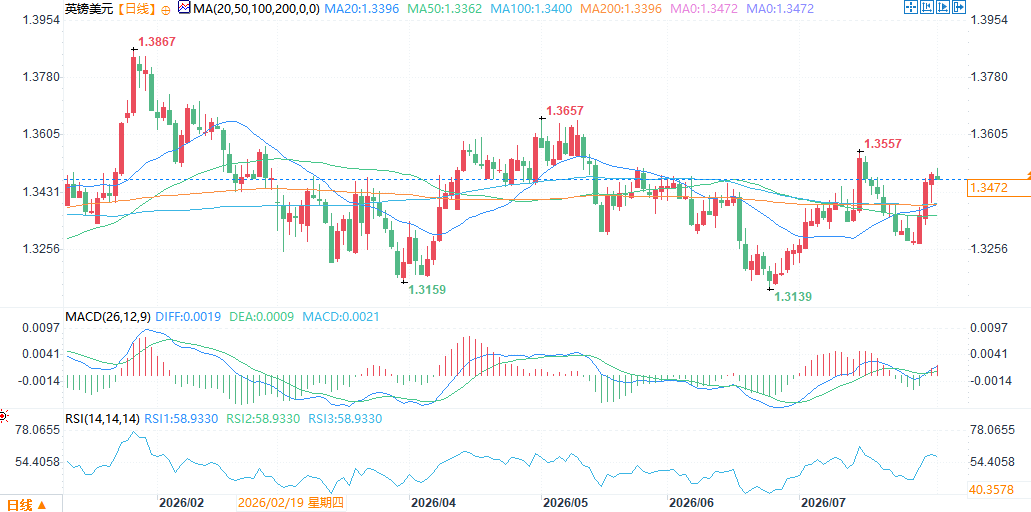 (GBP/USD daily chart, source: FX678) At 10:32 Beijing time on August 3, GBP/USD was trading at 1.3470/71.
US-Iran diplomacy hopes to boost risk appetite, but Iran denies requesting negotiations.
US-Iran diplomatic efforts initially boosted global risk appetite, but Iran's swift denial quickly dampened optimism. The improvement in risk appetite stemmed primarily from Trump's statement that Iran and other Middle Eastern countries had requested more time to finalize an agreement that would fully reopen the Strait of Hormuz and effectively eliminate the Iranian nuclear threat. The market interpreted this as a potential substantial easing of geopolitical tensions, leading to a decline in risk aversion and temporary support for risk assets. However, Iranian state media quickly denied this, calling Trump's claim of a "Tehran request for a suspension" "just a new lie," and emphasizing that the Iranian armed forces remained on high alert. This stark contrast indicates a significant gap between the two sides' positions, and the future of negotiations remains uncertain. Geopolitical uncertainty has not truly dissipated, and the risks to passage through the Strait of Hormuz and the nuclear impasse remain unresolved. Against this backdrop, market enthusiasm for risk assets may be temporary. If there is a lack of substantial progress or new signs of confrontation, risk aversion may rise again, and the sustainability of the improved risk appetite will be tested.The Bank of England held rates steady but left the option to raise them open, signaling a cautious stance.
The Bank of England voted 6-3 last week to keep interest rates unchanged at 3.75%, but clearly left open the possibility of future rate hikes—the central bank may take action if uncertainty surrounding the US-Iran conflict pushes up inflation. The money market is still pricing in a 25 basis point rate hike by the end of the year, indicating that the market has not completely ruled out further tightening. Scotiabank analysts described the latest decision as a "softening of the hawkish stance," noting that Governor Bailey downplayed the urgency of the next rate hike, although three members advocated for an immediate increase. This combination of "voting division + cautious guidance" reinforces the impression that the central bank remains vigilant about inflation risks but is not in a hurry to aggressively tighten. The policy path is more flexible, neither completely closing the door to rate hikes nor releasing strong signals prematurely. For the pound, the decision failed to provide strong policy support. In the short term, the exchange rate will depend more on external risk sentiment and UK economic data performance, with relatively limited upside potential. If subsequent inflationary pressures do not rise significantly, or if the US-Iran situation eases and reduces imported inflation risks, market expectations for rate hikes may cool further, and the pound will face even less policy support.The US-Iran situation and signals from the Bank of England are driving the direction of the pound.
The market's focus regarding the pound sterling and risk assets is currently concentrated on three key variables. First, the US-Iran situation: if negotiations achieve a substantial breakthrough and geopolitical tensions significantly ease, global risk appetite will further improve. A decline in risk aversion will benefit risk currencies, and the pound sterling is expected to strengthen in tandem with risk assets, receiving additional upward support. Second, the Bank of England's policy signals are equally crucial. If the central bank releases hawkish signals in its communications, suggesting that interest rates will remain high for a longer period or even tighten further, it will directly strengthen the pound's interest rate advantage, attract capital inflows, provide solid support for the exchange rate, and potentially push it out of its recent trading range. Third, UK economic data cannot be ignored. If subsequent inflation, employment, or growth data are generally strong, it will strengthen the market's pricing in the Bank of England maintaining or raising interest rates, further solidifying the interest rate differential support logic. In summary, if these variables resonate, the pound sterling's upward potential is expected to be significantly released, and the central point of fluctuation may gradually shift upward.Summarize
The pound retreated to around 1.3470 against the dollar after three consecutive days of gains. US-Iran diplomacy aimed to improve risk appetite, but Iran's denial of a negotiating request perpetuated uncertainty. The Bank of England's "softening" hawkish signals—divided voting but the governor downplaying the urgency of interest rate hikes—provided limited support for the pound. The pound's future direction depends on the dynamic interplay between US-Iran tensions, Bank of England policy signals, and the global economic outlook. (GBP/USD daily chart, source: FX678) At 10:32 Beijing time on August 3, GBP/USD was trading at 1.3470/71.
- Risk Warning and Disclaimer
- The market involves risk, and trading may not be suitable for all investors. This article is for reference only and does not constitute personal investment advice, nor does it take into account certain users’ specific investment objectives, financial situation, or other needs. Any investment decisions made based on this information are at your own risk.