Long-term US Treasury bonds hit a 19-year high. Why did Warsh's "hawkish rhetoric" fail to win over the market?
2026-08-03 14:30:57
Federal Reserve Chairman Warsh stated unequivocally on Wednesday (July 29) that the Fed would curb inflation, but without signaling a rate hike, triggering a sharp sell-off in the bond market. The 30-year Treasury yield broke through 5.2%, reaching a 19-year high. Although Trump canceled the planned attack on Iran over the weekend, causing a sharp drop in oil prices and slightly easing inflation concerns, the 30-year Treasury yield fell slightly but remained high; the 10-year Treasury yield was 4.69%, down 4.6 basis points. This statement may force him to face a difficult choice: whether to go against Trump's desire for loose monetary policy or to clash with his increasingly numerous Fed colleagues who advocate tightening. Even more unsettling for the market is Warsh's hint that the Fed might adjust its criteria for judging whether inflation is under control—the Fed has used a 2% year-on-year PCE price index as its inflation target for many years—raising questions about the Fed's commitment to combating inflation. 
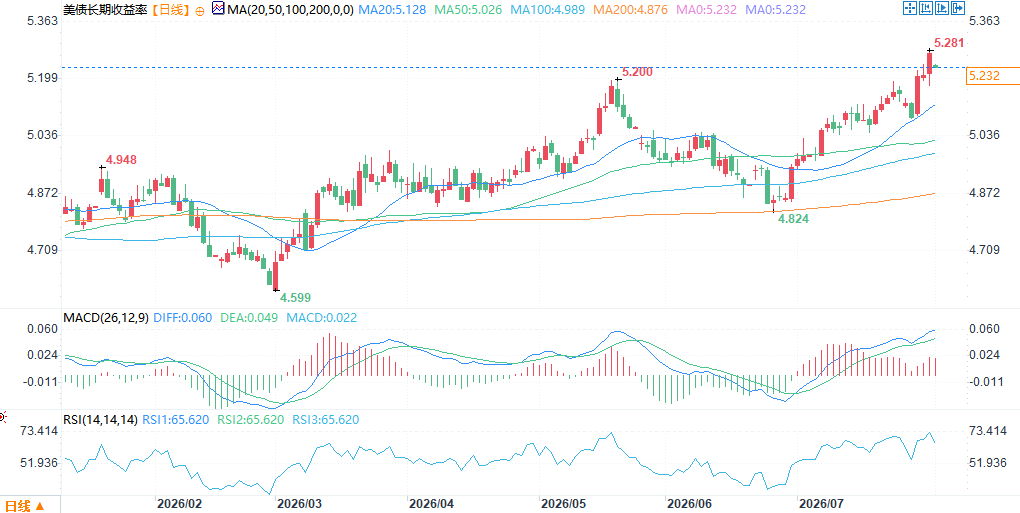 (Long-term US Treasury yields, source: FX678)
The market sell-off is a vote of no confidence in the Federal Reserve.
While emphasizing the need to curb inflation, Warsh failed to take action to push inflation back to the 2% target, and hinted that the target itself might be adjusted, both factors contributed to the continued rise in long-term Treasury yields. Citigroup's global chief economist stated, "Within the Fed, this situation is almost seen as a 'vote of no confidence' from the market in the Fed and its willingness and ability to suppress inflation." He pointed out that Warsh identified the problem but offered no solutions, "just saying 'I'm a hawk, trust me,' but the market needs much more than that." He believes Warsh must make a choice before September, especially after the "serious warning sign" of rising long-term yields. Meanwhile, short-term Treasury yields fell, with the current two-year Treasury yield down 4.5 basis points to 4.25%. Investors are reducing their bets on interest rate hikes under Warsh's leadership.The dissenting votes of three hawkish committee members reveal internal divisions.
Last Wednesday, three of the 12 voting members of the Federal Reserve opposed keeping interest rates unchanged, advocating for a 25-basis-point hike. Dallas Fed President Logan warned, "Without any policy constraints, inflation is likely to continue to rise above target." Minneapolis Fed President Kashkari stated, "Taking a series of small policy adjustments is better than waiting and watching." Cleveland Fed President Hamack bluntly stated, "Now is the time to act." Furthermore, officials who supported holding rates steady, including Governors Waller and Cook, had also indicated they might support a rate hike if inflation did not improve. SGH Macro Advisors' chief U.S. economist noted that Fed governors had "sent a clear signal to Warsh that if inflation does not decline significantly this summer, they intend to push for a rate hike in September."Economic data was mixed.
The PCE price index fell to 3.7% year-on-year in June from 4.1% in May, while the core PCE fell to 3.3% from 3.4%, indicating a cooling of inflation. However, business equipment spending grew at a rate of 15.2% in the second quarter, marking the second consecutive quarter of double-digit growth, suggesting that the economy remains resilient. This combination of data complicates the Federal Reserve's policy path—cooling inflation provides a reason to hold rates steady, but strong capital spending provides arguments for a hawkish rate hike.Walsh's "September Choice"
The surge in long-term Treasury yields reflects market skepticism about the Fed's commitment to combating inflation. The dissenting votes of three hawkish members reveal deep divisions within the FOMC, while Trump's pressure to cut rates further compresses policy space. Warsh must choose before the September meeting: adjust the inflation targeting framework to buy more time, or heed the calls from hawkish members to raise rates to maintain the Fed's credibility in combating inflation. For the market, either choice means the Fed is entering a highly uncertain policy phase. As a former Fed economist put it, "Wash pointed out the problems but didn't offer solutions—the market needs much more than that." (Long-term US Treasury yields, source: FX678)
- Risk Warning and Disclaimer
- The market involves risk, and trading may not be suitable for all investors. This article is for reference only and does not constitute personal investment advice, nor does it take into account certain users’ specific investment objectives, financial situation, or other needs. Any investment decisions made based on this information are at your own risk.