The US gold reserves have a trillion-dollar valuation gap, prompting economic historians to warn of the risks of unconventional policies.
2026-08-04 10:44:52
The US federal government's gold reserves, numbering in the thousands, are still valued at the statutory rate of $42.2222 per ounce, creating a valuation gap of over one trillion dollars compared to the current market price. Historically, the US has used gold revaluation to achieve fiscal maneuvering. Now, with US public debt approaching $40 trillion, proposals to revalue gold have repeatedly surfaced. Economic historians, reviewing a century of policy cases, remind the market that emergencies are often the trigger for policy shifts, a history that all gold holders should continue to pay attention to.
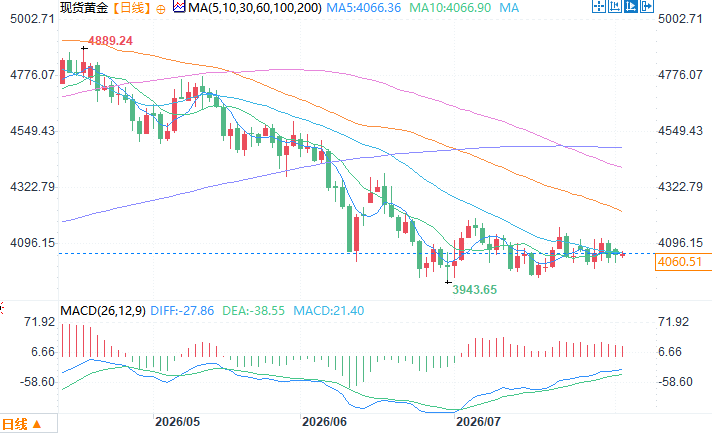 Spot gold daily chart source: FX678. At 10:42 AM Beijing time on August 4th, spot gold was trading at $4060.51 per ounce.
A trillion-dollar valuation gap: the official gold price that has remained unchanged for half a century.
The official U.S. gold price of $42.2222 per ounce is not an estimate, but a fixed standard established by legislation in 1973. Since the collapse of the Bretton Woods system during the Nixon era, there has been no channel globally to trade gold at this price. According to publicly available data from the U.S. Treasury Department, the U.S. holds 261,498,926 troy ounces of pure gold, equivalent to approximately 8,133 tons, with a book value of only $11.04 billion at the official price. With recent gold prices around $4,050 per ounce, the market price is approximately 96 times the official price, making this gold worth over one trillion dollars. This huge price difference sparks political debate in Washington every few years, with many lawmakers proposing a revaluation of the book value of gold. Economic historian Phillip Magness stated that reviewing history reveals the logic behind the distribution of benefits behind policy adjustments. He said, "Ultimately, it's always private enterprises that suffer the losses." When asked whether ordinary people holding gold coins could benefit from this, he frankly admitted that ordinary investors would find it difficult to receive dividends.Looking back at the 1933 gold policy: How did the historical gold revaluation take place?
During the Great Depression, in April 1933, Roosevelt issued an executive order requiring citizens to surrender their circulating gold reserves, with the Treasury paying out in cash at $20.67 per ounce. Magnus stated that this policy was an emergency measure, and the combination of multiple negative factors pushed the economic recession into the Great Depression. He said, "Roosevelt didn't have a clear plan when he took office; he could only keep trying and failing. Tight monetary policy, tariff bills, and increases in personal income taxes—a series of policies exacerbated the downward pressure on the economy." In 1934, the United States passed the Gold Reserve Act, raising the official gold price to $35 per ounce. The Treasury gained $2.8 billion from the book value difference, of which $2 billion was allocated to the Exchange Stabilization Fund, allowing the Treasury to independently conduct foreign exchange and asset market operations. Ordinary citizens who surrendered their gold nine months earlier did not receive any premium gains. For decades afterward, private gold holdings were restricted until President Ford lifted the ban in 1974. This Exchange Stabilization Fund, created through the revaluation of gold, is still operating today. On Friday, July 31, the Federal Reserve Bank of New York, on behalf of the Treasury Department, bought yen in coordination with Japanese authorities in a currency market intervention. This marked the first joint yen purchase operation between the two countries since 1998, when the yen fell to a near 40-year low. Ninety-two years after that gold revaluation, the fund continues to participate in global currency market regulation.The repeated proposals for revaluation are driven by the pressure of massive debt.
The gold price of $42.22 is a legacy of the Bretton Woods system. While the fixed exchange rate system officially ended in 1976, this accounting figure has been retained. Theoretically, revaluing gold doesn't require selling physical gold; simply adjusting the book value of gold certificates could artificially increase the Treasury's assets. Recently, some lawmakers have proposed legislation to explore raising funds through gold revaluation. Magnis stated that simply adjusting accounting figures cannot change the market pricing mechanism; book adjustments are largely paperwork. Politicians' continued push for this discussion stems from the fiscal predicament. He stated, "Tax increases are highly likely to provoke voter opposition, and large-scale borrowing and monetary policy have become means to circumvent taxes." As of July 30, the US public debt reached $39.84 trillion, and the massive debt relies on the purchasing power of currency to slowly dilute and pay interest.There is no need to repeat history now, but we must be wary of the "state of emergency" rhetoric.
Magnis believes that a repeat of the forced gold confiscation of the 1930s is unlikely at this stage, as improved legal provisions provide a buffer, and the US has already reopened restrictions on private gold holdings. However, he cautions investors to pay attention to key signals, stating, "We need to be wary of politicians constantly hyping up various emergency situations; this is a prerequisite for unconventional policies in history." The global central bank gold-buying spree continues, with data from the World Gold Council showing that central banks net purchased 288.9 tons of gold in the second quarter, a significant year-on-year increase. Physical precious metals can largely mitigate the risks of policy changes, and historical cases have already demonstrated the possibility of unconventional financial policies recurring; the market should remain vigilant in the long term. In short , the huge book value difference of US gold is not only a peculiar accounting phenomenon but also a bellwether for potential policy adjustments under immense debt pressure. Although the probability of a short-term replication of the gold confiscation policy is low, investors should learn from history and closely monitor policy variables brought about by geopolitical and economic crises. Spot gold daily chart source: FX678. At 10:42 AM Beijing time on August 4th, spot gold was trading at $4060.51 per ounce.
- Risk Warning and Disclaimer
- The market involves risk, and trading may not be suitable for all investors. This article is for reference only and does not constitute personal investment advice, nor does it take into account certain users’ specific investment objectives, financial situation, or other needs. Any investment decisions made based on this information are at your own risk.