Oil prices were just "pushed down" by Trump, but then "lifted up" by Iran. What will be the future trend of oil prices?
2026-08-04 15:04:57
On Tuesday (August 4th) during Asian trading hours, US crude oil futures rose slightly, currently trading below $81 per barrel. Behind the modest short-term rise in oil prices, the recurring tensions surrounding Middle East geopolitical news continue to dominate market sentiment. Since the start of August trading, the US-Iran situation has remained the core narrative for the market. Late last week, the situation seemed to be improving—US President Trump declared that an agreement on the Strait of Hormuz had been "reached" and that nuclear negotiations would resume "tomorrow afternoon." However, Iran completely denied this the following day, and to date, there is no indication that the two sides have sat down to negotiate. This back-and-forth has left the market perplexed—because the same script has been played out far too many times. 
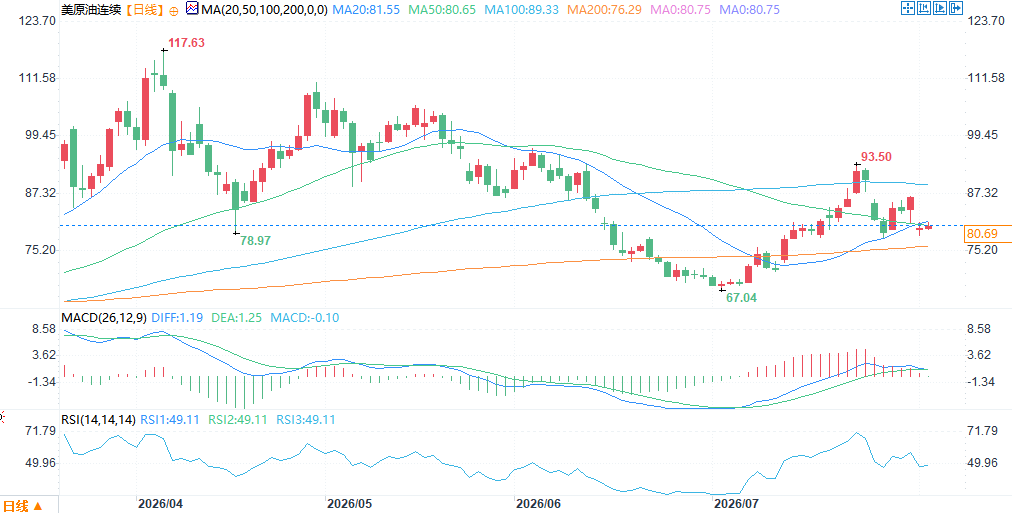 (US crude oil futures daily chart, source: FX678) At 15:02 Beijing time on August 4, US crude oil futures were trading at $80.27 per barrel.
Trump's "negotiation rhetoric": a familiar recipe, a familiar taste.
Trump's talk of an agreement and ongoing negotiations is a common tactic to de-escalate tensions—even when the reality is far from it. Yesterday, he reiterated that "negotiations are currently underway at Iran's request," and that the Strait of Hormuz might even "open tomorrow." However, he slightly withdrew his optimism on nuclear negotiations, acknowledging that "denuclearization will take some time." This pattern of "speaking out, then withdrawing, then speaking out again" is nothing new to the market. For Trump, signaling negotiations is itself a strategic tool—even if the two sides haven't actually made contact, as long as the statement that "negotiations are underway" dominates headlines, geopolitical risk premiums will naturally decline, and oil prices will cool down. However, the marginal effect of this strategy is diminishing—the market is beginning to learn to find a true balance between Trump's "verbal optimism" and Iran's "actual denials."Oil price movement: After a gap down opening, prices stabilized and rebounded.
Oil prices plunged on Monday, opening lower for the second consecutive week. However, prices rebounded somewhat during Tuesday's Asian session, with US crude futures rising slightly and currently trading below $81 per barrel. This movement clearly reflects the market's current contradictory sentiment: Trump's negotiating remarks triggered a rapid clearing of geopolitical premiums, but Iran's complete denial has made the market hesitant to fully price in a peaceful future. Therefore, short sellers chose to take profits after Monday's sell-off, driving a technical rebound in oil prices on Tuesday. The market is awaiting the next clear signal—and the key to that signal lies in Iran's hands.Iran's calculations: Strategic patience under a tough stance
Iran's next move will be a key variable in oil price movements this week. Trump's unilateral release of optimistic signals is nothing new; it's usually accompanied by initial resistance from the other side, followed by a reluctant temporary easing of tensions—this seems to be the market's "ideal scenario": returning the situation to what it was a month ago. However, Iran's stance is tougher than the market expected. Tehran insists it is currently only negotiating with Oman, while reiterating that the Strait of Hormuz will not reopen in a pre-war manner as long as US threats and naval blockade persist. In other words, Iran is directly linking control of the strait to US sanctions and military presence, refusing to compromise without substantial concessions. Meanwhile, the threat to ships passing through the Strait of Hormuz continues. The UK Maritime Trade Operations Centre reported an attack on a vessel near Hormuz. This "negotiations while fighting" situation makes the market skeptical of any verbal "agreement."Reports surfaced that Iran and Oman were close to reaching a Straits agreement, but US officials quickly denied the claims.
On March 3, the US, citing Iranian and US officials, reported that Iran and Oman were close to reaching an agreement on navigation in the Strait of Hormuz. US sources indicated that, according to the agreement, ships entering the Persian Gulf would use a route closer to the Iranian coast and controlled by Iran, while ships exiting would use a route closer to Oman. Several Iranian officials stated that ships would pay a "service fee," which would be split equally between Iran and Oman. However, a US official familiar with the negotiations stated that the Iranian officials' statements were "inaccurate," and that the establishment of any "temporary" route in the Strait of Hormuz would not require Iranian approval and would not incur any fees for passing ships.The core dilemma in the market: Who to trust?
A deeper question is: to what extent will the US turn a blind eye to these threats and attacks in order to maintain the facade of an "agreement"? Even if the US chooses to exercise temporary restraint, how long can it tolerate further Iranian attacks in the Strait? After all, Iran has not completely ceased similar actions since the ceasefire agreement was reached at the end of June. This uncertainty is unlikely to dissipate in the short term. Even if more optimistic signals emerge in the coming days or weeks, they may not truly calm the market. Just as the script played out in July—in the ongoing war of words between the US and Iran, a market already repeatedly tormented only needs the slightest disturbance to reignite tensions. The market is exhausted by this capricious game, and any new negative news could quickly trigger a violent reaction.Summarize
In summary, the current crude oil market is caught in a complex situation where the "verbal game" between the US and Iran is misaligned with their "actual actions." Trump unilaterally signaled a negotiation and declared an agreement "already reached," triggering a gap-down opening in oil prices; however, Iran's complete denial prevented the full pricing of supply risks, leading to a stabilization and rebound in oil prices. The market is caught in a dilemma between reality and illusion—the pattern of "speaking first, then withdrawing" is not new, but its marginal effect is diminishing. Meanwhile, Iran and Oman are close to reaching an agreement on the Strait of Hormuz navigation, involving fees and revenue sharing, but US officials immediately corrected this, calling it "inaccurate." This new cycle of "agreement" and "denial" perfectly illustrates the market's core dilemma: any positive signal can be subsequently denied, and traders cannot sustain bets in a single direction. Against this backdrop, oil prices are expected to maintain a highly volatile and oscillating pattern in the short term. Whether it's Trump's renewed "talking," Iran's substantive military actions, or changes in the Strait of Hormuz's navigation conditions, any of these could become the trigger for the next round of sharp fluctuations. The market has been repeatedly pulled to exhaustion, but before the geopolitical fundamentals become clear, oil prices are unlikely to have a clear trend, and any slight disturbance could quickly ignite two-way fluctuations. (US crude oil futures daily chart, source: FX678) At 15:02 Beijing time on August 4, US crude oil futures were trading at $80.27 per barrel.
- Risk Warning and Disclaimer
- The market involves risk, and trading may not be suitable for all investors. This article is for reference only and does not constitute personal investment advice, nor does it take into account certain users’ specific investment objectives, financial situation, or other needs. Any investment decisions made based on this information are at your own risk.