The Middle East tug-of-war: both sides want a dignified exit, but oil prices are destined to remain high.
2026-08-04 15:58:53
International crude oil prices experienced significant volatility this week. Brent crude plunged over 7% on Monday, hitting a three-week low, before rebounding quickly on Tuesday. However, the rebound was weak, only around 1%, leading some long positions to exit. Currently, WTI crude is at $80.48, a slight increase of 0.21%. The core driver of recent market fluctuations is the conflicting signals from the US and Iran regarding negotiations, coupled with the continued navigational risks in the Strait of Hormuz and the Bab el-Mandeb Strait, two key shipping lanes, causing repeated fluctuations in geopolitical premiums. Trump stated that the US had originally planned to launch an attack on Iran yesterday, and that it would be the most intense attack in history. He also expressed his hope that Iran would return to a rational approach. Regarding the Iran issue, Trump said: "Iran contacted me and said, 'Please do not launch an attack. We hope to reach an agreement with you.'" This is the reality; everyone knows this. Regardless of which side was in that situation, they would have proactively proposed negotiations. The current situation in the Middle East is under the broad attention of the international community. The interactions between the United States and Iran will greatly affect the security direction of the region. All parties are calling on relevant countries to exercise restraint, resolve differences through dialogue and consultation, and avoid further escalation of the situation, which could bring more unnecessary losses to the people of the region. 
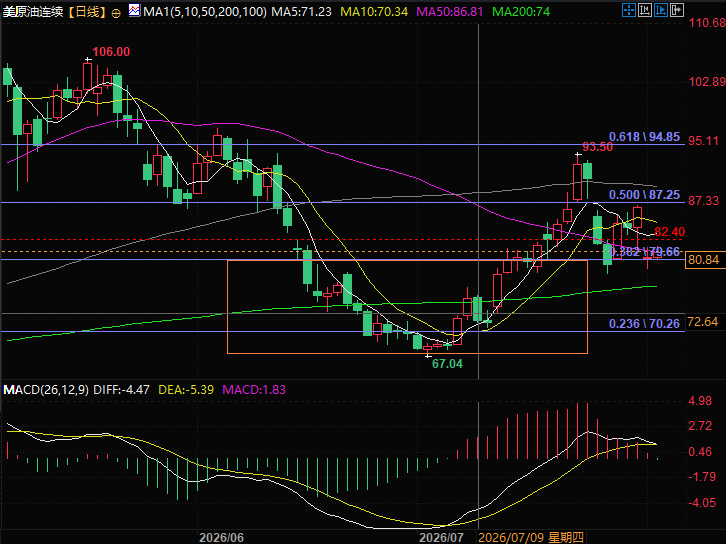 (WTI crude oil futures daily chart, source: EasyForex) At 15:50 Beijing time, WTI crude oil is currently trading at $80.86 per barrel.
Diplomatic Game: US and Iran's statements in negotiations are completely contradictory, making a diplomatic reconciliation unlikely in the short term.
Trump publicly declared that the US and Iran had resumed negotiations, planning to end the conflict and resolve the dispute over control of the Strait of Hormuz through diplomatic means, and stated that due to persuasion from Gulf allies, a large-scale strike against Iran would be temporarily suspended. However, Iranian officials immediately denied the negotiation news, emphasizing that they were only communicating with Oman, and the topics were limited to consultations on safe navigation routes in the Strait. Trump stated: "I will not allow Iran to charge ships for passage through the Strait of Hormuz," while Iran insists on charging. The two sides' statements are seriously contradictory, and Trump even accused Iran of being inconsistent in its words and actions on social media, leading to widespread market skepticism about the authenticity of the negotiations. The market clearly perceives that a diplomatic reconciliation between the US and Iran is unlikely to be achieved in the short term, and the risk of escalation of the conflict remains a constant concern.Current shipping situation: Risks coexist in both straits, and the geopolitical premium for crude oil cannot be completely cleared.
Shipping security alarms continue to escalate. The UK Maritime Authority reported that a cargo ship was attacked by an unidentified projectile in the Sea of Oman, northeast of Saab. The Strait of Hormuz carries one-fifth of the world's pre-war oil and gas shipments. Since the outbreak of the conflict in February, Iranian attacks on shipping and the US blockade of Iranian ports have kept the strait in a near-closed state. Meanwhile, risks on the Red Sea route continue to rise. Shipping data shows that six Saudi-flagged supertankers have chosen to circumnavigate the Cape of Good Hope empty, deliberately avoiding the Bab el-Mandeb Strait to evade the threat of Houthi attacks. This detour adds 6 to 7 days to the one-way voyage, increasing shipping insurance costs and transit time. Although the total volume of ships passing through the Bab el-Mandeb and Strait of Hormuz has not yet seen a sharp decline, the ever-present threat of attacks continues to lock in the geopolitical risk premium for crude oil. The simultaneous threat to these two shipping chokepoints also makes it difficult for oil prices to fully absorb the bullish expectations brought about by the conflict.Conflict Bonus: Saudi Arabia reaps huge profits from shipping route changes, while the Red Sea route harbors new crises.
Amidst the disruptions caused by the conflict, global oil trade routes have been forced to restructure, with Saudi Arabia reaping substantial benefits from its pre-planned infrastructure development. Saudi Aramco announced adjusted net profit of $33.4 billion for the second quarter, a 33% year-on-year increase, significantly exceeding market expectations. Benefiting from the war-driven rise in oil prices, Saudi Arabia utilized the East-West Pipeline to bypass the Strait of Hormuz, shifting its oil export focus to ports along the Red Sea coast, stabilizing export volume and gaining additional revenue. However, these benefits are not permanent. The Houthi rebels continue to threaten oil tankers sailing in the Red Sea, revealing a new crisis in export routes and posing a new round of uncertainty for Saudi oil shipments.Underlying logic: Based on the principles of national development, analyze the core demands of all parties.
Beyond superficial factors like public opinion, diplomatic rhetoric, and sectarian conflicts, a nation's primary needs for development boil down to two things: the continuous acquisition of wealth and ensuring its own survival and security. All conflicts, negotiations, and shipping blockades in the Middle East revolve around these two main themes, or simply put, a graceful exit where both sides retain their core interests. The United States: Maintaining Controllable Instability, Reaping Excessive Profits from the Energy Market in Two Directions The United States has achieved energy independence and transformed into a major global net exporter of crude oil. Rising Middle Eastern oil prices directly increase the profits of its domestic shale oil industry, which is the foundation for the US's ability to reap excessive profits from ongoing conflicts. From a survival and security perspective, Iran controls the Strait of Hormuz, continuously challenging the US-led Middle Eastern order and the petrodollar system. However, the US cannot rush to completely eliminate Iran. Furthermore, continued conflict would appear to demonstrate the incompetence of the US military and that the initial decision to intervene was a major blunder. Therefore, the optimal strategy now is to maintain controllable tension: sometimes releasing news of negotiations to suppress oil prices, sometimes releasing conflict risks to raise premiums, thus controlling energy prices and disguising its military actions as acts of profit-seeking. Meanwhile, Saudi Arabia repeatedly seeks to withdraw from the battlefield. If troop withdrawal is not possible, it continues to reinforce the logic of energy benefits derived from the war. Even if troop withdrawal is not possible in the short term, it aims to maximize the gains from energy trade. Saudi Arabia: Enjoying high oil prices to accumulate capital for transformation, while striving to avoid the risks of a full-scale war . Saudi Arabia's core development goal is to generate fiscal revenue through oil exports and promote its economic transformation. The obstruction of the Strait of Hormuz has driven up oil prices, directly increasing Saudi Aramco's profits. These high profits can support investment in new Saudi economic projects. However, Saudi Arabia is caught in the middle of the conflict: on the one hand, it relies on the US for security protection; on the other hand, it is unwilling to completely escalate the conflict with Iran and the Houthis. This is the core reason why Saudi Arabia has proactively adjusted its shipping strategy, arranging for oil tankers to detour and avoid exposing ships to high-risk waters. While high oil prices are tempting, a full-scale war would directly destroy oil infrastructure and threaten the survival of the royal regime. Therefore, Saudi Arabia's strategy is to enjoy the benefits of rising oil prices while striving to avoid the unlimited escalation of the conflict. Iran: Controlling the Strait of Hormuz as a Bargaining Chip, Seeking Economic Development and Survival Space Iran's demands are to break through external blockades and secure its own development space. Simultaneously, the Revolutionary Guard hopes to gain more independent revenue streams, such as charging fees in the Strait of Hormuz. From the outset, Iran has used these fees as a strong bargaining chip, and the Revolutionary Guard indeed needs this revenue to offset the financial deficit caused by war and sanctions. The Strait of Hormuz is a natural bargaining tool for Iran. Iran understands that a complete and permanent blockade of the strait would provoke strong retaliation, but by continuously creating the threat of navigation, it can maintain its grip on the United States, striving for the lifting of sanctions and gaining economic breathing room in negotiations. This is also the key reason why Iran repeatedly denies negotiating with the United States and is only willing to mediate with Oman—unwilling to easily relinquish its most important strategic bargaining chip.Market Outlook: With the situation in a prolonged stalemate, oil prices continue to fluctuate, driven by geopolitical news.
The biggest contradiction in the current market lies in the fact that neither the US nor Iran is willing to accept a complete ceasefire, nor are they willing to bear the extreme cost of a full-scale war. The situation will remain in a protracted stalemate. Oil prices will continue to be driven by news of negotiations and maritime attacks, resulting in significant price fluctuations. In the short term, as long as attacks in the Strait of Hormuz continue, the geopolitical premium will not completely disappear. If the risks to Red Sea shipping escalate further, hindering Saudi oil exports, it will trigger another rise in oil prices. Conversely, if there is substantial contact between the US and Iran, the risk premium will quickly recede. Technically, WTI crude oil has found support near the 0.382 Fibonacci retracement level of this round of gains and the upper edge of the previous rebound range. Currently, the price is fluctuating around this level. Watch for support at 79.66 and resistance at 82.40 and further down the range at 87.25. (WTI crude oil futures daily chart, source: EasyForex) At 15:50 Beijing time, WTI crude oil is currently trading at $80.86 per barrel.
- Risk Warning and Disclaimer
- The market involves risk, and trading may not be suitable for all investors. This article is for reference only and does not constitute personal investment advice, nor does it take into account certain users’ specific investment objectives, financial situation, or other needs. Any investment decisions made based on this information are at your own risk.