The USD/JPY pair has formed a long lower shadow; the 155-160 range will determine the next direction.
2026-08-04 15:48:52
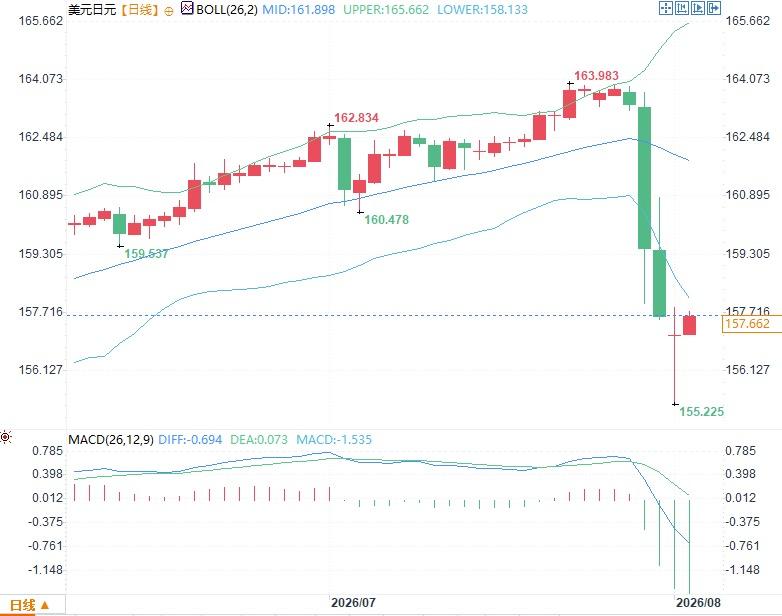
On Tuesday, August 4th, the USD/JPY pair traded around 157.6 after a rare joint intervention by the US and Japan in the foreign exchange market, the lowest level in nearly 30 years, rebounding slightly from the post-intervention low. The exchange rate had previously approached 164, then fell by approximately 5% over three consecutive trading days, recently hitting a low of around 155.2. 
 In the short term, the market may re-establish equilibrium around 155 to 160. If 155 repeatedly provides support, it indicates that intervention has primarily altered the trading range but has not yet triggered a reversal of the medium-term trend. If 160 continues to act as resistance, it suggests that official signals have effectively increased the cost of shorting the yen. If the exchange rate breaks through 160 quickly again and approaches 162, market expectations for further intervention will significantly intensify.
Joint intervention does not change interest rate spreads, but rather trading odds.
The most direct impact of this round of action is the redefinition of policy risks above 160. Previously, the market had been consistently betting on the USD/JPY interest rate differential, fiscal expansion, and a slow pace of interest rate hikes by the Bank of Japan, causing the USD/JPY exchange rate to surge rapidly from around 159 to around 164. After the joint intervention, speculative accounts had to recalculate the potential profits and risks of sudden pullbacks when continuing to short the yen. Former Bank of Japan official Jun Takeuchi believes that if the yen depreciates significantly again, Japan and the US may take joint action again, and he predicts the exchange rate may fluctuate between 155 and 162 in the short term. This assessment means that 160 is no longer just a technical level, but has become an important area to test the government's tolerance. US involvement amplified the policy signal because the market is no longer facing a single fiscal authority, but rather the coordinated action of two major financial authorities. However, the joint intervention did not eliminate the interest rate differential. As long as Japanese interest rates remain significantly lower than US rates, the basis for carry trade profits still exists. Therefore, while intervention can reduce speculative positions, it is difficult to establish a long-term appreciation trend for the yen on its own. The true determinants of exchange rate levels remain the Bank of Japan's policies, US employment and inflation data, and the relative changes in the long-term government bond yields of both countries.The yen is just the surface; long-term government bonds are the real policy focus.
A key reason for US intervention may not simply be stabilizing the yen, but rather preventing Japan from raising funds for intervention through large-scale sales of dollar assets. Japan's routine yen-buying intervention requires the use of dollar funds from its foreign exchange reserves. If the scale of the operation expands, the market could easily interpret it as Japan potentially reducing its holdings of US Treasury bonds, thereby pushing up already high long-term yields. At the end of July, the yield on 10-year US Treasury bonds rose to approximately 4.69%, and the 30-year yield to approximately 5.16%. Although the 10-year yield fell back to approximately 4.68% in early August, long-term financing costs remained high. In this environment, any reduction in allocations by major overseas holders could exacerbate term premium pressures. Japan's own long-term interest rates have also risen significantly. The yield on 10-year Japanese government bonds is close to 2.8%, and the 30-year yield is close to 4%, a fundamental change from the historical near-zero interest rate environment. When domestic bonds can provide higher yields, the necessity for Japanese institutions to continue bearing exchange rate hedging costs by allocating overseas bonds decreases. Even without directly selling existing assets, simply reducing new allocations will change the marginal demand for global long-term government bonds. Therefore, this round of actions can be understood as simultaneously stabilizing two price chains: one is the USD/JPY exchange rate, and the other is the yield on long-term US Treasury bonds. The former relates to Japan's imported inflation and domestic financial stability, while the latter relates to the cost of US fiscal financing.Why FIMA tools have become a critical buffer layer
Another key focus for the market is the potential for increased use of the Federal Reserve's Foreign and International Monetary Authority Repurchase Facility (FINRA). This mechanism allows eligible overseas official institutions to temporarily obtain dollar liquidity by pledging their holdings of U.S. Treasury bonds, without having to sell bonds directly in the open market. This effectively adds a buffer between foreign exchange intervention and the Treasury market. When Japan needs dollar funds, it can first obtain liquidity through repurchase agreements before implementing foreign exchange market operations, thereby reducing the impact of concentrated bond sales on yields. The U.S.'s willingness to expand the use of this mechanism reflects its sensitivity to overseas official capital flows and demand for long-term Treasury bonds. However, the repurchase facility addresses the form of liquidity, not the root cause of exchange rate imbalances. If the U.S.-Japan interest rate differential continues to widen, or if Japanese fiscal expectations further push up long-term interest rates, the market may still retest official defenses. While tools can reduce the market side effects of intervention, they cannot replace the consistency between monetary and fiscal policies.155 to 160 will become the core of pricing in the next stage.
From a chart perspective, the USD/JPY pair formed a short-term top around 163.983, subsequently breaking below both the Bollinger Band's middle and lower bands. The MACD fast and slow lines are also trending downwards, indicating that the upward trend has been broken. However, a significant lower shadow appeared around 155.225, and the exchange rate subsequently rebounded above 157, suggesting that there was support around 155 due to profit-taking, passive covering, and policy pressure. In the short term, the market may re-establish equilibrium around 155 to 160. If 155 repeatedly provides support, it indicates that intervention has primarily altered the trading range but has not yet triggered a reversal of the medium-term trend. If 160 continues to act as resistance, it suggests that official signals have effectively increased the cost of shorting the yen. If the exchange rate breaks through 160 quickly again and approaches 162, market expectations for further intervention will significantly intensify.
- Risk Warning and Disclaimer
- The market involves risk, and trading may not be suitable for all investors. This article is for reference only and does not constitute personal investment advice, nor does it take into account certain users’ specific investment objectives, financial situation, or other needs. Any investment decisions made based on this information are at your own risk.