Why can't increased production suppress oil prices? The market is ignoring the real supply gap.
2026-08-04 16:40:51
On Tuesday, August 4th, Brent crude oil rebounded to around $85 per barrel after falling in the previous trading day, rising approximately 1.7% on the day. Previously, the US-Iran conflict and disruptions to shipping in the Strait of Hormuz had briefly pushed oil prices above $100 per barrel, but recent news of easing tensions has caused risk premiums to shrink rapidly. The market is now trading not just on production changes, but also on the efficiency of the Strait of Hormuz passage, the availability of alternative pipelines, insurance costs, and companies' actual delivery capabilities. Saudi Aramco's latest financial report perfectly reveals the most crucial profit distribution logic in this round of energy market rallies. 
 The fundamentals present two opposing forces. Uncertainty surrounding shipping in the Strait of Hormuz and the Red Sea continues to provide a risk premium, but major oil-producing countries have decided to increase supply quotas, with an increase of 188,000 barrels per day in August and a further increase of approximately 188,000 barrels per day in September. This increase is still limited relative to the potential disruption to traffic in the straits, and therefore cannot completely offset the transportation risks, but it is sufficient to limit a sustained surge in oil prices during periods of easing tensions. The core variable for future price movements is not nominal production, but the effective supply that can actually reach refineries. Even if oil-producing countries increase quotas, the spot market may remain tight if shipping times are extended, freight rates rise, or insurance coverage decreases. Conversely, once traffic in the straits recovers and the backlog of tankers is released quickly, the risk premium in oil prices may recede faster than the actual supply-demand gap.
Oil prices are only the first factor behind the 44% profit growth.
Saudi Aramco's second-quarter net profit reached $32.69 billion, a 44% increase from $22.67 billion in the same period last year. What the market is truly focused on is that profit elasticity is far greater than production elasticity. This means the company did not rely on large-scale production increases, but rather on higher oil prices, refined and chemical product prices, and strong export continuity to achieve profit expansion. This implies that this round of profit growth cannot be simply interpreted as passive gains from rising oil prices. Even with the same resource reserves, ordinary producers cannot convert high oil prices into cash flow if logistics are disrupted, ports are closed, or ships cannot dock. Saudi Aramco's core advantage lies in its ability to maintain a 98.4% supply reliability rate despite rising supply risks, with high prices and high delivery rates creating a synergistic effect.East-West oil pipelines are undergoing a revaluation of their energy assets.
The Strait of Hormuz is projected to handle approximately 20.9 million barrels of oil and liquid fuels daily in the first half of 2025, equivalent to about 20% of global liquid oil consumption and about a quarter of global seaborne oil trade. Existing alternative pipelines can only handle a portion of this flow; therefore, a disruption to the strait does not equate to a complete loss of supply, but it significantly increases uncertainty regarding transport distances, charter rates, insurance premiums, and delivery times. Saudi Aramco's East-West pipeline transports crude oil from its eastern production areas to Yanbu port on the Red Sea coast, with a maximum capacity of 7 million barrels per day. This pipeline allows the company to bypass the Strait of Hormuz, transforming what would otherwise be a geopolitical transportation bottleneck into an infrastructure premium. CEO Amin Nasser recently stated that the company is assessing further enhancements to its export options and pipeline capacity, and has confirmed that the attacks on related facilities have not had a significant impact on operations and finances; the existing maximum capacity of 12 million barrels per day can still be restored within approximately three weeks. This has led the market to begin repricing the asset quality of energy companies. In the past, valuations focused on reserves, extraction costs, and capital expenditures. Now, pipeline redundancy, port distribution, the number of shipping routes, and emergency dispatch capabilities must also be taken into account. Producers who can maintain exports even when a single shipping route fails have significantly higher profitability stability than companies that rely solely on ocean shipping.Oil prices have entered a tug-of-war between high-risk premiums and expectations of increased production.
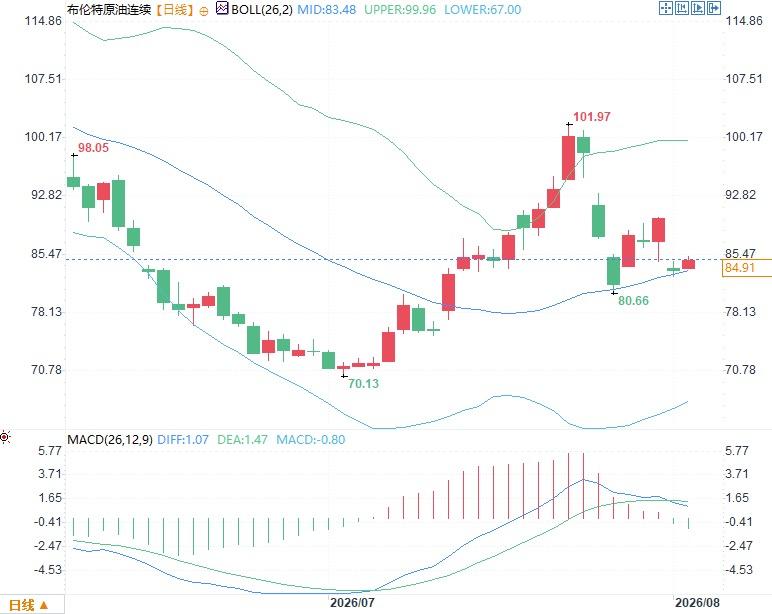
From a technical perspective, Brent crude oil is currently trading at around $85, with the Bollinger Band middle line at $83.48, the upper line at $99.96, and the lower line at $67. After touching $101.97, the price quickly retreated and is currently only slightly above the middle line. In the MACD indicator, the DIFF is 1.07, the DEA is 1.47, and the histogram is -0.80, indicating that the previous strong momentum has clearly weakened, and the market has shifted from unilateral risk pricing to high-volatility oscillation. The fundamentals present two opposing forces. Uncertainty surrounding shipping in the Strait of Hormuz and the Red Sea continues to provide a risk premium, but major oil-producing countries have decided to increase supply quotas, with an increase of 188,000 barrels per day in August and a further increase of approximately 188,000 barrels per day in September. This increase is still limited relative to the potential disruption to traffic in the straits, and therefore cannot completely offset the transportation risks, but it is sufficient to limit a sustained surge in oil prices during periods of easing tensions. The core variable for future price movements is not nominal production, but the effective supply that can actually reach refineries. Even if oil-producing countries increase quotas, the spot market may remain tight if shipping times are extended, freight rates rise, or insurance coverage decreases. Conversely, once traffic in the straits recovers and the backlog of tankers is released quickly, the risk premium in oil prices may recede faster than the actual supply-demand gap.
- Risk Warning and Disclaimer
- The market involves risk, and trading may not be suitable for all investors. This article is for reference only and does not constitute personal investment advice, nor does it take into account certain users’ specific investment objectives, financial situation, or other needs. Any investment decisions made based on this information are at your own risk.