Non-farm payrolls countdown: Behind the expected 80,000, the dollar faces a new direction.
2026-08-04 17:56:51
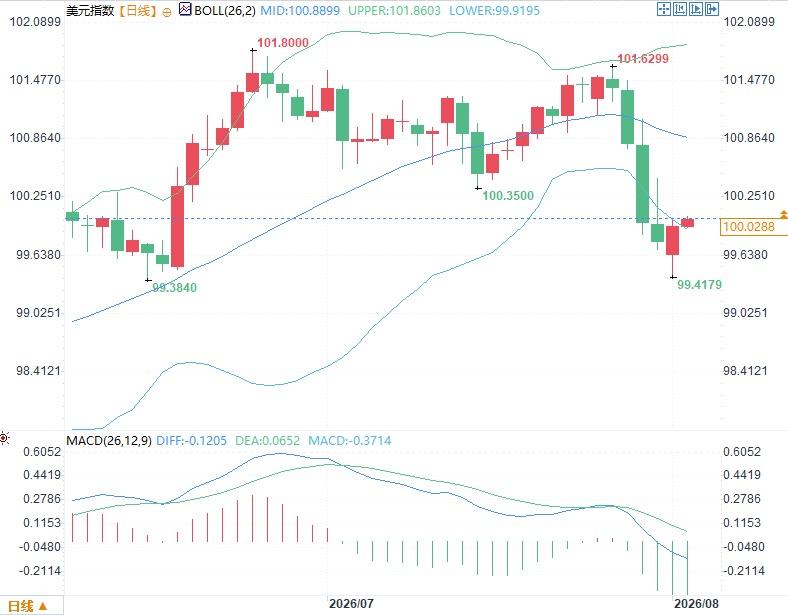
On Tuesday, August 4th, as major central banks entered their summer adjustment phase, US employment market data became a crucial variable influencing financial markets. The US dollar index weakened significantly recently, falling rapidly from around 101.6 to a low of around 99.4 before rebounding slightly to around 100. The market is currently awaiting the upcoming US July non-farm payroll report. The market expects approximately 80,000 new non-farm jobs in July, higher than June's 57,000, with the unemployment rate expected to remain at 4.2%. If the employment market continues its moderate slowdown, it may reinforce market expectations regarding the scope for future policy adjustments; however, if the data deviates significantly from expectations, it could also reshape interest rate pricing. 
 However, the dollar's trajectory is not solely determined by technical factors. The core market concern remains whether the US economy can maintain stability and how the Federal Reserve's policy space will evolve. While the US job market has shown signs of cooling, it has not yet entered a phase of significant deterioration. The decline in job growth from its previous high levels reflects a slowdown in economic expansion rather than an increased risk of a rapid recession. This is a key reason why the market is currently providing some support for the dollar.
The US dollar recently fell below the 100 mark, prompting the market to reassess economic resilience.
The recent movement of the US dollar index reflects a market reassessment of the outlook for US economic growth and monetary policy. From a technical perspective, the dollar index previously formed a high near 101.6 before declining continuously. After breaking below the 100.0 level, short-term market sentiment weakened significantly. Looking at daily indicators, the dollar index is currently trading below the middle Bollinger Band, with resistance gradually converging in the 100.8-101.0 area, while support is seen near the 99.4 level. The MACD indicator shows the fast and slow lines continuing to diverge downwards, indicating that short-term capital momentum remains cautious. However, the dollar's trajectory is not solely determined by technical factors. The core market concern remains whether the US economy can maintain stability and how the Federal Reserve's policy space will evolve. While the US job market has shown signs of cooling, it has not yet entered a phase of significant deterioration. The decline in job growth from its previous high levels reflects a slowdown in economic expansion rather than an increased risk of a rapid recession. This is a key reason why the market is currently providing some support for the dollar.Non-farm payroll data becomes a core market variable
The US July non-farm payrolls report will be the focus of market attention this Friday. Market expectations are for approximately 80,000 new non-farm jobs in July, an improvement from June's 57,000, with the unemployment rate expected to remain at 4.2%. If the actual data is close to this level, it means the job market continues to cool but remains stable. Such a result is unlikely to significantly alter market expectations regarding the Federal Reserve's policy, as policymakers are currently more focused on inflation trends than solely on employment indicators. From the perspective of the internal structure of the job market, the key is not the number of new jobs themselves, but whether job growth is accelerating again. If new jobs continue to rise, accompanied by increased pressure on wage growth, the market may reassess inflation risks. Currently, market expectations regarding the future path of interest rates have already shifted somewhat. Investors are paying close attention to data performance before subsequent policy meetings, hoping to use employment, inflation, and consumption data to determine whether the Federal Reserve will adjust its policy pace. Therefore, the importance of the July non-farm payrolls data lies not only in the result itself, but also in whether it changes the market's assessment of the current stage of the economic cycle.Interest rate expectations remain the main driver of the dollar's direction.
The medium- to long-term trend of the US dollar still depends on changes in interest rate expectations. The market has already partially priced in future policy paths, so the impact of a single data point needs to be analyzed in conjunction with previous expectations. If employment data meets expectations, the market may maintain its current assessment that the US economy has entered a phase of moderate cooling, and the Fed's policy focus will continue to revolve around inflation control. However, if employment data is significantly stronger than expected, the market may raise its expectations for the duration of high interest rates, thus supporting the dollar. Conversely, if the labor market shows signs of rapid deterioration, it could prompt the market to further adjust its assessment of future policy space. Currently, there is still some divergence in market expectations for interest rates in the coming quarters. On the one hand, the US economy continues to show some resilience; on the other hand, the cooling trend in the labor market is gradually becoming apparent. This contradiction has led to a data-driven phase for the dollar's movement. In the coming weeks, a series of economic indicators, including employment, inflation, and consumption, will jointly determine the market's repricing of the US economic cycle.- Risk Warning and Disclaimer
- The market involves risk, and trading may not be suitable for all investors. This article is for reference only and does not constitute personal investment advice, nor does it take into account certain users’ specific investment objectives, financial situation, or other needs. Any investment decisions made based on this information are at your own risk.