Yen faces four major negative factors; Bessant reveals the truth behind intervention.
2026-08-04 20:50:52
Recently, the US and Japan staged a historic joint intervention in the foreign exchange market, and Bessant commented on this cooperation today. Bessant emphasized the importance of the intervention and believes that the future trend of the yen will still mainly depend on domestic policy changes in Japan. The continued weakening of the yen is due to a confluence of factors, including energy shocks, rampant carry trades, and constraints from the US Treasury market, which led to this rare policy action. 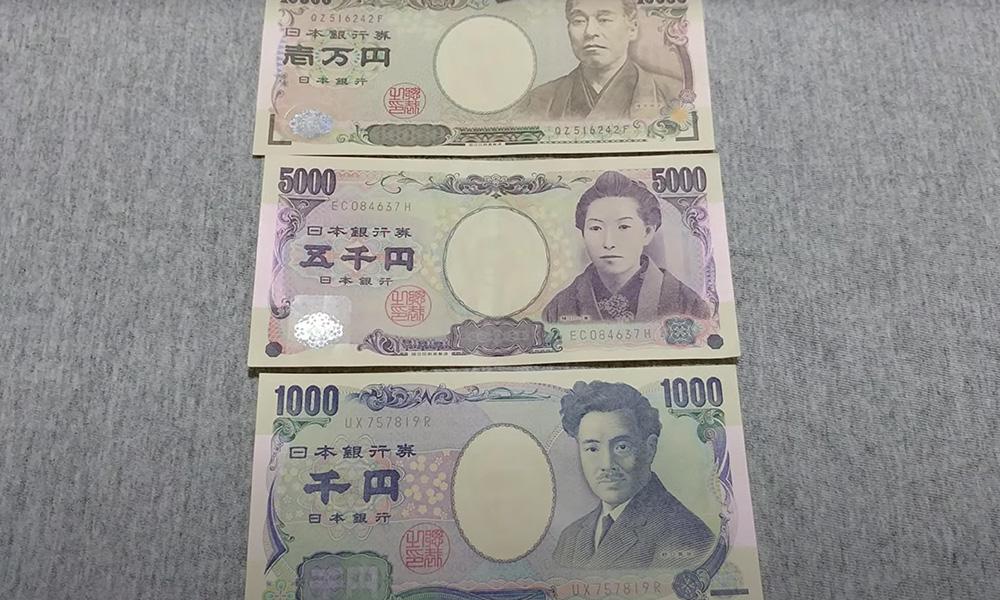
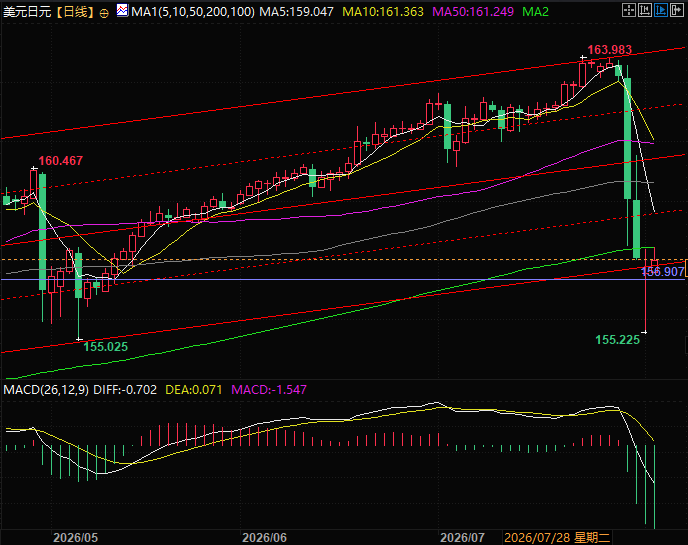 (USD/JPY daily chart, source: FX678) At 20:41 Beijing time, USD/JPY is currently trading at 157.45.
The yen fell to a 40-year low, and a single intervention was unlikely to stop the decline.
Before this round of joint intervention, the yen's exchange rate was already near a 40-year low. Market concerns about the Bank of Japan's slow pace of interest rate hikes, coupled with expectations of increased fiscal spending by the Sanae Takaichi government, continued to put downward pressure on the yen. While the yen's depreciation benefits Japanese outbound tourism and domestic export companies, it increases the burden on ordinary households, and inflationary pressures from imported goods rise rapidly. The Japanese government attempted intervention in April and May, trying to peg the dollar to yen to around 160, but after a brief period of support, the yen resumed its downward trend.The Middle East energy crisis exacerbates downward pressure on the yen.
The energy shock brought about by the situation in the Middle East has further amplified the downward pressure on the yen. Japan is highly dependent on oil and gas imports from the Middle East, and the conflict in Iran has tightened energy supply, pushing up Japan's import costs. International energy is priced in US dollars, and during periods of rising oil and gas prices, the currencies of importing countries often face depreciation pressure.Carry trade is prevalent, and short positions in the yen continue to accumulate.
The trading activities of overseas investors are also amplifying the yen's decline. Short positions in the yen are accumulating, driven by both investor expectations of continued yen weakness and the resurgence of carry trades. Investors are using derivatives to replicate their trading logic: borrowing low-interest yen, converting it into dollars, and buying higher-yielding US assets. This practice continues to exert downward pressure on the yen.US debt becomes a key constraint, Japan seeks alternative sources of intervention funds.
For the United States, an excessively weak yen carries a significant risk. Japan is the world's largest single holder of US Treasury bonds. To defend its currency, Japan needs to acquire US dollars; buying yen in the market theoretically requires selling its US Treasury bond holdings. Currently, US Treasury yields are already high, with war fears, massive fiscal deficits, inflation, and uncertainty surrounding Federal Reserve policy all contributing to this upward pressure. US Treasury Secretary Bessenter does not want to see Japan massively sell off US Treasury bonds, further exacerbating upward pressure on yields. Japan has stated that if further intervention is needed, it will choose to borrow dollars from the Federal Reserve rather than directly selling US Treasury bonds in the market.US Interpretation of Joint Intervention: Preventing a Chain Reaction of Asian Currency Devaluations
U.S. Treasury Secretary Bessenter explained the U.S.'s intervention on Tuesday: an excessively weak yen could disrupt the entire Asian market, which is the core reason the U.S. chose to work with Japan to support the yen. Bessenter stated on a program that maintaining yen stability is not only in the U.S. interest but also crucial for the entire Asia-Pacific region. He further pointed out that a sharp depreciation of the yen would force other economies in the region to follow suit, with the Korean won already showing volatility and the market consistently concerned about the undervaluation of the renminbi. Bessenter said, "The stability of the yen is of great significance in terms of trade volume, economic size, and contribution to the global savings market. The Japanese government is well aware of this, and we are happy to work with them to implement policies and maintain regional market stability."Intervention is merely a signal; a true reversal of exchange rate fluctuations still requires complementary policies.
This joint US-Japan intervention to buy yen was aimed at addressing the significant undervaluation of the yen. The two governments had maintained close communication, and the US believed Japan would subsequently introduce supporting policies to push the yen back to a more reasonable level. However, Bessant also cautioned that foreign exchange intervention alone cannot completely determine the medium- to long-term trend of the exchange rate. He stated, "Intervention can send a clear signal to the market, but what truly changes the market is still fundamental policy. The US's willingness to participate in intervention reflects its confidence in Japan's subsequent policy path." He did not directly comment on whether the Bank of Japan should raise interest rates, but emphasized that the Japanese authorities need to implement broader policy adjustments after the intervention. Technically, after a sharp drop and rebound, the yen held onto most of its gains the following day and is now expected to return to its upward channel and above the key price level of 156.9. The main focus in the near term is whether these two key support levels will be broken; if they are, the yen risks a second dip. (USD/JPY daily chart, source: FX678) At 20:41 Beijing time, USD/JPY is currently trading at 157.45.
- Risk Warning and Disclaimer
- The market involves risk, and trading may not be suitable for all investors. This article is for reference only and does not constitute personal investment advice, nor does it take into account certain users’ specific investment objectives, financial situation, or other needs. Any investment decisions made based on this information are at your own risk.