A chart shows that the overall recovery in freight rates has boosted market confidence, with the Baltic Dry Index rising for four consecutive days to reach a two-week high.
2026-08-04 23:24:53
The latest data shows that the Baltic Dry Index (BDI) reached 2936 points on August 4, 2026, a new high since July 14, 2026, up 3.27% month-on-month, marking the fourth consecutive day of increase (including zero growth). Looking at the short-term charts, the recent 11 BDI data points show: 7 positive increases, 4 negative increases, and 0 zero increases. Specifically, the Panamax Freight Index (BPI) was 2187 points, up 2.44% from the previous value; the Capesize Freight Index (BCI) was 4778 points, up 4.69%; and the Supramax Freight Index (BSI) was 1613 points, up 0.19%. For detailed 720-day and 10-year trend charts of the Baltic Dry Index and its three main sub-indices, please refer to the charts specially created by FX678. 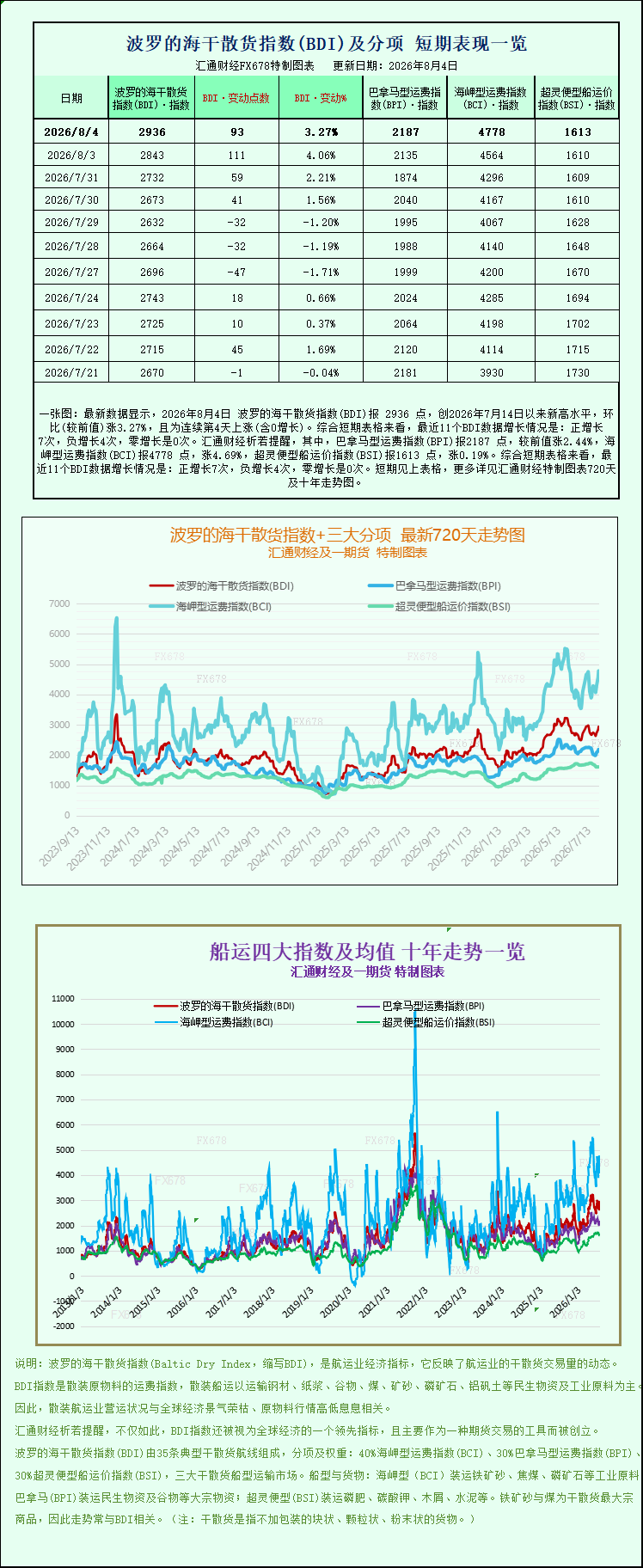 The international dry bulk shipping market has recently experienced a sustained recovery. Strongly boosted by rising freight rates across all vessel types, the Baltic Dry Index (BDI) rose again on August 4th, marking its fourth consecutive day of gains. The overall market trend has been steadily climbing, reaching a two-week high and demonstrating a phased recovery in global bulk shipping demand. Freight indices for various vessel types have strengthened simultaneously, with daily earnings for vessels of different tonnages and cargo types all increasing to varying degrees, indicating a continued warming of the overall market trading atmosphere. Data shows that the Baltic Dry Index, which tracks freight rates for Capesize, Panamax, and Supramax vessels, rose 93 points, or 3.3%, to close at 2936 points, a new high in nearly two weeks since July 14th. This four-day consecutive rise in the index has completely reversed the slight fluctuations and weak freight rates seen in mid-to-late July, representing the most definitive recovery in the recent dry bulk shipping market. From a market structure perspective, this index surge was not driven by a single vessel type; all three major vessel types saw gains, with large Capesize vessels being the core driver of the price increase, showing the most significant rise. Medium-sized Panamax vessels followed suit steadily, while small Supramax vessels maintained a steady upward trend, indicating a comprehensive recovery in the industry. As a market bellwether and primarily carrying core industrial raw materials such as iron ore and coal, Capesize vessels led the market in this round of gains. On that day, the Capesize vessel index surged 214 points, a significant increase of 4.7%, reaching 4778 points, a new high in over two months since June 5th, strongly driving the overall index upward. Specific profit data is even more telling: Capesize vessels with a deadweight tonnage of 150,000 tons, mainly serving cross-border iron ore and coal transportation, saw their average daily revenue increase significantly by $1939, rising to $39831, approaching the $40,000 mark, significantly expanding the profit margin for vessel operations. It is worth noting that the strong rebound in the Capesize vessel market differs from the trend in the commodity market. The global iron ore market remains in a state of oversupply, with international iron ore futures prices continuing their slight decline, putting significant pressure on the overall market. However, the decline has been narrowing, with the core supporting factor being the stable recovery of China's steel industry. Domestic steel mill production is gradually stabilizing, and operating rates are steadily recovering, leading to a marginal improvement in iron ore import demand. This has effectively offset the negative impact of the global oversupply, providing solid support for the demand for Capesize vessels in long-haul shipping. Meanwhile, major iron ore exporting countries such as Brazil and Australia are maintaining stable shipping schedules, and the lengthening of long-haul shipping routes has further increased the premium for large vessels, contributing to the continued rise in Capesize freight rates. The medium-sized vessel market is also recovering, becoming an important supporting force for the index's rise. Panamax vessels, which mainly transport energy and agricultural products such as coal and grains, performed steadily. The Panamax index rose 52 points, or 2.4%, to close at 2187 points, reaching a nearly half-month high since July 20th. The main deadweight range for this vessel type is 60,000 to 70,000 tons, suitable for mainstream global coal and grain cross-border transportation. Average daily revenue increased by $474 to $19,686. With the global autumn/winter stockpiling cycle gradually beginning, increased demand for coal replenishment in Europe, America, and Southeast Asia, along with increased activity in global grain trade, continues to drive demand for Panamax vessels, resulting in a steady upward trend in freight rates. The small dry bulk vessel market maintained steady growth with a relatively mild trend. The Supramax vessel index rose slightly by 3 points, or 0.19%, to 1613 points, maintaining a steady upward trend. This type of vessel is more flexible and mainly suitable for short-distance, small-batch bulk cargo transportation. It is less affected by the long-distance transportation of bulk raw materials, hence the relatively moderate increase. However, the continued upward trend confirms the comprehensive recovery of global demand for small and medium-sized bulk cargo shipping, with no obvious weaknesses in the market. Industry analysts stated that the continuous rise in the Baltic Dry Index is the result of multiple factors, including a recovery in demand, an optimized shipping capacity structure, and the arrival of the seasonal peak season. From the demand side, global industrial production is steadily recovering, coupled with the arrival of the traditional peak season for dry bulk shipping in the second half of the year. The trade and circulation of bulk commodities such as iron ore, thermal coal, and grain are accelerating, continuously releasing incremental demand for shipping. From the supply side, the pace of new capacity deployment for global dry bulk vessels has slowed. Factors such as the scrapping of older vessels and tight capacity allocation have brought the market supply and demand balance closer, providing a foundation for rising freight rates. Looking ahead, overall market optimism is rising. With continued stable industrial production in China, sustained global demand for bulk commodity stockpiling, and the continued effect of the traditional peak shipping season, dry bulk shipping demand is expected to continue to be released. However, uncertainties remain in the market. The global supply and demand pattern of bulk commodities, the pace of industrial production in various countries, and fluctuations in fuel prices may still disrupt freight rate trends. Whether the index can continue to break through high levels will depend heavily on iron ore trade flows, changes in global coal demand, and the deployment of capacity for major vessel types.
The international dry bulk shipping market has recently experienced a sustained recovery. Strongly boosted by rising freight rates across all vessel types, the Baltic Dry Index (BDI) rose again on August 4th, marking its fourth consecutive day of gains. The overall market trend has been steadily climbing, reaching a two-week high and demonstrating a phased recovery in global bulk shipping demand. Freight indices for various vessel types have strengthened simultaneously, with daily earnings for vessels of different tonnages and cargo types all increasing to varying degrees, indicating a continued warming of the overall market trading atmosphere. Data shows that the Baltic Dry Index, which tracks freight rates for Capesize, Panamax, and Supramax vessels, rose 93 points, or 3.3%, to close at 2936 points, a new high in nearly two weeks since July 14th. This four-day consecutive rise in the index has completely reversed the slight fluctuations and weak freight rates seen in mid-to-late July, representing the most definitive recovery in the recent dry bulk shipping market. From a market structure perspective, this index surge was not driven by a single vessel type; all three major vessel types saw gains, with large Capesize vessels being the core driver of the price increase, showing the most significant rise. Medium-sized Panamax vessels followed suit steadily, while small Supramax vessels maintained a steady upward trend, indicating a comprehensive recovery in the industry. As a market bellwether and primarily carrying core industrial raw materials such as iron ore and coal, Capesize vessels led the market in this round of gains. On that day, the Capesize vessel index surged 214 points, a significant increase of 4.7%, reaching 4778 points, a new high in over two months since June 5th, strongly driving the overall index upward. Specific profit data is even more telling: Capesize vessels with a deadweight tonnage of 150,000 tons, mainly serving cross-border iron ore and coal transportation, saw their average daily revenue increase significantly by $1939, rising to $39831, approaching the $40,000 mark, significantly expanding the profit margin for vessel operations. It is worth noting that the strong rebound in the Capesize vessel market differs from the trend in the commodity market. The global iron ore market remains in a state of oversupply, with international iron ore futures prices continuing their slight decline, putting significant pressure on the overall market. However, the decline has been narrowing, with the core supporting factor being the stable recovery of China's steel industry. Domestic steel mill production is gradually stabilizing, and operating rates are steadily recovering, leading to a marginal improvement in iron ore import demand. This has effectively offset the negative impact of the global oversupply, providing solid support for the demand for Capesize vessels in long-haul shipping. Meanwhile, major iron ore exporting countries such as Brazil and Australia are maintaining stable shipping schedules, and the lengthening of long-haul shipping routes has further increased the premium for large vessels, contributing to the continued rise in Capesize freight rates. The medium-sized vessel market is also recovering, becoming an important supporting force for the index's rise. Panamax vessels, which mainly transport energy and agricultural products such as coal and grains, performed steadily. The Panamax index rose 52 points, or 2.4%, to close at 2187 points, reaching a nearly half-month high since July 20th. The main deadweight range for this vessel type is 60,000 to 70,000 tons, suitable for mainstream global coal and grain cross-border transportation. Average daily revenue increased by $474 to $19,686. With the global autumn/winter stockpiling cycle gradually beginning, increased demand for coal replenishment in Europe, America, and Southeast Asia, along with increased activity in global grain trade, continues to drive demand for Panamax vessels, resulting in a steady upward trend in freight rates. The small dry bulk vessel market maintained steady growth with a relatively mild trend. The Supramax vessel index rose slightly by 3 points, or 0.19%, to 1613 points, maintaining a steady upward trend. This type of vessel is more flexible and mainly suitable for short-distance, small-batch bulk cargo transportation. It is less affected by the long-distance transportation of bulk raw materials, hence the relatively moderate increase. However, the continued upward trend confirms the comprehensive recovery of global demand for small and medium-sized bulk cargo shipping, with no obvious weaknesses in the market. Industry analysts stated that the continuous rise in the Baltic Dry Index is the result of multiple factors, including a recovery in demand, an optimized shipping capacity structure, and the arrival of the seasonal peak season. From the demand side, global industrial production is steadily recovering, coupled with the arrival of the traditional peak season for dry bulk shipping in the second half of the year. The trade and circulation of bulk commodities such as iron ore, thermal coal, and grain are accelerating, continuously releasing incremental demand for shipping. From the supply side, the pace of new capacity deployment for global dry bulk vessels has slowed. Factors such as the scrapping of older vessels and tight capacity allocation have brought the market supply and demand balance closer, providing a foundation for rising freight rates. Looking ahead, overall market optimism is rising. With continued stable industrial production in China, sustained global demand for bulk commodity stockpiling, and the continued effect of the traditional peak shipping season, dry bulk shipping demand is expected to continue to be released. However, uncertainties remain in the market. The global supply and demand pattern of bulk commodities, the pace of industrial production in various countries, and fluctuations in fuel prices may still disrupt freight rate trends. Whether the index can continue to break through high levels will depend heavily on iron ore trade flows, changes in global coal demand, and the deployment of capacity for major vessel types. - Risk Warning and Disclaimer
- The market involves risk, and trading may not be suitable for all investors. This article is for reference only and does not constitute personal investment advice, nor does it take into account certain users’ specific investment objectives, financial situation, or other needs. Any investment decisions made based on this information are at your own risk.